




Flexible Connectors for Lithium Battery Powder & New Energy Material Conveying
Summary: Lithium battery powder handling demands specialized, anti-static, metal-free, and abrasion-resistant flexible connectors. Whether conveying high-nickel cathode precursors (NMC), lithium iron phosphate (LFP), or abrasive graphite anode powders, standard rubber sleeves and metal-clamped hoses fail rapidly. SOSHH supplies ATEX-compliant polyether TPU sleeves engineered with surface resistivity of 10⁶ to 10⁹ Ω, continuous temperature resistance from -20°C to +110°C (high-temp PU up to +150°C), vacuum anti-collapse reinforcement, and 100% metal-free construction to prevent contamination and metal detector false alarms.
The Hostile Operating Environment of Battery Material Lines
Lithium-ion battery manufacturing moves some of the most demanding and sensitive bulk powders in modern industry:
- Cathode Active Materials: Lithium Nickel Manganese Cobalt Oxide (NMC 622 / 811), Lithium Iron Phosphate (LFP), and Cobalt Oxide.
- Anode Active Materials: Natural and artificial graphite, silicon-carbon composite powders.
- Conductive Additives: Carbon black, carbon nanotubes (CNT), and precursor salts.
These ultra-fine powders combine high abrasiveness, dynamic electrical conductivity, and extreme susceptibility to trace contamination. Furthermore, they are frequently transferred under closed inert loops (nitrogen-purged lines) or combustible dust hazard zones (ATEX Zone 20/21/22).
A conventional hose-clamped fabric or rubber connector fails on four critical fronts:
- Particulate Shedding: Degrades batch chemistry and causes battery cell micro-short circuits.
- Static Charge Accumulation: High-velocity powder transfer creates massive triboelectric charges without safe ground dissipation.
- Severe Abrasive Wear: Cathode particles rapidly wear through thin silicone or standard elastomer sleeves.
- Metal Contamination Hazard: Worm-gear hose clamps, loose wire braids, or steel retaining springs introduce metal fragments that trigger inline metal detectors and destroy downstream battery quality.
Why Battery Powder Lines Need a Purpose-Built Connector
| Engineering Requirement | Battery Powder Challenge | SOSHH Purpose-Built Solution |
|---|---|---|
| Electrostatic Dissipation | Conductive & dry powders build charge through pneumatic friction | PUAS Anti-Static Polyether TPU with surface resistance of 10⁶ to 10⁹ Ω (IEC 60079-32-2 tested). |
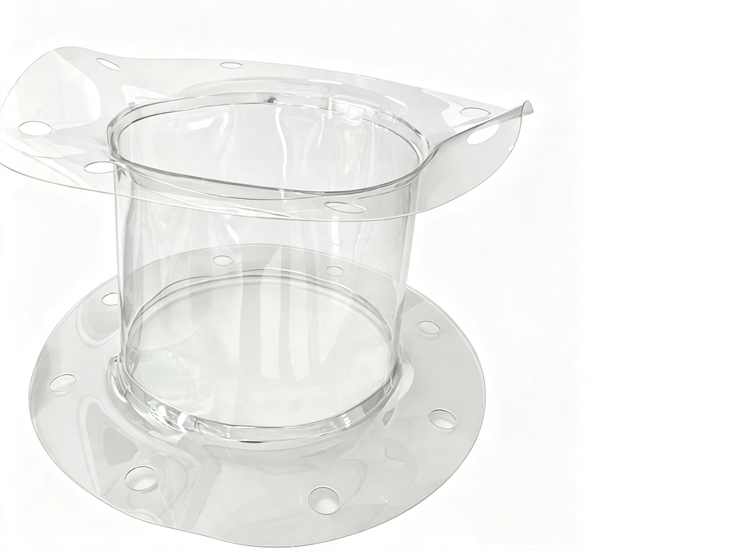
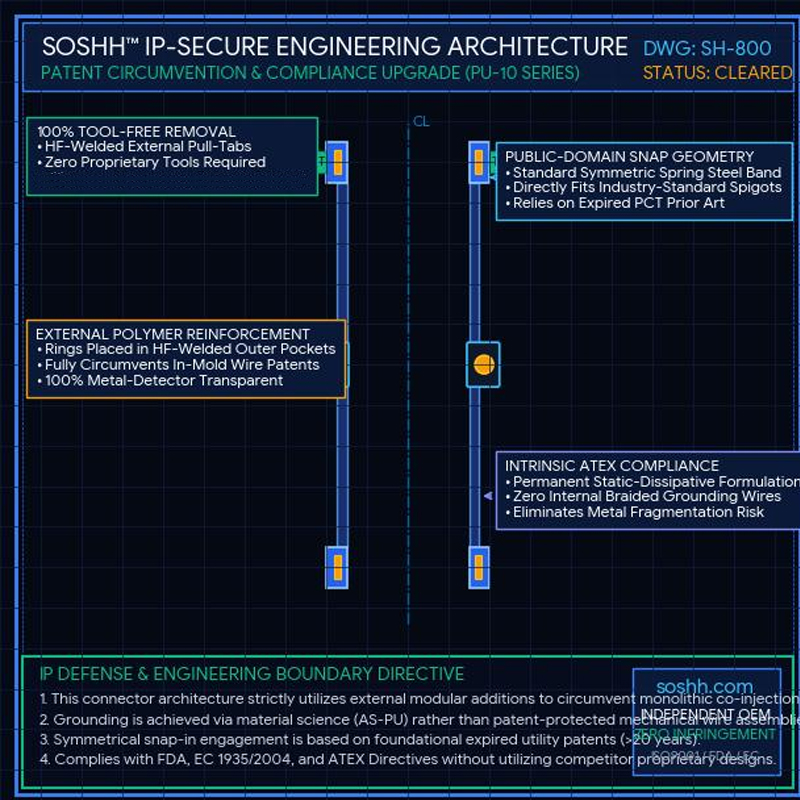
| 100% Metal-Free Design | Trace ferrous/non-ferrous metals ruin battery cell yield | Polymer snap-band construction with high-frequency welded exterior cuffs. Zero clamps, wires, or metal inserts. |
| Extreme Abrasion Resistance | Hard, sharp cathode crystals (LFP/NCM) cause rapid wall thinning | Heavy-duty polyether TPU with DIN ISO 4649 abrasion loss ≤ 39.0 mg and tensile strength 35–45 MPa. |
| Continuous Elevated Temperatures | High-temp drying ovens, spray dryers, and heated pneumatic lines | Standard TPU rated from -20°C to +110°C; High-Temp PU rated up to +150°C. |
| Negative Pressure / Vacuum | Dense-phase and lean-phase vacuum transfer collapse standard sleeves | Reinforced TPU wall equipped with internal/external anti-collapse support rings. |
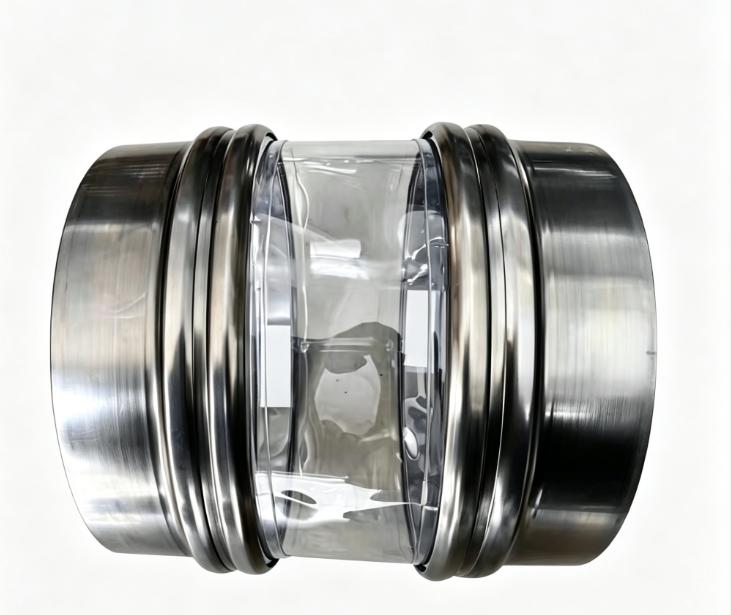
| Sanitary Clean Disconnect | Batch changeovers require fast washdown with zero cross-contamination | Tool-free snap-in installation; 30-second replacement with a flush, crevice-free inner bore. |
1. Static Control: The Critical Safety Path in ATEX Zones
The single most dangerous failure mode in a battery powder processing line is not material leakage — it is uncontrolled electrostatic discharge.
When high-velocity dry powders (such as micronized graphite or organic precursors) travel through non-conductive polymer sleeves, triboelectric friction generates thousands of volts of static charge. In the presence of fine combustible dust or residual electrolyte solvent vapors, a single spark represents an immediate ignition source.
The SOSHH PUAS Advantage:
- Safe Resistance Window: Surface resistivity is precision-controlled between 10⁶ Ω and 10⁹ Ω. This specific dissipative window drains charges safely to the plant ground without behaving as an electrical conductor.
- Homogeneous Formulation: Unlike low-end sleeves that spray a surface coating or embed fragile copper grounding wires that break under vibration, SOSHH PUAS incorporates anti-static agents directly into the molecular backbone.
- ATEX Tested: Fully compliant with ATEX combustible dust safety guidelines and verified by an IEC 60079-32-2 test report.
2. 100% Metal-Free by Design: Zero Contamination Risk
Modern gigafactories employ high-sensitivity inline metal detectors before slurry mixing and coating to intercept foreign particulates. A single metal shaving can pierce a separator film, triggering thermal runaway in completed lithium cells.
Traditional sleeves fastened by stainless steel hose clamps introduce constant failure points: clamp teeth shave polymer shavings, screw threads loosen under continuous motor vibration, and broken wire rings enter the process stream.
The SOSHH Snap-In Architecture:
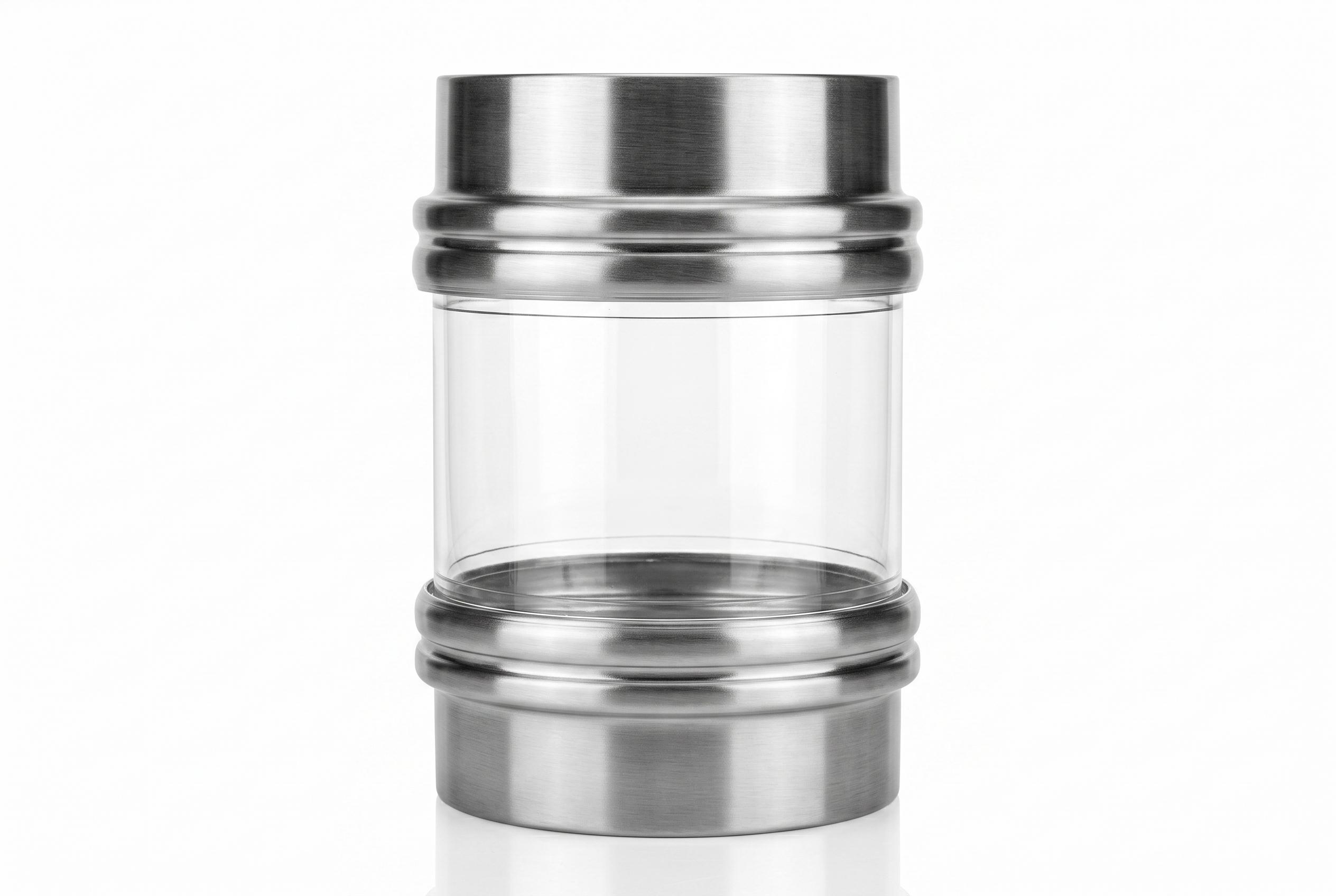
- Polymer Snap-Band Core: The retaining snap-ring is fabricated from high-memory polymer materials rather than spring steel.
- Exterior High-Frequency Welding: All structural seams and collar pockets are ultrasonically or HF-welded outside the product flow path.
- Metal Detector Friendly: The entire assembly is 100% non-metallic in the product contact zone, eliminating false metal-detection trips and zeroing out particulate contamination.
3. Temperature Resistance for Heated Drying & Calcinator Lines
From precursor synthesis to rotary kiln drying and hot-air pneumatic conveying, flexible connectors are continuously exposed to elevated thermal cycles.
| Material Grade | Continuous Service Temp | Peak Intermittent Temp | Typical Process Application |
|---|---|---|---|
| Standard Polyether TPU (PU10 / PUAS) | -20°C to +110°C | +120°C | Ambient pneumatic lines, vibratory screeners, bag dump stations |
| High-Temperature PU | -20°C to +150°C | +165°C | Spray dryer discharge, heated fluid beds, calcination cooling lines |
| CNC Virgin PTFE Bellows | -70°C to +260°C | +280°C | Electrolyte solvent transfer, severe chemical exposure, high-heat feeds |
For complete technical comparisons, download our Flexible Connector Material Selection Guide.
4. Battery Material Compatibility Matrix
Selecting the proper material grade prevents premature elastomeric degradation and product loss:
| Battery Processing Stage | Primary Powders Handled | Recommended Connector Grade | Key Engineering Benefit |
|---|---|---|---|
| Cathode Synthesis & Milling | NMC 811 / 622, LFP, Cobalt Oxide | PUAS Anti-Static TPU (1.5mm / 2.0mm) | Superior abrasion resistance against sharp cathode crystals; static-safe. |
| Anode Preparation | Synthetic Graphite, Carbon Black | PUAS Anti-Static TPU | Dissipates heavy electrostatic charges generated by fine carbon powders. |
| Spray Drying & Calcination | Wet cake discharge, dry oxides | High-Temperature PU (+150°C) | Thermal stability without hardening, cracking, or plasticizer leaching. |
| Electrolyte Mixing & Dosing | Organic carbonates (EC, DMC, EMC), LiPF6 | CNC-Machined PTFE Bellows | 100% chemical inertness against harsh fluorinated electrolyte solvents. |
| Loss-in-Weight (LIW) Feeders | Active materials to twin-screw extruders | Ultra-Thin LightTC Bellows | Zero-resistance flexibility, protecting load-cell gravimetric weighing accuracy. |
5. Vacuum & Negative-Pressure Integrity: Anti-Collapse Engineering
Closed-loop pneumatic transfer of battery active materials frequently operates under vacuum (negative pressure) to prevent dust from escaping into cleanroom environments.
Under sustained negative pressure, standard straight flexible sleeves experience severe inward suction, collapsing the connector, choking material flow, and causing extreme cyclic fatigue at the clamping point.
SOSHH Anti-Collapse Solutions:
- Integrated Support Rings: High-strength polymer or exterior reinforcement rings welded at calculated axial pitches to resist circumferential hoop stress.
- Engineered Wall Thickness: Heavy-gauge 1.5mm and 2.0mm polyether TPU walls engineered specifically for continuous differential pressures.
- Vacuum Specification: Simply provide your operating vacuum level (in mbar or kPa) and installation span; our engineering team calculates the exact ring interval required to prevent collapse.
6. Engineering Specification Checklist: 5-Step RFQ Guide
To ensure a seamless fit for your battery production equipment, have the following parameters ready when contacting our technical support:
- Powder Classification: Identify whether the medium is cathode (NMC/LFP), anode graphite, or raw additive.
- Safety & ATEX Zone: Specify your site zoning (e.g., Zone 20, 21, or 22) and grounding continuity protocols.
- Geometric Dimensions: Measure the spigot outer diameter (OD), installation gap/length, and connection type (Snap-in spigot, Tri-Clamp ferrule, or bolt flange).
- Operating Conditions: Confirm continuous/peak temperature, operating pressure, or vacuum differential (mbar).
- Equipment Dynamics: Note if the connection is subject to high-frequency horizontal vibration (vibratory sifter) or vertical compression (LIW batching scale).
Secure Your Battery Powder Line with SOSHH
Eliminate downtime, dust leakage, and metal contamination in your battery material production facility.
- Review our full polymer specifications in the Material Selection Guide.
- Explore our tool-free SF Internal Snap-On Flexible Connectors.
- Ready to upgrade your line? Contact SOSHH Engineering Support with your operating parameters for a 24-hour engineering review and custom quote.
Related Posts