Entity-Dense Summary:
A pneumatic conveying flexible connector is a resilient sleeve installed between conveying line sections, feeders, rotary valves, and receiving equipment. Pneumatic conveying subjects the connector to three combined operational loads: positive pressure, negative pressure (vacuum), and electrostatic charge generated from continuous powder-to-wall friction. Selecting the correct grade depends on which load dominates the process — pressure duty requires the PU-15 or fiber-reinforced PURF, vacuum duty requires the PU-10-VR rated to −1000 mbar, and combustible dust environments require the inherently static-dissipative PU-10-AS (10⁶–10⁹ Ω). All TPU grades are fully FDA 21 CFR 177.2600 compliant.
Why Pneumatic Conveying Is a Three-Load Duty
Pneumatic conveying is the only powder-handling application that combines pressure, vacuum, and static charge within a single operational span. Each load attacks the flexible connector differently:
| LOAD | WHAT IT DOES TO THE SLEEVE | CONSEQUENCE |
|---|
| Positive pressure | Balloons the wall outward | Wall overstretches, loses elasticity, and tears |
| Negative pressure (vacuum) | Pulls the wall inward | Wall collapses, choking the material flow |
| Static charge | Accumulates on insulating walls | Creates an ignition/spark risk with combustible dust |
A standard sleeve rated for only one of these conditions will fail when exposed to the other two. Selection must begin by identifying which operational load dominates your conveying line.
The Three Selection Paths
Path 1 — Positive Pressure Dominant
Dilute-phase or dense-phase conveying pushes powder under positive pressure. The connector wall must actively resist outward ballooning.
- Moderate pressure: Choose PU-15 (1.5 mm wall, +0.70 bar).
- High pressure pulses / surge: Choose PU Fiber-Reinforced (PURF) (300 MPa tensile strength).
Path 2 — Vacuum Dominant
Vacuum conveying pulls powder through the line under negative pressure. The connector must resist inward collapse to prevent flow restriction.
- Full vacuum: Choose PU-10-VR (−1000 mbar, vacuum reinforced).
- Partial vacuum: Choose PU-15 (−120 mbar).
Path 3 — Static Dominant (Combustible Dust)
Pneumatic conveying inherently generates high electrostatic charges through powder-to-wall friction. For combustible dust, the sleeve must bleed this charge safely to earth.
- Combustible dust / ATEX: Choose PU-10-AS (10⁶–10⁹ Ω surface resistivity, ATEX Zones 20/21/22).
- Non-combustible powder: Choose PU-10 Standard.
(Note: For a line with two or three loads combined—such as heavy vacuum plus combustible dust—contact our engineering team. A single-grade off-the-shelf selection may not cover multiple extreme loads simultaneously).
The Static Dissipation Path in Pneumatic Conveying
Static dissipation acts as a complete system, not just a standalone sleeve. To safely eliminate static in a pneumatic line:
- Charge is generated by continuous powder-to-wall friction in the conveying stream.
- Charge reaches the sleeve wall — the 10⁶–10⁹ Ω TPU bleeds it gradually.
- Charge flows to the spigot — the stainless steel head conducts the energy.
- The spigot is permanently grounded — safely discharging the energy to earth.
The PU-10-AS is inherently static-dissipative. The property is built directly into the TPU formulation, meaning there is no surface coating to wear off under high-velocity abrasion and no internal wire to break under vibration.
What Causes Pneumatic Conveying Connector Failure?
| FAILURE MODE | DOMINANT LOAD | THE ENGINEERED FIX |
|---|
| Ballooning / overstretch | Positive pressure | PU-15 (+0.70 bar) or PURF (300 MPa) |
| Collapse / choked flow | Vacuum | PU-10-VR (−1000 mbar) |
| Spark / ignition risk | Static accumulation | PU-10-AS (10⁶–10⁹ Ω) |
| Wall abrasion | High-velocity powder | PU-15 (1.5 mm thicker wall) |
| Softening / melting | High temperature | PU-HT (−20 to 150°C continuous) |
Product Selection Quick Reference
| CONVEYING CONDITION | RECOMMENDED GRADE | KEY SPECIFICATION |
|---|
| General powder, low pressure | PU-10 Standard | 1.0 mm, +0.35 bar / −50 mbar |
| Abrasive / high-velocity powder | PU-15 | 1.5 mm, +0.70 bar / −120 mbar |
| Combustible dust | PU-10-AS | 10⁶–10⁹ Ω, ATEX Zones 20/21/22 |
| Full vacuum suction | PU-10-VR | −1000 mbar rating |
| High pressure pulse | PU Fiber-Reinforced (PURF) | 300 MPa tensile strength |
| High temperature (≤150°C) | PU-HT | −20 to 150°C continuous service |
(For strong chemical media or temperatures exceeding 150°C, standard TPU grades are not suitable. Please contact us for PTFE corrugated bellows).
How to Specify a Pneumatic Conveying Connector
To ensure perfect fitment and operational safety, please provide these eight parameters to our engineering team:
- Line spigot OD (both ends)
- Installed gap
- Conveying mode (dilute-phase / dense-phase / vacuum)
- Operating pressure (positive, bar)
- Operating vacuum (negative, mbar)
- Powder type and abrasiveness
- Operating temperature
- Static requirement (Is the powder combustible?)
Send these details to amin@soshh.com for CAD verification and precise grade selection. See our How to Measure & Size Guide.
Frequently Asked Questions
Q1: Can one connector handle pressure, vacuum, and static at once?
A: Not always from a single off-the-shelf grade. Each grade optimizes one dominant load — pressure (PU-15/PURF), vacuum (PU-10-VR), or static (PU-10-AS). For combined extreme loads, contact our engineering team for a paired solution.
Q2: What is the vacuum rating for pneumatic conveying?
A: The PU-10-VR is rated to −1000 mbar full vacuum, making it ideal for aggressive suction conveying. The PU-15 can handle up to −120 mbar partial vacuum.
Q3: Do I need anti-static connectors for pneumatic conveying?
A: If the powder is combustible, yes. Pneumatic conveying generates exceptionally strong static charges due to continuous friction. You must specify the PU-10-AS (10⁶–10⁹ Ω surface resistivity, ATEX Zones 20/21/22).
Q4: What pressure can a conveying connector handle?
A: The PU-15 safely handles up to +0.70 bar. For high-pressure pulses or system surges, specify the PU Fiber-Reinforced (PURF) grade, which features a massive 300 MPa tensile strength.
Q5: Why does a conveying connector balloon or collapse?
A: Positive pressure forces the wall outward (ballooning), while vacuum pulls it inward (collapse). Using standard sleeves on high-load lines causes premature failure. The correct reinforced grade resists its dominant load — PU-15 for pressure, PU-10-VR for vacuum.
Q6: Are these conveying connectors food-contact compliant?
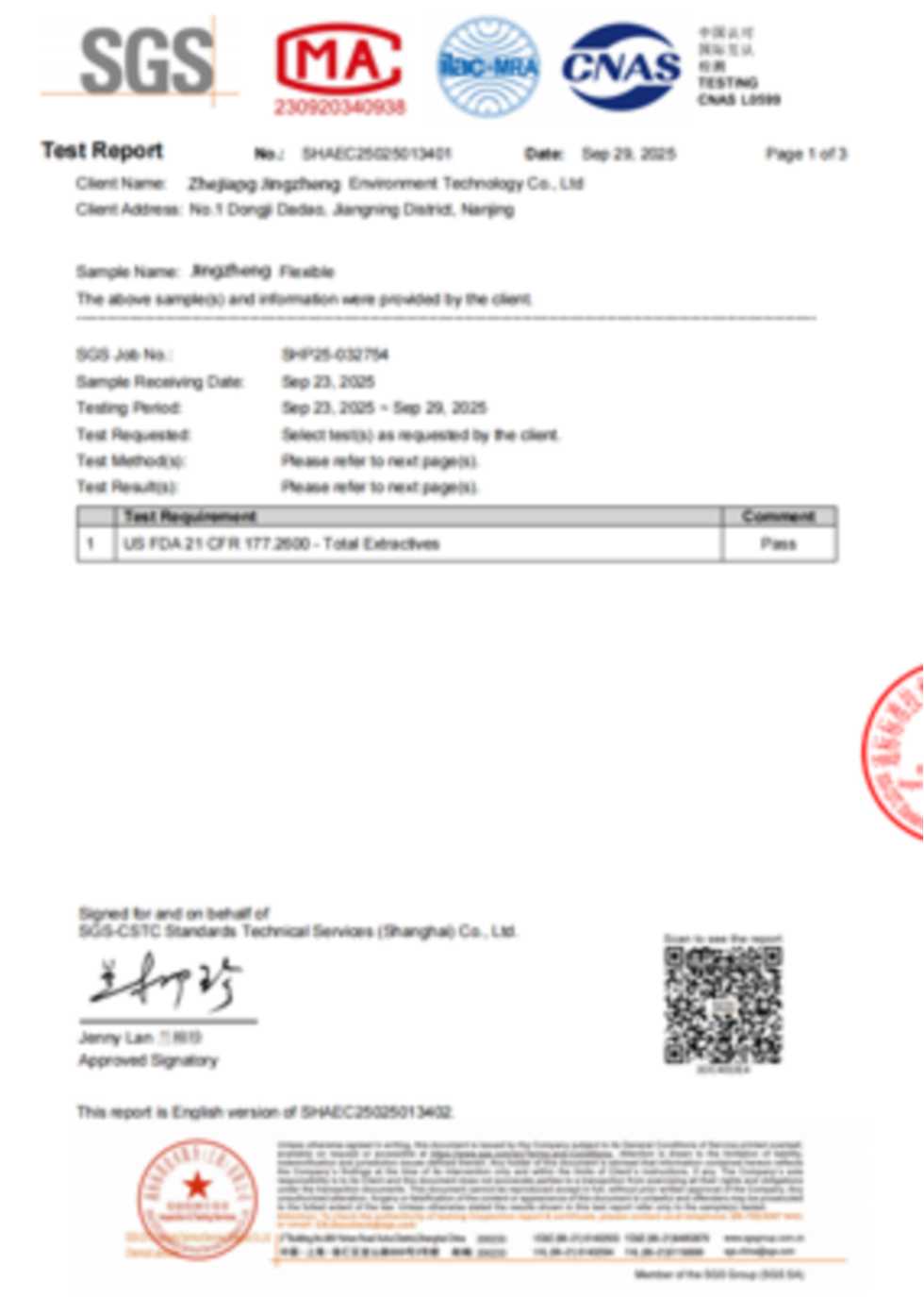
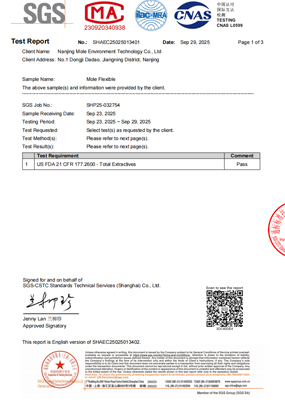
A: Yes. All SOSHH TPU grades are FDA 21 CFR 177.2600 compliant (Report TQT4821B36E) and formulated in accordance with EC 1935/2004 and EU 10/2011.