Combustible Dust & ATEX Flexible Connectors — Static Dissipation & Explosion Safety
SOSHH anti-static flexible connectors are precision-engineered from inherently static-dissipative polyether TPU with surface resistivity strictly below 10⁹ Ω, verified by SGS volume-resistivity testing (4.02×10⁷ Ω per IEC 62631-3-1:2023 under Report Ref: SHMR240801578301-1). Engineered specifically for combustible-dust atmospheres across ATEX Zones 20, 21, and 22, our systems deliver a 100% metal-free product-contact bore, 40 MPa tensile strength, and 39.0 mg DIN abrasion resistance across standard diameters from Ø102 mm to Ø804 mm.
A combustible-dust explosion requires five elements: fuel (the dispersed dust cloud), oxygen, confinement, suspension, and an ignition source. The flexible connector sits at the exact point where all five can converge—bulk powder is agitated and suspended during transfer, confined by the sleeve walls, and moving rapidly enough to generate massive triboelectric voltage. SOSHH eliminates the electrostatic ignition source through material dissipation, protecting facilities against secondary fugitive dust clouds.
1. Understanding ATEX Zone Classification for Flexible Connections
Selecting the correct connector configuration requires understanding site hazardous-area zoning. The ATEX zone defines the operational risk profile and dictates earthing and containment protocols:
| ATEX Zone | Atmosphere Definition | Typical Process Location | Flexible Connector Engineering Implication |
| Zone 20 | Combustible dust cloud present continuously or for long periods | Inside hammer mills, cyclones, silos, and conveying chutes | Highest risk; dissipative sleeve (< 10⁹ Ω) + bonded spigots mandatory |
| Zone 21 | Combustible dust cloud likely to occur occasionally in normal operation | Bag dumping stations, packaging heads, screener discharge points | Dissipative sleeve recommended; plant grounding verification required |
| Zone 22 | Dust cloud unlikely in normal operation; persists for short duration | External pipework joints, silo venting perimeters, warehouse aisles | 100% dust-tight snap-in seal prevents explosive clouds from forming |
Note: Common bulk materials—flour, sugar, starch, cocoa, wood flour, sulfur, and organic active pharmaceutical ingredients—are Class St 1 or St 2 combustible dusts with low minimum ignition energies (MIE). An electrostatic discharge from an ungrounded, insulating sleeve can easily exceed these thresholds.
2. Three Critical Combustion-Risk Failure Points
Traditional flexible connectors fail under combustible dust handling due to poor polymer selection and compromised grounding methods:
Electrostatic Charge Accumulation & Spark Arc Discharge
As dry powder flows through standard insulating sleeves (canvas, generic silicone, or non-conductive vinyl), rapid contact-and-separation creates high electrostatic potential. Once voltage exceeds the dielectric breakdown of the surrounding air, an incendiary brush discharge ignites the suspended dust cloud. SOSHH anti-static polyether TPU maintains surface resistivity below 10⁹ Ω and volume resistivity of 4.02×10⁷ Ω (SGS tested), continuously bleeding charges to earth before sparks can form.
Metal Particulate Ignition & Wire Fatigue
Conventional flexible sleeves frequently incorporate internal spiral steel wire or external braided copper ground straps. Dynamic oscillation on vibrating screeners causes these metal braids to work-harden, fray, and snap. Broken wire ends risk making spark contact with machinery or breaking off into the product stream. SOSHH connectors feature high-frequency welded exterior cuffs; the retention band sits completely outside the fluid flow path, ensuring the entire contact bore is 100% non-metallic.
Dust Leakage Creating Secondary Explosive Clouds
An explosion is impossible without an airborne fuel-air mixture. Traditional clamped canvas sleeves continuously weep fine dust plumes through fabric pores and distorted clamp creases. This airborne powder settles on overhead cable trays, pipes, and beams, creating the fuel source for catastrophic secondary explosions. The SOSHH snap-in design delivers a 100% airtight seal under operating pressures up to +0.35 bar, eliminating dust release at the source.
3. Engineering Specification Matrix (SSOT Aligned)
| Engineering Parameter | SSOT Verified Specification | Process Safety & Operational Benefit |
| Base Polymer Formulation | Static-Dissipative Polyether TPU | Inherent matrix dissipation; zero ester hydrolysis; plasticizer-free |
| Surface Resistivity (Rs) | < 10⁹ Ω | Static dissipative; prevents electrostatic charge accumulation |
| Volume Resistivity (Rv) | 4.02×10⁷ Ω | Verified by SGS Shanghai (Report Ref: SHMR240801578301-1) |
| Electrical Standard | IEC 62631-3-1:2023 | Authoritative international laboratory dielectric test standard |
| Tensile Strength | 40 MPa | Resists pressure shock pulses and high-velocity pneumatic loads |
| Elongation at Break | 600% | High elasticity absorbs continuous multi-axis sifter strokes |
| DIN Abrasion Loss | 39.0 mg (DIN ISO 4649) | High mechanical resistance against abrasive combustible grains and crystals |
| Standard Thickness | 1.0 mm (PU-10-AS) | Optimal engineering balance between flex fatigue and wear life |
| Thermal Envelope | −20 °C to +110 °C | Withstands continuous process heat and washdown |
| Vacuum Support Option | Stainless Steel or Plastic Rings | Prevents negative-pressure sleeve collapse in pneumatic vacuum transfer |
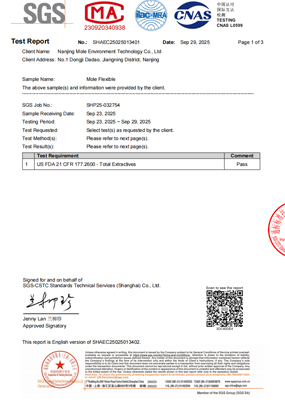
| Food-Contact Regulatory | FDA 21 CFR 177.2600 Compliant | Certified extraction limits for combustible food and grain powders |
| Standard Diameter Range | Ø102 mm to Ø804 mm | Zero tooling charges on custom transitions, cones, and offsets |
4. The Honest Grounding Specification: Plant Safety Protocol
A dangerous misconception in plant safety engineering is assuming that installing an anti-static sleeve eliminates the need for mechanical grounding:
- Sleeve Charge Dissipation: The SOSHH dissipative sleeve prevents static accumulation on the connector itself by providing a conductive pathway with surface resistivity below 10⁹ Ω.
- Plant Bonding Requirement: The metal docking spigots and surrounding piping must be bonded to the plant grounding grid. The dissipative sleeve routes charges into those grounded spigots.
- Cross-Bonding Best Practice: Where upstream and downstream machinery are separated by structural vibration mounts, a flexible cross-bonding ground strap between the rigid steel flanges is strongly recommended to maintain equipotential bonding.
- ATEX Assessment Support: SOSHH supplies the full SGS volume-resistivity report (SHMR240801578301-1) to support site DSEAR/ATEX risk assessments. Final hazardous-area sign-off rests with the facility electrical and safety engineers.
5. Frequently Asked Questions (FAQ) — Combustible Dust & ATEX
Q1: Is your anti-static flexible connector ATEX certified?
ATEX certification under Directive 2014/34/EU applies to complete machine assemblies rather than passive, standalone elastomeric components. SOSHH provides the official SGS test report (Report Ref: SHMR240801578301-1, tested per IEC 62631-3-1:2023) confirming volume resistivity of 4.02×10⁷ Ω and surface resistivity below 10⁹ Ω to support your site hazardous-area documentation and ATEX Zone 20/21/22 risk assessments.
Q2: What does surface resistivity below 10⁹ Ω mean in practice?
It places the polymer squarely in the static dissipative range. The sleeve conducts electricity well enough to bleed triboelectric charges safely to ground before spark breakdown occurs, but is not so conductive as to present a short-circuit, ground-fault, or secondary electrical ignition hazard.
Q3: Do I still need to ground the process equipment?
Yes. The dissipative sleeve prevents localized charge build-up on the flexible element, but the metallic spigots and process piping must be bonded to the facility grounding grid. The sleeve transfers accumulated charges directly into those grounded spigots. Where connected equipment is electrically isolated by rubber isolators, an external bonding strap across the joint is recommended.
Q4: Can I install this connector in ATEX Zone 20 (inside the dust cloud)?
Yes. The dissipative TPU is specified for service in ATEX Zones 20, 21, and 22. In Zone 20 environments (mills, silos, cyclones), the installation requires the complete safety package: dissipative sleeve, properly bonded metallic docking spigots, and a 100% dust-tight snap-in seal. Final zone installation suitability must be confirmed by the site safety engineer.
Q5: Does the anti-static dissipation degrade or wash off over time?
No. The static-dissipative property is compounded intrinsically throughout the polyether polymer matrix. It is not an external spray coating and cannot wash off, leach, or wear away during repeated CIP chemical washdowns or continuous abrasive powder conveying.
Q6: Can you supply vacuum-rated anti-static connectors?
Yes. For negative-pressure conveying or dust collector vacuum lines, we incorporate internal or external stainless steel or engineered polymer support rings to prevent sleeve collapse while maintaining full static dissipation.
6. Request an Engineering Proposal & 24-Hour CAD Drawing
Verify IEC 62631-3-1:2023 test data and ATEX Zone suitability for your site. Submit the following five parameters directly to amin@soshh.com:
- [ ] Spigot Outer Diameter (OD): Seating channel outer diameter in mm
- [ ] Installation Gap (IG): Static face-to-face distance between rigid spigots in mm
- [ ] Combustible Media: Specific powder handled (flour, starch, sugar, wood, resin, active API)
- [ ] Operating Pressure: Maximum working positive pressure (bar) or negative vacuum level (mbar)
- [ ] Designated Safety Zone: Target ATEX Zone classification (Zone 20, 21, or 22)
Our engineering desk returns an intrinsically dissipative 2D proposal, official SGS electrical test reports, and quotation within 24 hours.