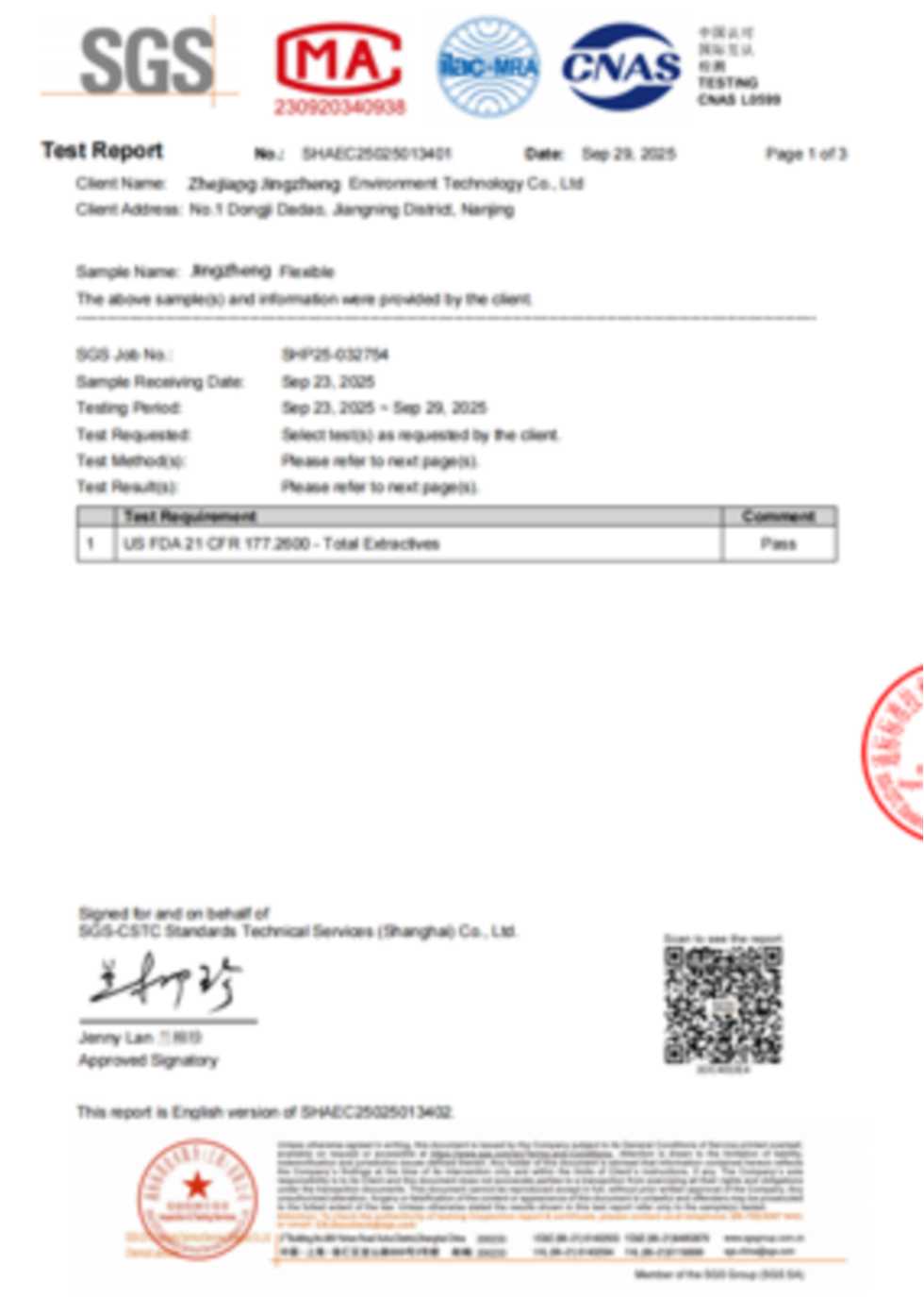
Entity-Dense Summary: A vibrating sifter flexible connector is a flexible sleeve installed between a vibrating screen or sifter and its feed or discharge equipment. Sifter duty subjects the connector to high-frequency flex, so the sleeve must absorb amplitude without running in tension and must not create a clamp-edge pinch point where tears start. The correct grade depends on the powder: general powders use PU-10, combustible dusts use static-dissipative PU-10-AS, and abrasive powders use 1.5 mm PU-15. All TPU grades are FDA 21 CFR 177.2600 compliant.
Why Vibrating Sifters Are the Hardest Duty
A vibrating sifter concentrates flex at the connector — thousands of cycles per minute, continuously. Three failure factors act together:
| FAILURE FACTOR | WHY IT HAPPENS AT A SIFTER |
|---|
| High-frequency flex | The sifter oscillates continuously, flexing the sleeve at every stroke |
| Clamp-edge stress concentration | A hose clamp pinches the sleeve along one line, and flex fatigue starts a tear at that line |
| Static + dust | Fine powders generate charge; if the powder is combustible, that charge is an ignition risk |
A standard clamped sleeve fails at the clamp edge first. The snap-in design removes the pinch point.
The Three Requirements for Sifter Duty
1. No clamp-edge pinch point
A hose clamp concentrates stress along a single line. Under continuous flex, that line becomes a tear. The snap-in cuff distributes retention around the full circumference — no single stress line.
2. Flex allowance, not tension
The sleeve must never run in tension at full amplitude. For vibratory service, allow 10–15% extra slack on the installation gap so the sleeve flexes freely instead of stretching.
3. Static dissipation where required
Sifting generates electrostatic charge. For combustible dust, specify PU-10-AS — inherently static-dissipative at 10⁶–10⁹ Ω, no coating to wear off, no internal wire to break.
Selection by Powder Type
| POWDER TYPE | RECOMMENDED GRADE | KEY SPEC |
|---|
| General fine powder | PU-10 | 1.0 mm, −20 to 110°C |
| Abrasive powder | PU-15 | 1.5 mm wall |
| Combustible dust | PU-10-AS | 10⁶–10⁹ Ω, ATEX |
| High temperature (≤150°C) | PUHT | −20 to 150°C |
What Causes Sifter Connector Failure
| FAILURE | POSSIBLE CAUSE | FIX |
|---|
| Tearing at the edge | Clamp-edge stress concentration | Snap-in design (no pinch point) |
| Tearing at the flex point | Sleeve running in tension | 10–15% flex allowance |
| Static accumulation | Insulating wall + combustible dust | PU-10-AS, 10⁶–10⁹ Ω |
| Wall abrasion | Abrasive powder | PU-15, 1.5 mm wall |
| Softening | Temperature above standard TPU | PUHT |
How to Specify a Sifter Connector
Provide these seven parameters:
- Sifter spigot OD (both ends)
- Static installation gap
- Dynamic stroke (amplitude)
- Powder type and abrasiveness
- Temperature
- Static requirement (combustible dust?)
- Cleaning method (dry / CIP)
For the full walkthrough, see How to Measure & Size.
Frequently Asked Questions
Q1: Why do sifter connectors tear at the clamp edge?
A: A hose clamp concentrates stress along one line, and continuous flex fatigue starts a tear at that line. The snap-in cuff distributes retention around the full circumference, removing the pinch point.
Q2: How much slack does a sifter connector need?
A: Allow 10–15% extra slack on the installation gap so the sleeve flexes freely and never runs in tension at full amplitude.
Q3: Do I need anti-static for a vibrating sifter?
A: If the powder is combustible, yes. Specify PU-10-AS (10⁶–10⁹ Ω, ATEX Zones 20/21/22). Sifting generates electrostatic charge in fine powders.
Q4: Can a snap-in connector handle sifter vibration?
A: Yes. The snap-in cuff is designed for vibratory service, and with correct flex allowance it absorbs amplitude without a clamp-edge pinch point.
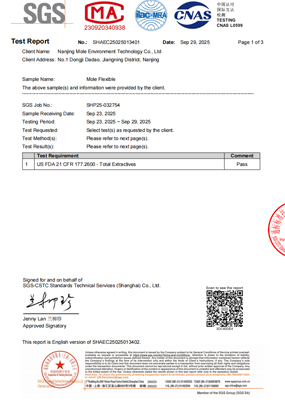
Q5: Is it food-contact compliant?
A: Yes. TPU grades are FDA 21 CFR 177.2600 compliant (Report TQT4821B36E) and formulated in accordance with EC 1935/2004 and EU 10/2011.