Three flexible connector interfaces dominate powder processing: bolted flanges, hose clamps, and tool-free snap-in cuffs. Flanges seal well but require tools and 10–20 minutes per changeover. Hose clamps pinch the sleeve wall, creating a tear point and putting metal in the product path. Snap-in cuffs lock over a welded spigot with a spring-steel band in HF-welded exterior pockets — tool-free, under 30 seconds per end, and no exposed metal hardware in the product bore .
(This decision matrix is designed for rapid engineering specification.)
Direct Answer
There is no universal lowest-TCO flexible connector. The best interface depends on changeout frequency, existing equipment geometry, installation labor, downtime, movement, and process requirements.
For frequent sleeve replacement, a tool-free SF snap-in configuration can reduce recurring maintenance labor. For existing sanitary Tri-Clamp systems, TC preserves the existing connection architecture. For existing round or rectangular flanges, FLC or FLR can avoid major piping changes. For plain pipe retrofit applications where welding is undesirable, HC provides an external clamp solution.
The correct interface is therefore determined by the equipment connection, changeout frequency, movement requirements and process environment—not by sleeve price alone.
The Six SOSHH Flexible Connector Interfaces
SOSHH currently organizes its flexible connector range around six primary interface configurations: SF, TC, LightTC, FLC, FLR and HC.
| INTERFACE | CONNECTION METHOD | BEST FIT |
|---|
| SF Internal Snap-In | Spring-band snap-in connection to a compatible spigot | Frequent changeout, hygienic powder handling |
| TC Quick-Clamp | Sanitary Tri-Clamp interface | Existing sanitary piping |
| LightTC | Lightweight sanitary quick-clamp interface | Gravimetric and weighing applications |
| FLC Round Flange | Bolted round flange | Existing round flanged equipment |
| FLR Square Flange | Bolted square/rectangular flange | Hoppers, chutes and rectangular transitions |
| HC Hose Clamp | External clamp over pipe OD | Retrofit applications with plain pipe ends |
Which Flexible Connector Should You Choose?
Use this decision logic before comparing price.
1. Choose SF Snap-In when:
- The line uses compatible welded spigots.
- Connectors are changed frequently.
- Operator-accessible, tool-free replacement is important.
- The product bore must remain free of exposed metal hardware.
- The application involves food, pharmaceutical or fine-powder processing.
The SF design uses integrated spring-steel bands within the snap-in cuff and is designed for rapid tool-free installation.
→ View SF Snap-In Flexible Connectors
2. Choose TC Quick-Clamp when:
Your equipment already uses sanitary Tri-Clamp ferrules and you want to preserve the existing sanitary connection architecture.
SOSHH’s TC range is positioned for food, pharmaceutical and nutraceutical powder-processing applications and supports FDA 21 CFR 177.2600 configurations.
→ View TC Quick-Clamp Flexible Connectors
3. Choose LightTC when:
Weight at the flexible connection matters, particularly around:
- Weighing systems
- Gravimetric feeders
- Load-cell assemblies
- Low-mechanical-interference applications
SOSHH specifically positions LightTC around gravimetric feeders and misaligned sanitary chutes.
→ View LightTC Flexible Connectors
4. Choose FLC Round Flange when:
- The equipment already uses round bolted flanges.
- Welding new spigots is undesirable.
- The connection requires a mechanically compressed flange interface.
- The equipment is circular.
SOSHH describes FLC as a bolted flange solution for rigid flanged piping and powder-processing systems.
→ View FLC Round Flange Flexible Connectors
5. Choose FLR Square Flange when:
The equipment interface is:
- Square, rectangular, or offset
- Hopper-shaped
- Transitioning between non-circular equipment geometries
SOSHH positions FLR specifically for square and rectangular powder-handling transitions.
→ View FLR Square Flexible Connectors
6. Choose HC Hose Clamp when:
You need a retrofit solution for plain pipe ends and do not want to modify the existing piping.
HC installs over the outside diameter of the existing pipe and uses an external clamp. SOSHH positions this interface specifically as a retrofit option without equipment modification.
→ View HC Hose Clamp Flexible Connectors
TCO Comparison: What Actually Costs Money?
The purchase price of the flexible sleeve is only one part of lifecycle cost. A more useful engineering model is:
Annual TCO = Connector Cost + Changeover Labor + Planned Downtime + Failure Cost + Cleaning/Maintenance Cost
For a frequently serviced powder-processing line, the recurring cost of removing, cleaning, inspecting and reinstalling a connector can exceed the initial connector price.
| COST FACTOR | FLANGE | HOSE CLAMP | SNAP-IN |
|---|
| Initial connector cost | Lower | Lowest in many retrofit cases | Moderate |
| New spigot required | No | No | Usually yes |
| Tools Required | Required | Clamp tool / hand tools | No |
| Operator changeout | Usually maintenance | Maintenance/operator | Operator-friendly |
| Changeover labor | Higher | Moderate | Low |
| Piping modification | Usually none | None | Required if no spigot |
| Exposed metal in bore | Configuration-dependent | Clamp remains outside sleeve | No exposed metal hardware |
Important: actual lifecycle cost depends on the plant’s labor rate, connector price, replacement interval and downtime cost. The table above is an engineering decision framework, not a universal cost claim.
Worked TCO Example
Consider a powder-processing line where one flexible connector is replaced once per week. Assume 52 changeouts/year, $60/hour loaded maintenance labor, and 2 connection ends per changeout.
Illustrative maintenance-time assumptions:
| INTERFACE | ILLUSTRATIVE CHANGEOUT TIME | ANNUAL LABOR TIME | ILLUSTRATIVE ANNUAL LABOR COST |
|---|
| Flange | 40 min / changeout | 34.7 hr / year | $2,080 |
| Hose Clamp | 20 min / changeout | 17.3 hr / year | $1,040 |
| Snap-In | 1 min / changeout | 0.87 hr / year | $52 |
These are illustrative TCO assumptions, not SOSHH measured labor data. Replace them with your actual maintenance time and labor rate.
The Break-Even Calculation
Instead of simply claiming that snap-in is cheaper, let the buyer calculate the answer.
Annual Changeover Cost = Changeovers per Year × Changeover Time × Loaded Labor Rate
Break-even changeouts = Additional Initial Investment ÷ Savings per Changeout
Example: If the snap-in conversion requires an additional $600 of spigot investment and saves $20 of labor per changeout:
$600 ÷ $20 = 30 changeouts
At one changeout per week: 30 weeks to break even. At two changeouts per week: 15 weeks.
Engineering Deep Dives
Why Clamp Interfaces Can Develop Fatigue Problems
An external hose clamp creates a concentrated compression zone where the flexible sleeve is restrained. In a vibrating application, the transition between the restrained area and the freely flexing sleeve can become a mechanically important stress location.
The actual failure mechanism depends on sleeve material, wall thickness, clamp geometry, clamp torque, pipe diameter, installation gap, vibration amplitude and frequency, temperature, pressure or vacuum, and chemical exposure.
Therefore, the engineering question should not simply be: “Is a hose clamp good or bad?”
It should be: “Does the interface distribute mechanical load appropriately for the movement and service conditions?”
Why Snap-In Can Reduce Maintenance Labor
The principal economic advantage of the SF interface is not simply the sleeve material. It is the interface architecture. A compatible spigot provides the fixed connection geometry. The flexible sleeve then engages with the spigot through the snap-in mechanism, allowing rapid removal and replacement without conventional flange bolts or external hose-clamp tightening.
For plants with frequent CIP access, preventive maintenance, sieve inspection, product changeovers, or sleeve replacement, the time saved per intervention can become a measurable operating-cost advantage.
Product-Bore Considerations
A connector may contain metal components without exposing metal hardware to the conveyed product. For SF Snap-In, SOSHH describes integrated spring-steel bands and a flush internal wall.
Therefore the relevant engineering question is: “Is metal exposed to the product bore?” rather than “Does the connector contain metal?” For metal-detection-sensitive processes, always evaluate the complete installed assembly.
Food-Contact Compliance
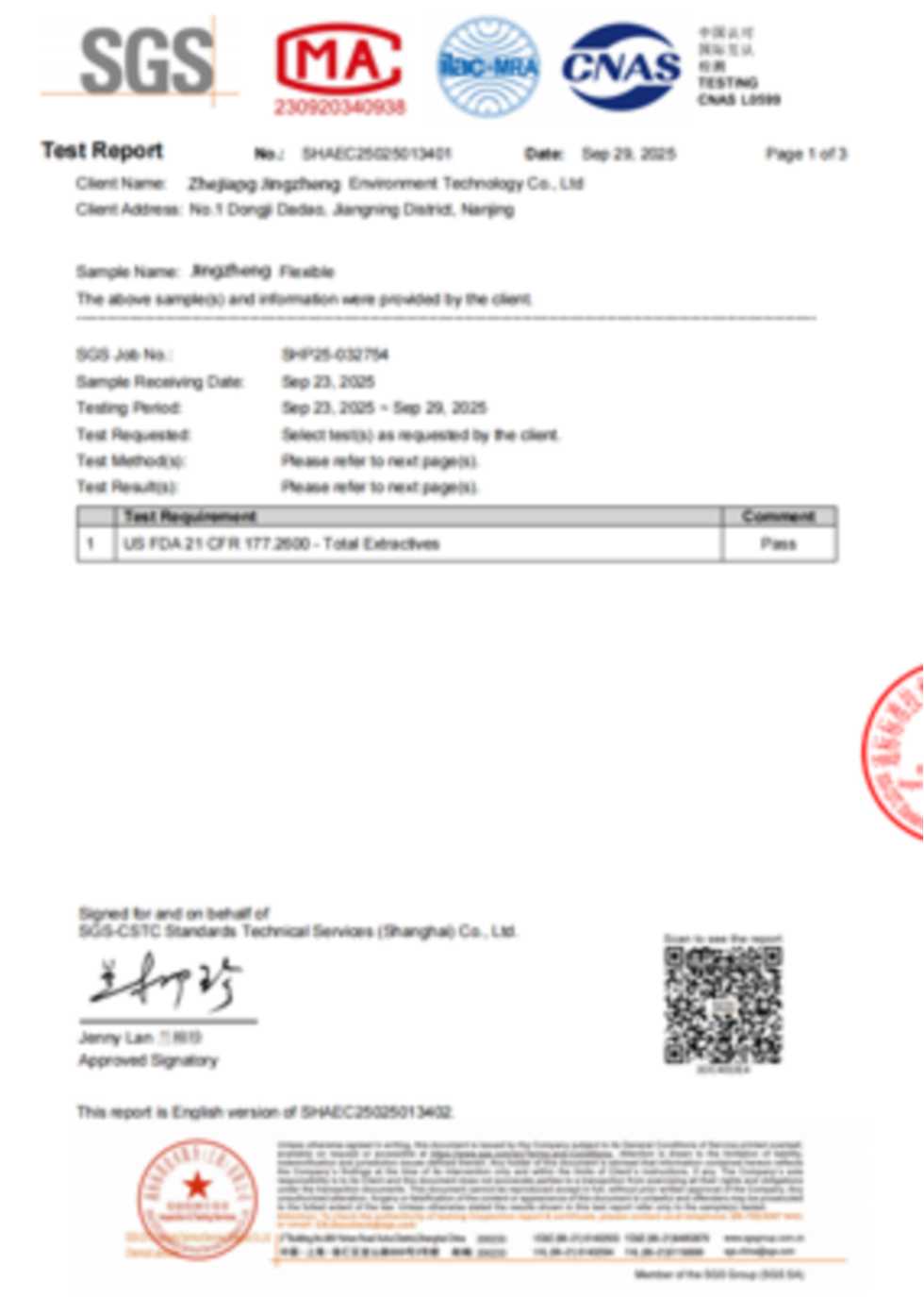
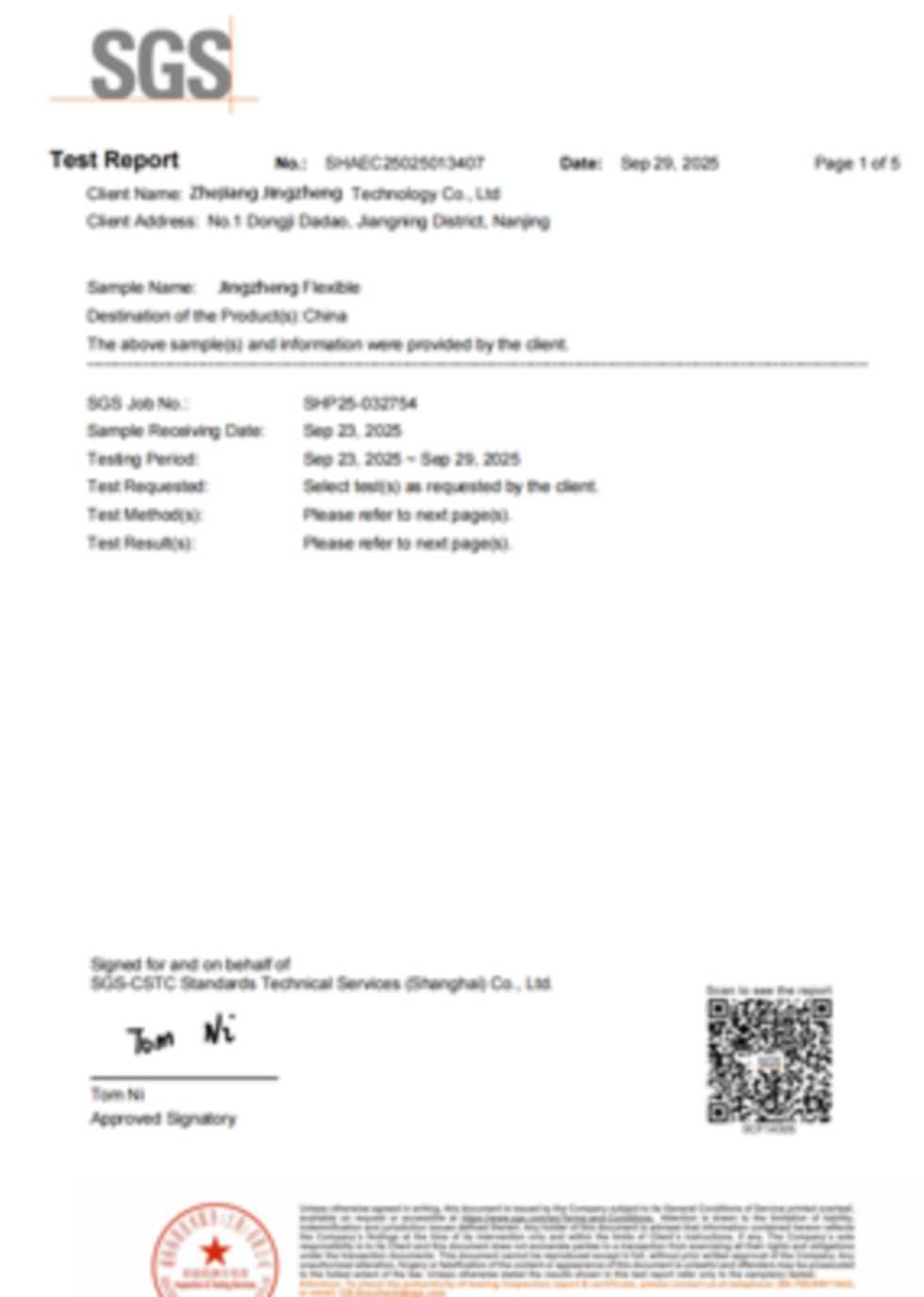
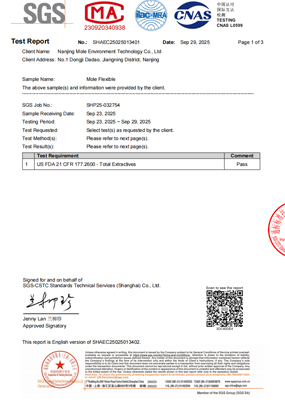
For food-contact applications, material selection must be tied to the specific material grade and documented test basis. SOSHH currently references Published test evidence: SOSHH has published FDA 21 CFR 177.2600 test report TQT4821B36E for a food-grade transparent polyether TPU flexible connector sample. The report identifies Zhejiang Jingzhen Environmental Protection Technology Co., Ltd. as applicant and manufacturer. FDA 21 CFR 177.2600 test report.
Important distinction: Do not interpret FDA 21 CFR 177.2600 as meaning that every SOSHH product, every material and every operating condition is automatically covered.
The correct purchasing process is:
- Identify the exact connector.
- Identify the material grade.
- Confirm intended food-contact use.
- Review the applicable compliance documentation.
- Confirm processing temperature and cleaning conditions.
How to Select the Interface by Equipment
| EQUIPMENT / SITUATION | RECOMMENDED STARTING POINT |
|---|
| Vibratory screener with frequent sleeve replacement | SF Snap-In |
| Existing sanitary Tri-Clamp line | TC Quick-Clamp |
| Weigh hopper / gravimetric feeder | LightTC or SF weighing configuration |
| Existing round bolted flange | FLC Round Flange |
| Square hopper outlet | FLR Square Flange |
| Square-to-round transition | FLR / custom transition |
| Plain pipe retrofit | HC Hose Clamp |
| High-frequency maintenance | SF Snap-In |
| No welding permitted | HC / TC / FLC depending on connection |
| Food or pharmaceutical powder | Select documented food-contact material + appropriate interface |
| Combustible powder | Select applicable anti-static configuration and certification |
Before You Order: 8 Engineering Inputs
- A flexible connector should not be specified from diameter alone. Provide these eight engineering inputs:
1. Connection type
2. Inside / outside diameter
3. Static installation gap
4. Dynamic movement / stroke
5. Process material
6. Operating temperature
7. Positive pressure or vacuum
8. Food-contact / anti-static / chemical requirements
For SF applications, SOSHH’s sizing guide specifically asks engineers to measure spigot OD, installation gap, dynamic stroke, media, temperature and pressure.
Frequently Asked Questions
Q: Which flexible connector has the lowest total cost of ownership?
A: There is no universal winner. For high-frequency changeouts, a tool-free snap-in interface can reduce recurring maintenance labor substantially. For low-frequency replacement or existing piping, a flange, Tri-Clamp or hose-clamp interface may have the lower overall lifecycle cost.
Q: Is a snap-in connector really tool-free?
A: SOSHH describes the SF snap-in connector as a tool-free installation system designed for rapid field replacement.
Q: Does the SF connector put metal into the product?
A: The SF connector incorporates spring-steel bands, but the engineering objective is a flush product bore without exposed metal hardware. The complete installed assembly should still be evaluated for the specific process and metal-detection requirements.
Q: Do I need to weld a spigot for SF?
A: A compatible spigot is part of the SF connection architecture. If compatible spigots are not already installed, conversion requires an installation decision that should be evaluated against the existing piping configuration.
Q: What if I cannot weld?
A: For plain pipe ends, HC provides an external hose-clamp retrofit configuration.
Q: What if I already have a bolted flange?
A: FLC is the natural starting point for existing round bolted flange connections. FLR is intended for square and rectangular configurations.
Q: What connector is best for a weighing hopper?
A: The answer depends on the connection architecture and the amount of mechanical force the connector introduces into the weighing system. LightTC and specialized SF weighing configurations are relevant starting points; the installation should be reviewed using the actual geometry and movement data.
Q: Does changing the connector interface affect weighing accuracy?
A: Yes. A flexible connector interface can influence a weighing system if it introduces significant mechanical force, stiffness, preload or movement restriction into the weighing structure. The effect depends on connector material, geometry, installation gap, movement and mounting architecture. For load-cell applications, the connector should be selected and reviewed as part of the complete weighing assembly rather than evaluated by sleeve material alone.
Q: How can I calculate my actual TCO?
A: Send SOSHH your connector diameter, interface type, annual changeout frequency, typical changeover time, labor rate and replacement cost. SOSHH can then compare the current interface against an alternative configuration.
Can a flexible connector affect load-cell readings?
Yes. If a flexible connector applies unwanted restoring force, preload, stiffness or lateral restriction to a weighing structure, it can influence load-cell readings. The magnitude depends on the connector geometry, material stiffness, installation condition and required movement. Load-cell applications should therefore be evaluated as a complete mechanical system.
Get a Connector TCO Review
Send these five numbers to our engineering team:
- Current interface: Flange / Hose Clamp / Tri-Clamp / Other
- Connector diameter: _____ mm
- Changeouts per year: _____ / year
- Maintenance labor rate: $_____ / hour
- Average downtime cost: $_____ / hour
Optional engineering information to include: Drawing / DWG, STEP model, Existing connector photos, Installation gap, Vibration amplitude, Process material, Temperature, Pressure / vacuum.
Related SOSHH Engineering Resources
Interface Selection:
Sizing & Components: