1. Corporate Identity and Facility Overview
SOSHH is the dedicated industrial flexible connector brand of Zhejiang Jingzhen Environmental Protection Technology Co., Ltd. The manufacturing organization is located in Quzhou City, Zhejiang Province, China, and focuses on flexible process connections for bulk solids and powder-handling equipment.
| Item | Detail |
|---|
| Legal Entity | Zhejiang Jingzhen Environmental Protection Technology Co., Ltd. |
| Brand | SOSHH |
| Established | 2018 |
| Unified Social Credit Code | 91330803MACAW6T11U |
| Registered and Works Address | No. 82, Kengtou Village, Dazhou Town, Qujiang District, Quzhou City, Zhejiang Province, China |
| Engineering Contact | amin@soshh.com |
| Engineering Telephone | +86 13567045023 |
| Country of Origin | China |
| HS Code - Flexible Sleeves | 3926909090 |
| HS Code - Stainless Steel Spigots | 7326901900 |
| Core Manufacturing | CNC cutting, HF welding, polyurethane sleeve fabrication, stainless-steel spigot machining, assembly and inspection |
| Main Application Areas | Pharmaceutical, food and dairy, battery materials, chemicals and bulk powder processing |
SOSHH supplies standard and non-standard flexible connectors in configurations including snap-in connectors, quick-clamp connectors, flanged connectors, hose-clamp connectors, weighing bellows, PTFE bellows, inflatable FIBC loading seals and custom transitions. The engineering scope extends from standard replacement components to dimension-controlled OEM components designed around a customer's equipment interface.
2. Manufacturing Infrastructure and Controlled Partner Network
SOSHH separates its manufacturing activities into two categories: core processes controlled directly within the SOSHH production operation and specialized processes performed by qualified external partners under defined supplier controls. This distinction is important because manufacturing responsibility should not be confused with the origin of one individual process.
Core Processes Under SOSHH Control
High-frequency welding is used to construct polymer sleeves, cuffs and external retention pockets. The HF process creates the welded seam without relying on sewing holes or adhesive bonding across the primary welded joint. CNC knife cutting is used for repeatable polymer component geometry, while polyurethane sleeve forming, welding and assembly are controlled through defined production drawings and dimensional checks.
For metallic connection components, SOSHH works with AISI 304 (1.4301) and AISI 316L (1.4404) stainless steel spigots and flanged connection components. Machined interfaces are produced to the applicable drawing requirements, with general dimensional tolerances specified according to the relevant drawing tolerance class and critical interface dimensions inspected separately.
Finished assemblies are inspected before release. SOSHH retains responsibility for conformity to the approved drawing, material specification and purchase requirements regardless of whether an individual upstream operation has been performed internally or by a controlled partner.
Qualified External Partners Under SOSHH Control
Certain specialized operations may require external process capability, including specialized surface finishing, large casting operations or specialized polymer compounding. These operations are assigned only to qualified suppliers appropriate to the technical requirement.
External processing does not transfer final product responsibility away from SOSHH. Supplier qualification, incoming verification, document review, dimensional inspection and final product release remain part of the SOSHH quality process. Where customer specifications require specific certificates, reports or traceability records, the relevant documentation is reviewed against the actual supplied material or component before release.
The objective is a controlled manufacturing chain with a clearly defined point of quality responsibility rather than an undocumented trading or pass-through arrangement.
3. How SOSHH Flexible Connectors Are Manufactured
A typical polymer connector begins with the selected TPU, PTFE or silicone material and an approved production drawing. The material is cut to the specified geometry using CNC-controlled cutting equipment. The individual sections are then formed and joined according to the specified construction. For HF-welded TPU connectors, cuffs, convolutions and external retention pockets are joined by high-frequency welding. The finished polymer body is then assembled with the specified spigots, ferrules, reinforcement or connection components.
For custom transitions, the production geometry can include different diameters, square-to-round connections, eccentric transitions, offset connections and equipment-specific interfaces. CNC cutting and HF welding allow these configurations to be produced without the need for an injection-mold tooling program for the flexible body.
The final assembly is checked against the approved drawing. Critical spigot seating dimensions and other customer-defined interface dimensions are inspected before shipment. Where a general tolerance is specified on the engineering drawing, ISO 2768-m may be used as the applicable general tolerance class. Critical functional dimensions remain controlled by their individual drawing tolerances rather than being treated as generic ISO 2768 dimensions.
4. Engineering Precision and Machining Tolerances
The stainless-steel interface is one of the most important parts of a flexible connector because dimensional error at the spigot directly affects installation, sealing and mechanical loading. SOSHH uses AISI 304 and AISI 316L stainless steel for applicable spigots and connection components.
| Engineering Capability | SOSHH Reference |
|---|
| Stainless-steel materials | AISI 304 (1.4301) and AISI 316L (1.4404) |
| General drawing tolerance | ISO 2768-m where applicable |
| Standard internal bore surface | Ra < 0.8 um |
| Sanitary pharmaceutical finish | Ra < 0.4 um where specified |
| Critical dimensional inspection | 100% inspection of customer-defined critical dimensions |
| Polymer dimensional control | Drawing-specific dimensions and installation requirements |
| Standard custom diameter range | Approx. 102 to 804 mm |
| Custom geometry | Square-to-round, eccentric, offset and equipment-specific transitions |
| CAD formats | STEP and IGES for approved OEM engineering projects |
The nominal tolerance system does not replace functional fit verification. For a connector installed between two rigid components, the actual seating diameter, installation gap, sleeve length and movement range determine whether the finished part will install correctly and operate within its intended mechanical envelope.
For non-standard OEM projects, the approved drawing becomes the manufacturing reference. Material, dimensions, tolerances and connection geometry are reviewed before production. When the customer changes a controlled dimension or material after drawing approval, the change is treated as an engineering revision and is re-evaluated before production continues.
5. Engineering Development and ECO Control
SOSHH supports custom flexible connector development from an equipment drawing, existing-part sample, dimensioned sketch or installation photograph. The engineering review normally begins with the two connection diameters, installation gap, connector length, process media, temperature and pressure or vacuum conditions. Where movement is important, the engineering team also reviews the expected dynamic stroke, vibration direction and operating frequency.
For OEM equipment, the customer can exchange 2D and 3D design information with SOSHH during the engineering process. Watermarked 2D PDF outline drawings are available for dimensional review, while STEP or IGES files are released under the applicable NDA or NNN agreement.
Once the customer approves the production drawing, the drawing, material specification and tolerance requirements become controlled production information. Subsequent revisions are handled through engineering change control so that a changed dimension does not enter production without a corresponding technical and commercial review.
6. Dual-Track Material Traceability and Quality Documentation
Metallic and polymer materials require different documentation approaches. SOSHH therefore maintains separate traceability regimes rather than presenting all materials under one generic certificate statement.
Stainless Steel Components
For 304 and 316L stainless-steel components where certification is required, SOSHH can provide traceable EN 10204 Type 3.1 inspection certificates for the applicable metallic components. The documentation can include the material grade, applicable product information, chemical and mechanical test results where specified, and heat-number traceability.
EN 10204 Type 3.1 is an inspection-document framework primarily used for metallic products and specific inspection requirements. SOSHH applies the 3.1 route to qualifying stainless-steel components rather than using the term as a blanket certificate for every material in a finished flexible connector.
Polymer Materials
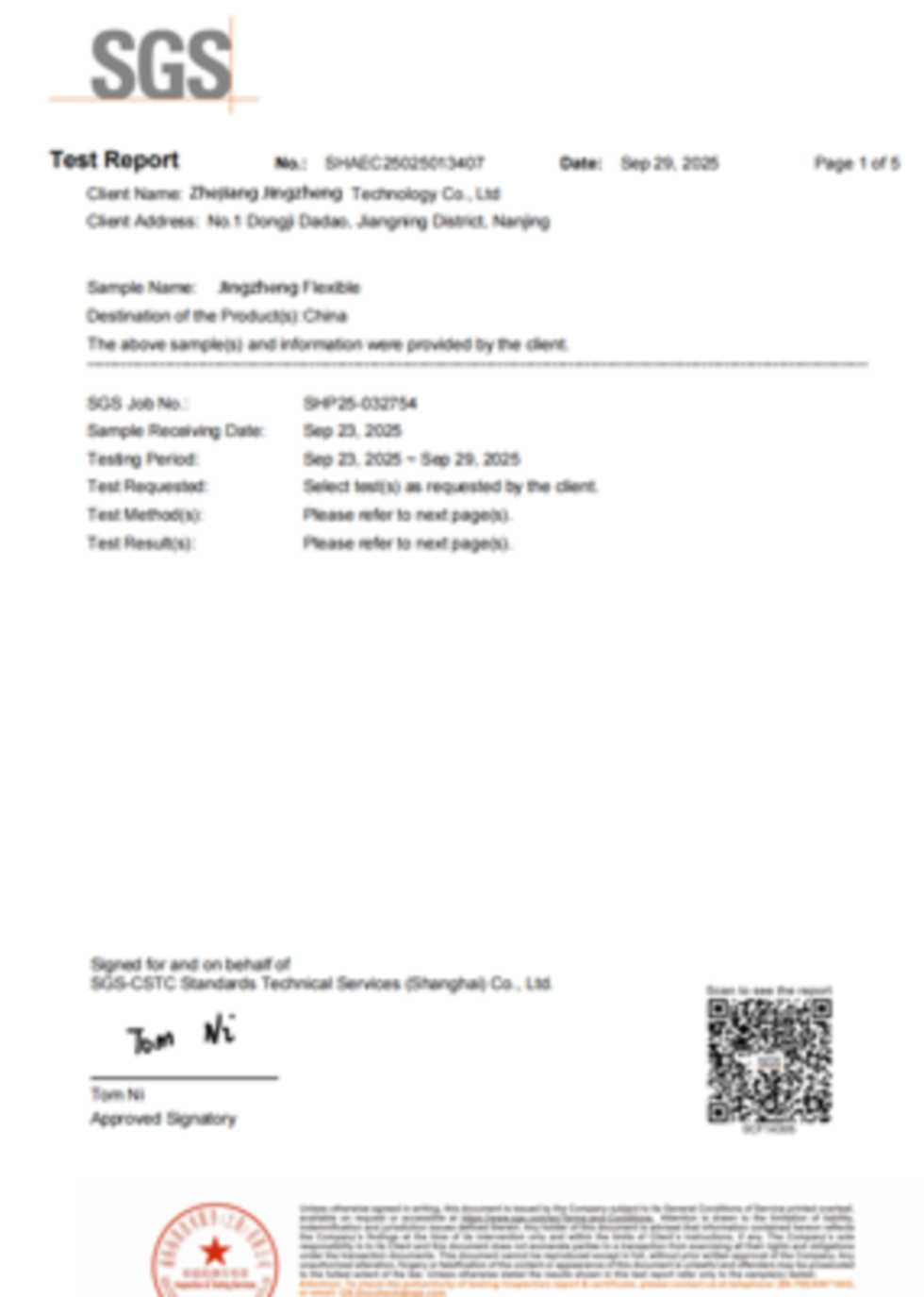
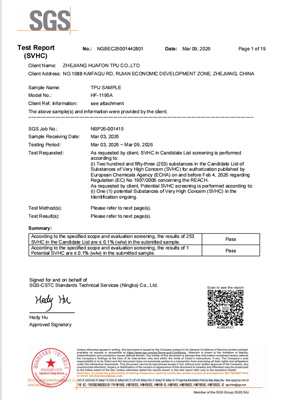
TPU, PTFE and silicone are controlled through polymer-specific documentation. Depending on the material and application, documentation can include raw-material batch information, Declaration of Conformity, Certificate of Analysis, safety or composition documentation and independent third-party migration or material test reports.
For food-contact configurations, the relevant regulatory statement and supporting test report are identified separately from the general commercial material description. This allows a purchaser or QA department to distinguish between raw-material traceability, food-contact compliance evidence and final product inspection.
7. Food-Contact and Regulatory Compliance
SOSHH treats a regulation, a test report, a Declaration of Conformity and a finished-product certification as different forms of evidence. A material test report is not presented as a universal certificate for every finished assembly or every process condition.
| Standard or Regulation | Application | Documentation Boundary |
|---|
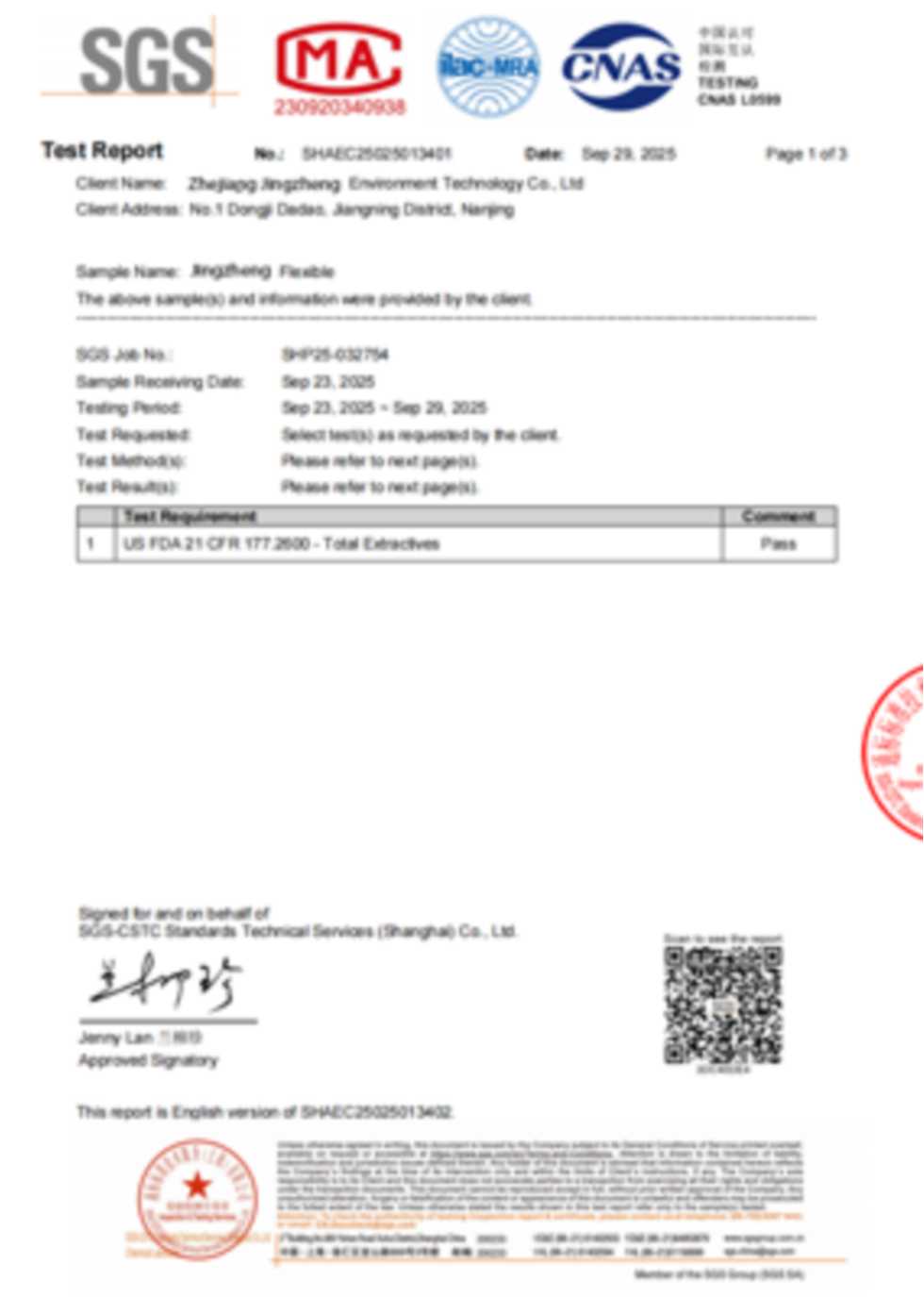
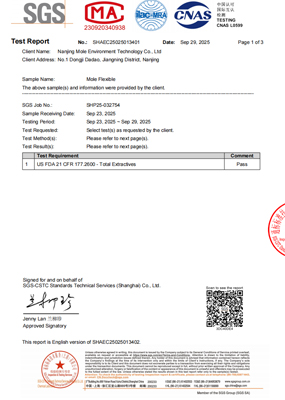
| FDA 21 CFR 177.2600 | Applicable repeated-use rubber or elastomeric food-contact articles | SOSHH food-contact TPU documentation is supported by independent third-party extraction testing, Report Ref. TQT4821B36E, where applicable |
| EC 1935/2004 | General EU food-contact framework | Applies according to the material and finished article scope |
| EU 10/2011 | Plastic materials and articles intended for food contact | Applies to qualifying plastic materials and articles within its scope |
| IEC 60079-32-2 | Electrostatic hazard test methods | Used for electrical property evaluation; it is not itself a blanket ATEX certificate |
| EN 10204 Type 3.1 | Inspection documentation primarily used for metallic products | Applied by SOSHH to qualifying stainless-steel components, with material and heat-number traceability where specified |
SOSHH's food-contact documentation uses the wording "compliant with the applicable requirements" together with the supporting report or declaration. The company does not use "FDA approved" as a blanket product statement, and the FDA reference is tied to the relevant material and test evidence.
For polyether TPU food-contact products, the applicable SOSHH documentation references FDA 21 CFR 177.2600 and independent extraction testing under Report Ref. TQT4821B36E where that material configuration is covered. European food-contact requirements are documented separately according to the applicable polymer and finished-product scope.
8. Electrostatic Control and Hazardous-Dust Applications
SOSHH PUAS flexible connectors use a static-dissipative polymer formulation with a surface resistance range of 10^6 to 10^9 ohm/sq under the applicable electrical test method. IEC 60079-32-2 provides standardized test methods for electrostatic properties including surface resistance and earth leakage resistance. The standard is a test framework for electrostatic hazard control and should not be represented as a standalone blanket ATEX certification.
For an installation in an ATEX classified area, the flexible connector is one component of the electrostatic-control system. Metallic spigots, process piping and associated equipment must remain properly bonded according to the plant grounding design. The final hazardous-area classification and conformity assessment depend on the complete installation and applicable requirements.
SOSHH therefore uses the engineering statement:
PUAS static-dissipative property tested according to IEC 60079-32-2; suitable for assessment within ATEX Zone 20, 21 or 22 applications according to the site hazardous-area classification.
9. Product Solutions by Process Requirement
| Process Requirement | SOSHH Engineering Direction | Primary Engineering Consideration |
|---|
| General food and powder transfer | PU10 polyether TPU snap-in connector | -30 to +85 deg C continuous; +110 deg C peak; 85 deg C CIP |
| Abrasive powder transfer | PU15 heavy-duty TPU | 1.5 mm wall; 39.0 mg DIN abrasion loss; +0.70 bar / -120 mbar |
| Static-dissipative powder handling | PUAS polyether TPU | 10^6 to 10^9 ohm/sq surface resistance |
| Continuous elevated temperature | PUHT | -20 to +150 deg C; separate evaluation for cleaning chemistry |
| Deep vacuum with metallic reinforcement permitted | PU10VR | External coiled-wire reinforcement; -1000 mbar |
| Vacuum with non-metallic reinforcement requirement | PU10VRNM | POM reinforcement; -500 mbar |
| Pharmaceutical or chemical high-temperature duty | Pure PTFE | -70 to +260 deg C continuous; +280 deg C peak |
| Low-stiffness weighing | PU05WB or application-specific bellows | Low parasitic reaction force |
| Repeated hot caustic cleaning | PU15CIP | Qualified for the specified 85 deg C CIP duty |
| FIBC bulk-bag filling | Inflatable FIBC loading seal | Pneumatic radial sealing and actual bag-neck qualification |
10. Connection Method and Application Engineering
SOSHH manufactures several connection architectures because connector selection depends on the equipment interface and maintenance method rather than on material alone.
| Connection Type | Engineering Principle |
|---|
| Manual clamp | Mechanical clamping around the connector end |
| Snap-in | Polymer retention system seated into an external pocket and mating spigot |
| Tri-Clamp | Sanitary ferrule connection with removable clamp |
| Flanged | Bolted connection for equipment interfaces requiring a flange |
| Hose clamp | Conventional clamped connection for hose-style interfaces |
| Inflatable FIBC | Pneumatic expansion around the FIBC neck or filling interface |
For snap-in products, the flexible sleeve, retention system and spigot geometry are specified together. For weighing applications, the connector geometry is evaluated according to movement and parasitic reaction force. For vacuum applications, reinforcement and pressure differential must be considered together with wall thickness and installed gap. For FIBC filling, bag-neck dimensions, liner construction, sealing engagement and filling-head movement become part of the engineering specification.
11. Custom OEM Manufacturing
Custom flexible connectors can be produced for equipment manufacturers requiring dimensions or geometries that are not available in a standard catalogue configuration. Typical projects include custom diameters, long-length sleeves, eccentric transitions, square-to-round hoppers, offset connections, weighing bellows, vacuum-reinforced connectors and equipment-specific connection geometries.
Custom fabrication is based on CNC cutting and HF welding of sheet or tube constructions where applicable. This avoids the need for an injection-mold tooling program for the flexible body in configurations that can be fabricated from flat sheet or tube.
Custom development normally follows this sequence: customer drawing or sample review, process-condition review, material selection, dimensional proposal, watermarked 2D drawing, customer approval, controlled production and final inspection. For OEM integration, STEP or IGES 3D models can be exchanged under a signed NDA or NNN agreement.
12. Quality Release and Inspection
Final product release is based on the approved drawing, material specification and applicable inspection requirements. Critical dimensional interfaces are inspected before shipment, with additional checks applied where the order requires pressure testing, material documentation, surface finish verification, electrical-property evidence or food-contact documentation.
The inspection system is designed to separate three questions that are frequently confused in industrial purchasing:
Does the material meet the specified material requirement?
Does the finished component meet the approved drawing?
Does the finished assembly have the documentation required for the customer's process and regulatory environment?
These are separate quality questions and are controlled separately.
13. Procurement Information and Standard Commercial Terms
| Item | SOSHH Policy |
|---|
| Engineering prototype MOQ | 1 piece |
| Standard production MOQ | Typically 5 pieces per SKU |
| Standard evaluation sample | Freight collect |
| Sample fee | Credited toward the first commercial purchase order exceeding 3000 USD |
| Custom flexible body tooling | No injection-mold tooling charge for CNC-cut and HF-welded flat-sheet constructions |
| Standard catalog sleeve lead time | Approximately 5 business days for standard DN100 to DN150 configurations |
| DN200 to DN250 lead time | Approximately 5 to 7 business days |
| Extended length above 1000 mm | Approximately 7 business days |
| 304 / 316L stainless-steel spigots | Approximately 7 to 10 business days |
| 2D drawing | Watermarked PDF drawing targeted within 1 business day of RFQ receipt |
| 3D CAD | STEP / IGES released under signed NDA or NNN |
| Engineering response | Within 1 business day |
| Engineering RFQ | amin@soshh.com |
Actual lead time depends on material availability, custom geometry, quantity, drawing approval and required documentation.
14. Frequently Asked Questions
Is SOSHH a manufacturer or a trading company?
SOSHH is the industrial flexible connector brand of Zhejiang Jingzhen Environmental Protection Technology Co., Ltd. Core processes including CNC cutting, HF welding, polyurethane sleeve fabrication, assembly and dimensional inspection are controlled within the Quzhou manufacturing operation. Specialized external processing is managed through controlled suppliers, while final quality release remains under SOSHH responsibility.
Where is SOSHH located?
The registered and works address is No. 82, Kengtou Village, Dazhou Town, Qujiang District, Quzhou City, Zhejiang Province, China.
Do you provide EN 10204 3.1 certificates?
EN 10204 Type 3.1 documentation is available for qualifying 304 and 316L stainless-steel components where specified. Heat-number and document traceability are maintained according to the applicable order and material documentation requirements. Polymer materials are documented through their applicable DoC, CoA and test-report system instead of being placed under one generic metallic certificate statement.
Are your flexible connectors FDA certified?
The FDA does not issue a general product certificate for finished elastomeric processing components. Where applicable, SOSHH food-contact TPU products are documented as compliant with FDA 21 CFR 177.2600 and supported by independent third-party extraction testing under Report Ref. TQT4821B36E and the applicable Declaration of Conformity.
Can you manufacture custom sizes and irregular shapes?
Yes. Custom flexible connectors can be produced in diameters from approximately 102 to 804 mm, including square-to-round transitions, eccentric connections, offset transitions and equipment-specific profiles. CNC cutting and HF welding can be used for flexible constructions that do not require injection-mold tooling.
What is your minimum order quantity?
The engineering prototype MOQ is 1 piece. Standard production batches typically start from 5 pieces per SKU.
What is your evaluation sample policy?
Standard evaluation samples ship freight collect. The sample fee is credited toward the first commercial purchase order exceeding 3000 USD.
Do you provide 2D drawings and 3D CAD?
Watermarked 2D PDF outline drawings are available for engineering review. STEP and IGES models are released for OEM equipment integration under the applicable signed NDA or NNN agreement.
What information is required for an engineering RFQ?
Provide the spigot seating OD at both ends, installation gap, required connector length, process media, continuous temperature, peak temperature where relevant, positive pressure, vacuum, dynamic stroke and any special requirements such as food contact, static dissipation, metal detection or CIP/SIP.
15. Compliance and Engineering Documentation
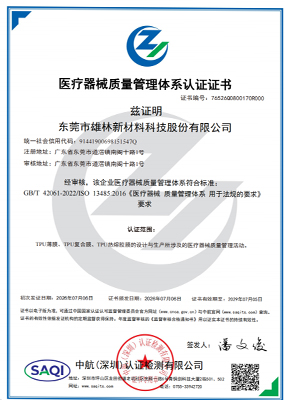
SOSHH maintains technical documentation for engineering and procurement review, including applicable food-contact evidence, anti-static material data, flexible connector sizing information, installation guidance, PTFE documentation and application-specific engineering material information.
Documentation is supplied according to the actual product configuration. A report applying to one polymer grade or one finished configuration should not be interpreted as automatically applying to a different material, reinforcement design or finished assembly.
For OEM and regulated applications, customers may request the applicable material documentation, dimensional drawing, inspection information and technical declarations as part of the quotation and engineering-review process.
16. Engineering RFQ
For a dimensional review, material recommendation, custom transition or OEM connector quotation, send the engineering information directly to:
amin@soshh.com
For the fastest review, include the spigot seating OD at both ends, static installation gap, dynamic stroke, connector length, process media, continuous temperature and pressure or vacuum conditions. Where the application is regulated or technically sensitive, also state the food-contact requirement, cleaning method, electrostatic requirement, metal-detection requirement and required material documentation.
A drawing, photograph or existing connector sample is useful for confirming the interface geometry.
SOSHH targets an engineering response within 1 business day after the required technical information is received. Watermarked 2D drawings can be provided for dimensional confirmation, while STEP or IGES 3D CAD files are exchanged under the applicable NDA or NNN agreement.
Partner with SOSHH Engineering
SOSHH supports standard replacement components as well as custom flexible connections for OEM powder-processing equipment. The engineering objective is to select the appropriate material and connection architecture from the actual process conditions, confirm the physical interface from the approved drawing and release a traceable finished component under the defined quality requirements.
Engineering Material, Dimension and OEM RFQ: amin@soshh.com