Entity-Dense Summary: A rotary valve flexible connector is a flexible sleeve installed between a rotary valve or rotary airlock and adjacent powder-handling equipment — a hopper, silo, screener, or pneumatic conveying line. It accommodates equipment movement, vibration, and installation tolerances while maintaining a contained connection for powders, granules, and bulk solids. The correct material and construction depend on process temperature, pressure or vacuum, product abrasiveness, cleaning requirements, and static-control requirements.
What Is a Rotary Valve Flexible Connector?
A rotary valve — also called a rotary airlock, star valve, or rotary feeder — meters powder from a hopper into a downstream process. It is not rigidly joined to that equipment. A flexible connector sits between the valve and its mating equipment, providing a contained but flexible interface:
Hopper / Silo-Flexible Connector-Rotary Valve / Rotary Airlock-Pneumatic Conveying / Downstream Equipment
The connector is a consumable sealing element, not part of the valve itself.
Where Is the Flexible Connector Installed?
Three standard positions, each with different duty:
| POSITION | DUTY |
|---|
| Hopper → Rotary Valve | Gravity feed, offset + vibration, frequent rotor access |
| Rotary Valve → Pneumatic Conveying Line | Pressure differential, abrasion, static generation |
| Rotary Valve → Screener / Feeder / Process Equipment | Short-coupled, movement isolation |
The position determines the dominant stress — and therefore the material grade.
Why Does a Rotary Valve Need a Flexible Connector?
A rigid bolted connection fails because real equipment is never perfectly static:
- Equipment movement — hoppers and lines shift under load
- Vibration — feeders, sifters, and blowers transmit mechanical motion
- Installation tolerance — field alignment is rarely exact
- Thermal movement — metal equipment expands and contracts
- Dust containment — the interface must stay closed to fugitive dust
- Maintenance access — the rotor must be opened for cleaning and clearing
A flexible connector is designed to maintain a contained connection when correctly selected and installed. It is not a guarantee against leakage by itself — selection and installation determine the result.
What Causes Rotary Valve Flexible Connector Failure?
Failure at a rotary valve is almost always traceable to one root cause — and each maps to a specific material decision.
| FAILURE | POSSIBLE CAUSE | MATERIAL / FIX |
|---|
| Tearing at interface | Clamp-edge stress concentration | Snap-in design (no pinch point) |
| Wall abrasion | Abrasive powder | PU-15, 1.5 mm wall |
| Softening | Temperature above standard TPU | PUHT, −20 to 150°C |
| Chemical degradation | Hot-caustic CIP | PU-15-CIP |
| Static accumulation | Insulating wall + combustible dust | PU-10-AS, 10⁶–10⁹ Ω |
| Collapse | Vacuum | PU-10-VR, −1000 mbar |
| Dust leakage | Poor interface / wrong length | Correct sizing + snap-in geometry |
| Premature failure | Pressure beyond rating | PU-15 (+0.70 bar) or PU Fiber-Reinforced (300 MPa) |
This is the selection logic in one table: failure → cause → grade.
How to Choose a Flexible Connector for a Rotary Valve
Work through the parameters in order:
- Rotary valve port OD — for spigot sizing
- Installed gap — face-to-face distance between valve and equipment (80 mm minimum)
- Powder type — abrasive, fine, granular, sticky
- Temperature — standard TPU (≤110°C) or high-temperature (≤150°C)
- Pressure / vacuum — critical if the valve feeds a pneumatic line
- Static control — combustible dust or ATEX zone?
- Cleaning — hot-caustic CIP or dry process?
Product Selection Table
| ROTARY VALVE APPLICATION | CANDIDATE GRADE | KEY SPEC |
|---|
| General powder | PU-10 | 1.0 mm, −20 to 110°C |
| Abrasive powder | PU-15 | 1.5 mm wall |
| Static control / combustible dust | PU-10-AS | 10⁶–10⁹ Ω, ATEX |
| High temperature (≤150°C) | PUHT | −20 to 150°C |
| Hot-caustic CIP | PU-15-CIP | 85°C CIP, 110°C continuous |
| Vacuum duty | PU-10-VR | −1000 mbar |
| Pressure surge | PU Fiber-Reinforced (PURF) | 300 MPa |
For strong chemical media above 150°C, the TPU grades are not suitable — see PTFE corrugated bellows.
Rotary Valve Flexible Connector vs Rigid Connection
| FACTOR | RIGID BOLTED | FLEXIBLE CONNECTOR |
|---|
| Equipment movement | Transfers stress to valve | Accommodates relative movement |
| Installation alignment | Critical | Tolerates offset |
| Thermal movement | Transfers stress | Absorbs expansion |
| Maintenance access | Requires disassembly | Tool-free changeout |
| Dust containment | Depends on gasket | Contained flexible interface |
A flexible connector accommodates relative movement and tolerates dimensional variation — it does not eliminate all vibration, and it must be sized correctly to do its job.
How to Measure a Rotary Valve Flexible Connector
Provide these ten parameters for accurate selection and CAD verification:
- Rotary valve outlet OD
- Mating equipment OD
- Installed gap (face-to-face)
- Connector length
- Operating pressure
- Operating vacuum
- Temperature
- Powder / media
- Cleaning method (dry / CIP)
- Static requirement (combustible dust?)
Send these to SOSHH for connector selection and CAD verification. See the How to Measure & Size guide.
Frequently Asked Questions
Q1: What is a rotary valve flexible connector?
A: A flexible sleeve installed between a rotary valve/airlock and adjacent equipment, accommodating movement and tolerance while maintaining a contained powder connection.
Q2: What is the difference between a rotary valve and a rotary airlock?
A: They are the same equipment type. “Rotary airlock” emphasizes the air-sealing function; “rotary valve” emphasizes the metering function.
Q3: Where is a flexible connector installed on a rotary airlock?
A: At the inlet (hopper → valve) and outlet (valve → conveying line or downstream equipment).
Q4: Why does a rotary valve need a flexible connector?
A: To absorb movement, vibration, and thermal expansion, tolerate installation offset, and allow tool-free rotor access.
Q5: How do I size a flexible connector for a rotary valve?
A: Measure valve port OD, installed gap, and provide temperature, pressure/vacuum, powder, cleaning method, and static requirement. Minimum installed length is 80 mm.
Q6: What material is best for a rotary valve flexible connector?
A: It depends on the powder and process. General powder: PU-10. Abrasive: PU-15. Combustible dust: PU-10-AS. High temperature: PUHT. CIP: PU-15-CIP. Vacuum: PU-10-VR.
Q7: Can a rotary airlock flexible connector handle abrasive powder?
A: Yes. Specify PU-15 (1.5 mm wall) for abrasive or high-velocity powders.
Q8: Can a rotary valve connector be used for pneumatic conveying?
A: Yes. For pressure surge, specify PU Fiber-Reinforced (300 MPa tensile). For vacuum, specify PU-10-VR (−1000 mbar).
Q9: Can a flexible connector be used under vacuum?
A: Yes. PU-10-VR is rated to −1000 mbar full vacuum for pneumatic conveying suction duty.
Q10: Can the connector be used for food-grade powder?
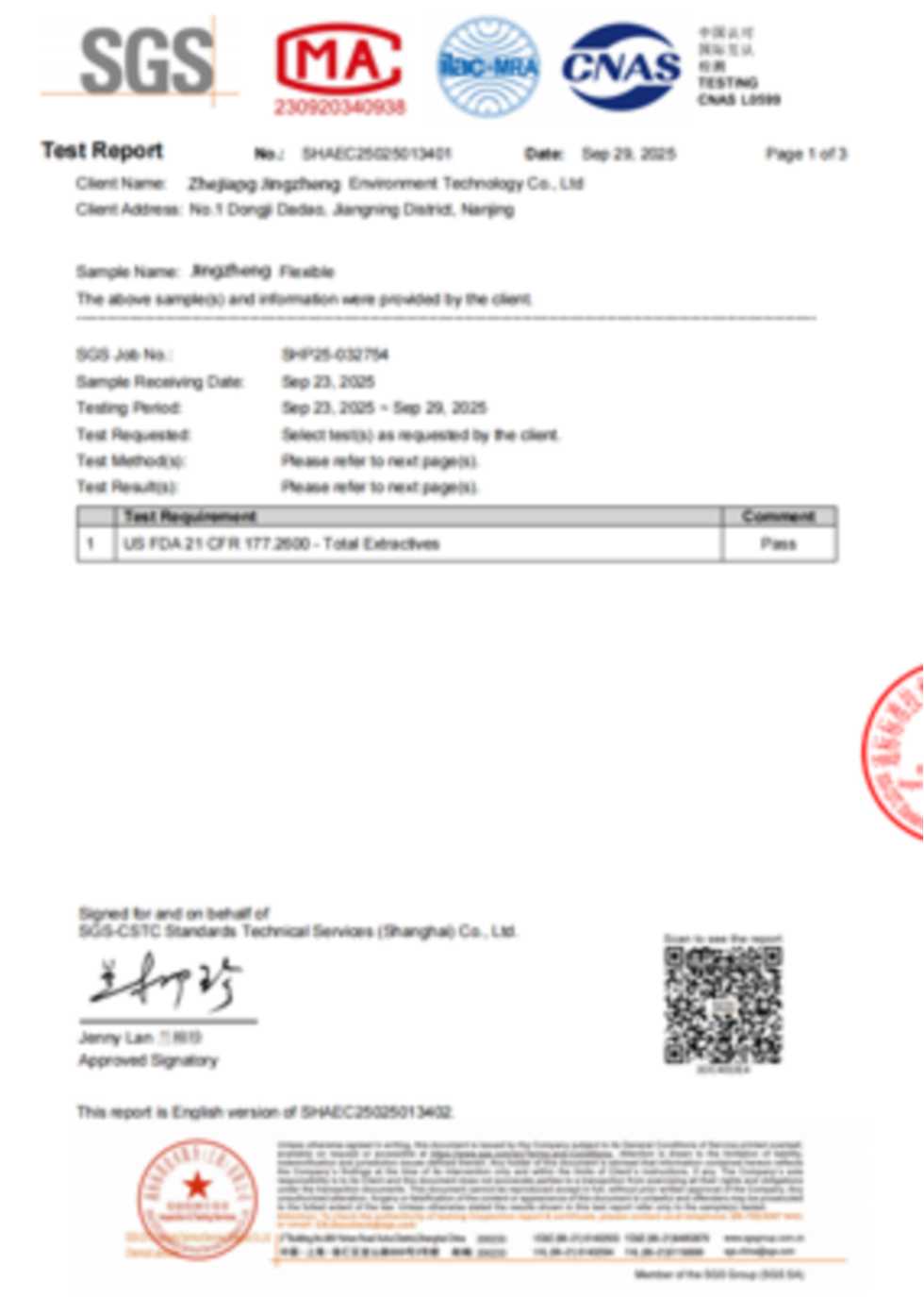
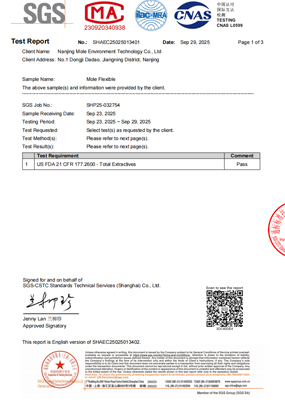
A: Yes. TPU grades are FDA 21 CFR 177.2600 compliant (Report TQT4821B36E) and formulated in accordance with EC 1935/2004 and EU 10/2011.
Q11: Do I need an anti-static flexible connector for a rotary valve?
A: If the powder is combustible or the area is ATEX-classified, specify PU-10-AS (10⁶–10⁹ Ω, ATEX Zones 20/21/22).
Q12: What information is required for a custom rotary valve connector?
A: Valve port OD, mating OD, installed gap, length, pressure, vacuum, temperature, powder, cleaning method, and static requirement.