





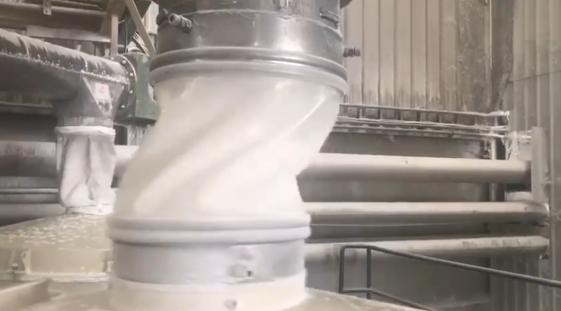
Flexible Connectors for Vibrating Sifters: The Ultimate Guide to Preventing Dust Explosions and Material Leakage
1. Why Standard Connectors Fail in Vibrating Applications
Vibrating sifters generate high-frequency oscillations. Standard rubber or cheap PVC sleeves are not engineered for this dynamic stress. Over time, they fail in three predictable ways:
- Material fatigue: micro-cracks form in the sleeve wall, creating leaks.
- Dust cloud formation: leakage turns into suspended dust, which — combined with an ignition source — becomes the fuel for a catastrophic explosion.
- Static accumulation: non-dissipative materials act as insulators, accumulating dangerous levels of electrostatic charge.
The connection point is not a passive spare part — it is the first line of defence against both leakage and ignition.
2. The Critical Selection Criteria for ATEX Environments
If your sifter operates in an ATEX-rated zone (Zone 20, 21 or 22), the connector must satisfy three criteria simultaneously.
A. Static Dissipation — Not “Conductivity”
The correct specification for combustible-dust duty is static-dissipative, not conductive:
| PROPERTY | CONDUCTIVE | STATIC-DISSIPATIVE (CORRECT) |
|---|---|---|
| Surface resistivity | < 10⁴ Ω | 10⁶–10⁹ Ω |
| Discharge behaviour | Abrupt, can spark | Gradual, safe |
| ATEX suitability | Not recommended | Required |
SOSHH specifies PU-10-AS — inherently static-dissipative polyether TPU with 10⁶–10⁹ Ω surface resistivity and volume resistivity of 4.02×10⁷ Ω tested per IEC 62631-3-1:2023 (SGS Report SHMR240801578301-1). Charge dissipates through the material itself — no internal wires, no surface coating that wears off, no grounding strap across the joint.
B. Mechanical Flexibility and Fatigue Resistance
The material must flex without forming micro-fissures. Polyether TPU delivers ~600% elongation at break and 40 MPa tensile strength, absorbing high-frequency flex without cracking — the root cause of dust escape.
C. Verifiable Compliance Standards
Always verify the supplier provides real report numbers, not vague claims:
- ATEX: engineered for Directive 2014/34/EU, Zones 20/21/22 (IEC 60079-32-2)
- Food contact: FDA 21 CFR 177.2600 (Report TQT4821B36E), EU 10/2011, EC 1935/2004
- Spigots: EN 10204 3.1 material test certificate with every order
3. Soshh.com: Engineering Safety into Your Sifter
SOSHH provides explosion-mitigation solutions, not generic boots. The engineering difference:
- Zero-leakage seals: the HF-welded cuff is formed slightly undersized and snaps over a tapered stainless spigot to create a 360° radial compression seal — no clamps, no drilled holes, no torque settings.
- Permanent anti-static properties: the dissipative grade is built into the material itself (10⁶–10⁹ Ω), not a surface coating that wears off after heavy use.
- Abrasion resistance: 39.0 mg DIN abrasion against abrasive powders like flour, sugar, starch or chemical additives.
4. Material & Grade Selection Table
| SIFTER DUTY | RECOMMENDED GRADE | KEY PROPERTIES |
|---|---|---|
| Food / dairy / general powder | PU-10 | 1.0 mm wall, 40 MPa, Shore A 90, −20 to +110 °C |
| Abrasive powder (starch, minerals) | PU-15 | 1.5 mm wall, +0.70 bar / −120 mbar |
| Combustible dust / ATEX | PU-10-AS | 10⁶–10⁹ Ω, IEC 62631-3-1 tested |
| Full vacuum discharge | PU-10-VR | Polymer rings, −1000 mbar |
| Hot caustic CIP | CIP-grade TPU | Hydrolysis-resistant, 85 °C CIP |
5. Maintenance Checklist for ATEX Compliance
Perform these checks quarterly:
- Visual inspection: look for surface hardening, micro-cracking or loss of transparency at each screen change.
- Installation gap: set IG with 10–15% extra slack for vibratory service, so the sleeve never runs in tension at full amplitude.
- Cuff condition: the snap-in cuff is the seal — if it becomes loose or deformed, replace the sleeve. Tool-free replacement takes under 60 seconds.
- No over-tightening: the snap-in design removes clamps and torque settings entirely, eliminating stress concentration at the cuff.
6. Request Engineering Review
Is your sifter leaking or building static? Send us your screen outlet diameter, installation gap, g-force/frequency, powder type and temperature — we’ll confirm the correct sleeve + spigot configuration and return a watermarked 2D approval drawing within 24 hours.
1-piece prototype testing is available, with 100% of the sample fee credited toward your first bulk order exceeding $3,000.