





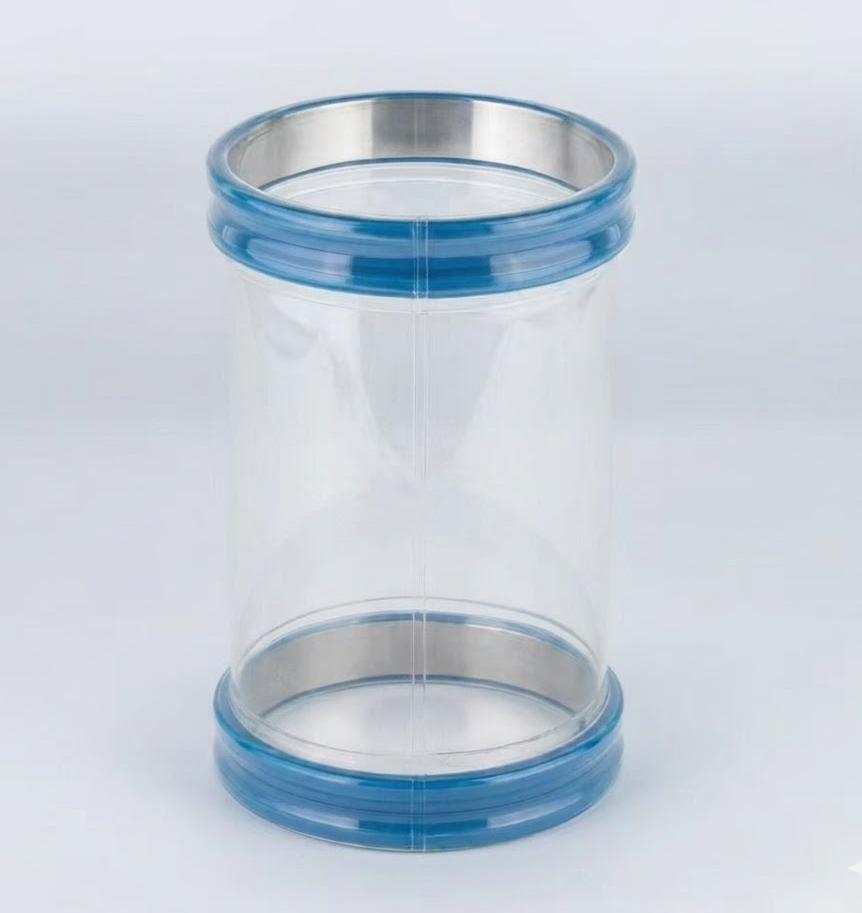
How to Select a High-Temperature Flexible Connector for Powder Handling
Specify the lowest-cost material that safely covers your continuous process temperature, cleaning temperature, chemical exposure, pressure/vacuum, mechanical movement, and static requirements.
Quick Material Selection
| Material | Temperature Range | Best Starting Point | Important Limitation |
|---|---|---|---|
| Standard Polyether TPU | −30 to +85 °C continuous (peak +110 °C; 85 °C CIP capable) | General powder handling below the high-temperature threshold | Not the first choice for sustained service above its validated range |
| PUHT High-Temperature Polyether TPU | −20 to +150 °C continuous | Hot powder, heated conveying, warm-air and drying lines | Pressure rating is construction-specific |
| Platinum-Cured Silicone | −50 to +200 °C (121 °C SIP) | Hot air, drying, weighing and applications requiring high flexibility | Chemical compatibility must be checked case by case |
| Virgin PTFE | −70 to +260 °C (peak +280 °C) | Extreme temperature, aggressive chemicals, SIP and demanding chemical service | Higher material and fabrication cost; pressure/movement must be engineered |
| Reinforced TPU / Vacuum-Reinforced TPU | Within TPU temperature limits | Vacuum, pressure surges or mechanical stability requirements | Reinforcement changes flexibility and must be matched to the application |
SOSHH’s material guide also distinguishes grades for anti-static service, abrasion, vacuum, reinforced pressure duty, and weighing. Temperature is one selection axis, not the entire specification.
1. Start With the Real Temperature — Not One Number
Before selecting a flexible connector, record at least three temperatures:
Process temperature — the normal operating temperature of the powder, granules, gas, or air actually contacting the connector.
Maximum process temperature — the highest temperature reached during start-up, shutdown, upset condition, thermal cycle, or batch change.
Cleaning temperature — the temperature the connector experiences during CIP, hot washdown, steam cleaning, or other sanitation procedures.
These temperatures can be very different. A powder line may operate continuously at 120 °C but experience a separate cleaning cycle at a different temperature. A connector that survives the production condition may still fail because of the cleaning cycle. The reverse can also happen: a short temperature spike should not be treated as the continuous operating rating.
For every RFQ, distinguish:
| Parameter | What to provide |
|---|---|
| Continuous process temperature | Normal operating value |
| Maximum process temperature | Highest expected temperature |
| Cleaning temperature | CIP, washdown or SIP condition |
| Exposure duration | Continuous, intermittent or cycle-based |
| Temperature ramp | How quickly temperature rises or falls |
A temperature rating is only meaningful when the exposure time and operating condition are known.
2. Process Temperature and Cleaning Temperature Are Different Design Loads
A common specification mistake is: “My process is 120 °C, so I only need a connector rated to 120 °C.” That is incomplete.
You also need to ask:
- Does the connector see the full process temperature continuously?
- Does hot powder stay in contact with the flexible wall?
- Does hot air heat the connector from inside?
- Does the connector experience hot washdown?
- Does the cleaning chemical change material compatibility?
- Does steam enter the connector directly?
- Is the connector removed before cleaning?
For food and pharmaceutical equipment, sanitary design and cleanability are separate engineering considerations. EHEDG specifically treats flexible connections and dry-material handling as part of hygienic equipment design, while 3-A SSI establishes criteria for sanitary design, fabrication, installation and cleanability in food and dairy equipment.
CIP vs. SIP
CIP — Clean-in-Place: The connector remains installed while the line is cleaned. Verify the actual chemical concentration, temperature, exposure time and flow conditions.
SIP — Steam-in-Place: The connector is exposed to steam or a steam sterilization cycle. Do not infer SIP suitability simply from a high dry-temperature rating. For demanding repeated steam exposure, SOSHH identifies virgin PTFE bellows as compatible with 121 °C live-steam SIP. Silicone should only be selected for a specific SIP cycle when the actual silicone formulation and finished construction have been validated for that duty.
3. When to Choose PUHT High-Temperature TPU
Choose PUHT when your process is hotter than the standard TPU operating window but remains within the high-temperature TPU range.
SOSHH currently publishes PUHT at −20 to +150 °C continuous service. The PUHT product page positions this grade for heated conveying, hot powder discharge and hot-air applications where standard TPU reaches its thermal limit. It is a high-temperature polyether TPU construction with food-contact documentation for the grade.
Typical PUHT applications
- Hot powder transfer
- Heated conveying lines
- Warm-air conveying
- Drying equipment
- Powder discharge from heated equipment
- Process lines operating continuously between approximately 110 and 150 °C
- Applications where flexibility is still important but standard TPU is thermally limited
Why PUHT is preferable to automatically specifying PTFE
If the application is within the validated PUHT envelope, PTFE may be technically unnecessary. PUHT preserves the flexible TPU-style architecture while extending the continuous operating temperature compared with standard TPU. The result can be a simpler and more economical solution when chemical resistance and extreme-temperature performance are not required.
Important PUHT limitation
Do not use the +150 °C figure as a universal pressure rating. Pressure capability depends on sleeve geometry, wall thickness, reinforcement, diameter, installed length and temperature. The pressure specification must be confirmed against the exact part rather than inferred from the material temperature limit.
Link: PUHT High-Temperature Connector → https://www.soshh.com/products/pu-high-temp-flexible-connector
4. When to Choose Virgin PTFE
Choose virgin PTFE when the application crosses the limits of TPU or when chemical resistance becomes a primary design requirement.
SOSHH’s material guide lists virgin PTFE bellows at −70 to +260 °C continuous (peak +280 °C). The heavy-duty PTFE bellows product page identifies full-vacuum capability and engineered pressure ratings for its specific machined construction. PTFE is positioned for extreme temperatures, aggressive chemical service, pharmaceutical applications and demanding process conditions.
PTFE is the preferred starting point when:
- Continuous process temperature exceeds the practical range of PUHT
- Strong acids or bases are present
- Aggressive solvents are present
- The application combines high temperature and chemical exposure
- Repeated steam sterilization is required and the exact PTFE construction is validated
- Deep vacuum requires a more engineered bellows construction
- The line requires a custom large-bore or non-standard bellows geometry
PTFE and chemical resistance
PTFE has broad chemical resistance, but “chemically resistant” should never be interpreted as “compatible with every chemical under every condition.” Chemical compatibility should be checked against chemical identity, concentration, temperature, exposure duration, pressure, permeation requirements, mechanical stress, and cleaning agents. For a production RFQ, provide the exact chemical name rather than simply writing “corrosive chemical.”
PTFE pressure performance is construction-specific
PTFE bellows are highly temperature resistant, but pressure behavior is strongly dependent on geometry and temperature. Pressure capability changes with temperature, and creep must be considered in long-term high-temperature service. Some designs add reinforcement, sleeves, rings or armored construction to increase pressure stability.
Therefore: never select a PTFE bellows from the temperature rating alone. Specify temperature, pressure, vacuum, diameter, movement and connection geometry together.
PTFE Corrugated Bellows
5. When to Choose Platinum-Cured Silicone
Choose platinum-cured silicone when high flexibility, hot-air service, drying duty or low mechanical reaction force is more important than abrasion or aggressive chemical resistance.
SOSHH’s material guide lists platinum-cured silicone at −50 to +200 °C (121 °C SIP). The silicone weighing connector is specifically positioned for loss-in-weight feeders, load-cell hoppers and precision dosing applications.
Typical silicone applications
- Hot-air handling
- Drying systems and drying ovens
- Food and pharmaceutical weighing
- Low-reaction-force flexible connections
- Applications where the connector must remain highly compliant
- Non-abrasive powder handling at elevated temperature
Silicone is especially useful around weighing systems
In a gravimetric feeder, a connector that is too stiff can become a mechanical spring. That spring force can introduce parasitic force into a load-cell system and influence the measured weight. SOSHH’s silicone weighing connector is designed around this problem, using a thin flexible section and thicker connection cuffs.
Do not select silicone based on temperature alone
Silicone offers a broad temperature window, but abrasion, chemical exposure, static control, vacuum and connection mechanics may make another material more appropriate. For aggressive chemical solvents, PTFE should normally be evaluated first.
Also note that a platinum-cured silicone process connector and a silicone-coated fiberglass fabric duct connector are different constructions. Their published temperature limits should never be substituted for one another. The silicone duct product is a fabric-reinforced construction for industrial fans, blowers and ducting — a different engineering application from a food-contact silicone process sleeve.
Silicone Duct Flexible Connector
6. The Selection Decision Tree
Use this sequence instead of choosing the highest-temperature material by default.
Step 1 — Is continuous temperature above the standard TPU range?
No: start with standard TPU. Yes but within +150 °C: evaluate PUHT. Above +150 °C: evaluate PTFE or another qualified high-temperature construction.
Step 2 — Are aggressive chemicals present?
Yes: evaluate PTFE first. No: continue.
Step 3 — Is the connector exposed to SIP or repeated steam?
Yes: evaluate PTFE or a silicone formulation specifically validated for the complete SIP cycle.
Step 4 — Is full vacuum or substantial pressure present?
Yes: select based on the actual pressure/vacuum requirement. A high-temperature material without the required reinforcement is not automatically suitable.
Step 5 — Is the powder combustible or electrostatically sensitive?
Yes: evaluate a static-dissipative grade and the complete grounding/bonding arrangement.
Step 6 — Is the application abrasive?
Yes: increase wall thickness or select an abrasion-oriented construction (such as PU15 with a 1.5 mm wall).
Step 7 — Is the equipment weighing-sensitive?
Yes: minimize mechanical reaction force. Consider thin-wall or bellows-type constructions engineered specifically for weighing duty.
7. High Temperature Changes More Than Material Strength
Temperature can change the mechanical behavior of a flexible connector. As the material becomes softer, radial sealing behavior, clamp retention, flexibility, creep, pressure capability, vacuum resistance, fatigue behavior, and dimensional stability can all change.
This is why pressure and temperature should always be specified together. A connector that works well at room temperature under a particular pressure differential cannot automatically be assumed to have the same pressure capability at 150 °C.
The correct question is not “what is the material temperature rating?” It is “what is the allowable operating envelope of this exact connector at my actual temperature and pressure/vacuum?”
8. Temperature Is Only One Side of Thermal Expansion
High-temperature equipment frequently creates relative movement between rigid components. A hot process may cause hopper expansion, duct expansion, frame movement, differential expansion between stainless-steel components, and movement around dryers, fans or blowers. Flexible connectors are commonly used to accommodate thermal expansion, vibration and alignment changes between connected equipment.
The connector must have enough installed length and movement capacity to operate without being permanently stretched, compressed beyond its design range, twisted, or forced against a clamp edge.
Measure both static and dynamic dimensions
For a vibrating or moving application, provide static installed gap, maximum compressed length, maximum extended length, lateral movement, angular movement, dynamic stroke or amplitude, and frequency where relevant. A connector that fits when the machine is stationary may still fail when the machine starts moving.
9. Pressure and Vacuum Require Their Own Selection
A high-temperature flexible connector is not automatically a pressure connector.
Positive pressure tends to push the flexible wall outward. Excessive pressure can create ballooning, loss of dimensional stability, excess strain, cuff retention problems, and premature fatigue.
Vacuum tends to pull the flexible wall inward. Excessive vacuum can cause collapse, reduced flow area, powder restriction, localized wall deformation, and fatigue under repeated vacuum cycles.
SOSHH’s material portfolio includes reinforced and vacuum-reinforced grades because pressure/vacuum is a separate engineering requirement from temperature. For severe vacuum duty, specify the actual vacuum level in mbar, kPa or inHg, not simply “vacuum.” For pressure duty, specify the actual operating pressure and whether the system experiences pressure spikes.
10. Static Control Can Be More Important Than Temperature
Combustible powders can create electrostatic charge during conveying, mixing and handling. OSHA specifically identifies dry powder handling as a situation in which static electricity can accumulate and recommends grounding and bonding precautions where combustible-dust hazards are present.
SOSHH’s PUAS grade is a static-dissipative polyether TPU with a surface-resistance range of 10⁶–10⁹ Ω/sq tested to IEC 60079-32-2. ATEX suitability must be evaluated against the site hazardous-area assessment.
A connector specification for combustible dust should contain both a material requirement (static-dissipative connector material) and a system requirement (correct grounding/bonding of the complete installation). A dissipative sleeve does not remove the need for a properly engineered grounding system.
11. Chemical Exposure Should Be Specified by Name
“Food chemical,” “solvent,” or “corrosive” is not enough information for material selection. Provide the actual chemical whenever possible — ethanol, isopropyl alcohol, acetone, NMP, sodium hydroxide, nitric acid, sulfuric acid, cleaning detergent, sanitizer, process additive, or API solvent mixture — together with concentration, temperature, and exposure duration. A material that is compatible at room temperature may behave differently under hot continuous exposure.
PTFE is generally the strongest candidate in the SOSHH range for aggressive chemical service, but chemical compatibility should still be confirmed for the exact process conditions.
12. Connection Type Is Independent of Temperature
The material handles the environment. The connection handles the installation geometry.
A high-temperature application may still require SF internal snap-in, TC quick-clamp, LightTC, FLC round flange, FLR square/rectangular flange, HC hose clamp, custom transition, or PTFE bellows with flanged ends. Choose the connection based on existing equipment, available installation space, maintenance frequency, changeover speed, movement, hygiene, accessibility, pressure/vacuum, and product-contact requirements — not from temperature alone.
13. High-Temperature Applications That Commonly Need Custom Geometry
High-temperature process equipment is often less standardized than ordinary conveying equipment. Custom connectors may be required for dryer outlets, rotary valves, vibratory screens, fluid-bed dryers, spray dryers, hot-air ducts, powder hoppers, heating systems, offset equipment, rectangular-to-round transitions, conical transitions, short-clearance installations, and large-diameter equipment.
SOSHH’s custom connector program supports non-standard transitions including square-to-round and offset geometries.
Standard Size Database
Custom Non-Standard Transitions
14. Common High-Temperature Selection Mistakes
Mistake 1: Choosing by maximum temperature alone. A 260 °C material is not automatically the best choice for a 120 °C process. You still need to check pressure, movement, abrasion, chemical exposure and cleaning.
Mistake 2: Treating peak temperature as continuous temperature. A material may survive a short excursion without being suitable for continuous operation. Specify duration and frequency for every thermal peak.
Mistake 3: Ignoring cleaning temperature. The production temperature may be acceptable while the cleaning cycle causes premature degradation.
Mistake 4: Assuming silicone is automatically suitable for steam. A high dry-temperature rating does not automatically establish suitability for repeated SIP.
Mistake 5: Assuming PTFE is automatically suitable for pressure. PTFE has excellent chemical and temperature resistance, but pressure capability is construction- and temperature-dependent.
Mistake 6: Using a standard sleeve in a full-vacuum application. Vacuum collapse is a mechanical problem. Temperature rating does not solve it.
Mistake 7: Ignoring vibration. A connector can have sufficient static dimensions yet fail under continuous cyclic movement.
Mistake 8: Ignoring static control. For combustible dust, material selection and grounding must be considered together.
Mistake 9: Assuming food-contact compliance is the same as FDA certification. FDA food-contact status is formulation-, regulation- and finished-article-specific. For example, 21 CFR 177.2600 addresses rubber articles intended for repeated use and specifies conditions for their use. A supplier’s material or extraction report should therefore be checked for the exact finished configuration. SOSHH’s TPU grades carry third-party 21 CFR 177.2600 extraction-test documentation (Report Ref: TQT4821B36E), but the exact report and configuration should be confirmed during procurement.
15. High-Temperature Connector Selection Examples
Example A — 80 °C powder transfer. Process 80 °C, standard washdown, low pressure, no chemicals, no combustible-dust requirement. Starting point: standard polyether TPU. There is no reason to jump directly to PTFE simply because the application involves elevated temperature.
Example B — 125 °C hot powder. Process 125 °C continuous, controlled washdown, low pressure, no chemicals. Starting point: PUHT.
Example C — 145 °C drying line. Process 145 °C continuous, dry powder plus hot air, moderate pressure, low-to-moderate movement. Starting point: PUHT, subject to confirmation of the pressure and movement envelope.
Example D — 180 °C hot-air connection. Process 180 °C, hot air, minimal chemicals, high flexibility required. Starting point: platinum-cured silicone, subject to verification of the exact construction.
Example E — 180 °C plus aggressive solvent. Process 180 °C, strong solvent, moderate pressure. Starting point: PTFE. The chemical requirement has become the dominant selection factor.
Example F — 120 °C plus full vacuum. Process 120 °C, full vacuum, low movement. Starting point: do not select a material solely from the temperature. Evaluate a reinforced or vacuum-rated construction whose pressure-vacuum rating is valid at the actual operating temperature.
16. How to Size the Connector Correctly
Temperature selection comes first, but correct geometry is equally important.
For a typical flexible connector RFQ, provide spigot seating OD at each end, installed gap, process media, particle characteristics, continuous temperature, maximum temperature, cleaning temperature and method, positive pressure, vacuum level, dynamic stroke or movement, connection type, and required quantity. Measure the spigot seating dimensions and installation gap rather than guessing from nominal pipe size.
How to Measure & Size
17. What SOSHH Needs for a High-Temperature Quote
A high-quality RFQ should contain enough data to select the material and geometry on the first review.
| Input | Example |
|---|---|
| Connector location | Dryer outlet to rotary valve |
| Media | Milk powder / starch / resin / API |
| Continuous temperature | 135 °C |
| Maximum temperature | 145 °C |
| Cleaning | Hot washdown / CIP / SIP |
| Pressure | +0.2 bar |
| Vacuum | −100 mbar |
| Spigot OD | 204 mm |
| Installed gap | 300 mm |
| Dynamic movement | ±15 mm |
| Connection | Snap-in / clamp / flange |
| Quantity | 12 pcs |
For unusual geometries, a drawing, photograph, or old connector sample can significantly improve the engineering review.
18. Frequently Asked Questions
What is the best material for a high-temperature flexible connector?
There is no universal best material. The correct choice depends on temperature, cleaning, pressure/vacuum, chemistry, movement, abrasion and static requirements. For SOSHH material guidance, PUHT covers up to +150 °C continuous, platinum-cured silicone is listed up to +200 °C, and virgin PTFE is listed up to +260 °C.
What temperature can PUHT handle?
SOSHH currently lists PUHT at −20 to +150 °C continuous service. The pressure and vacuum capability must be checked separately for the exact connector construction.
When should I choose PTFE instead of PUHT?
Choose PTFE when the process exceeds the PUHT operating envelope or when aggressive chemical exposure, extreme thermal conditions, demanding vacuum duty or specific sterilization requirements make PTFE the safer engineering choice.
Can PTFE handle both high temperature and chemicals?
PTFE is widely used where high temperature and aggressive chemical exposure occur together. However, the exact chemical, concentration, temperature and exposure time should still be reviewed before final material approval.
Can silicone be used at 180 °C?
SOSHH’s material guide lists platinum-cured silicone at −50 to +200 °C (121 °C SIP). Whether it is suitable for a particular process also depends on pressure, vacuum, abrasion, chemical exposure, movement and connector construction.
Can I use a silicone connector for SIP?
Do not assume that a general silicone temperature rating equals validated SIP capability. For repeated steam sterilization, specify the sterilization temperature, pressure, duration and cycle frequency and confirm the exact formulation and finished construction. SOSHH identifies its PTFE bellows as compatible with 121 °C live-steam SIP.
Does high temperature reduce pressure capability?
Potentially, yes. The permissible pressure of a flexible connector is tied to material behavior, geometry, reinforcement, diameter and temperature. PTFE bellows engineering literature identifies temperature-dependent creep as a major consideration in long-term pressure service.
What information do I need to request a quotation?
At minimum, provide the connector diameter, installed gap, process media, continuous and maximum temperature, cleaning method, pressure/vacuum and connection type. For moving or vibrating machinery, also provide the movement or stroke.
Do high-temperature flexible connectors need to be food-grade?
Only when the connector contacts a food or pharmaceutical product and the process requires the relevant food-contact status. The material and finished article should be checked against the actual applicable regulation and supplier documentation rather than relying on the phrase “food grade” alone.
How do I choose between a flange, clamp and snap-in connector?
Choose the interface from the equipment geometry and maintenance requirements, not from the temperature alone. SF snap-in suits frequent changeout, TC suits sanitary Tri-Clamp systems, LightTC suits weighing-oriented applications, FLC suits round flanges, FLR suits rectangular interfaces, and HC suits plain-pipe retrofit conditions.
Can you manufacture a custom high-temperature transition?
Yes. Custom geometry may be required where standard circular sleeves cannot fit the equipment. SOSHH offers custom square-to-round, offset and other non-standard transition configurations.
19. High-Temperature Connector Selection Checklist
Process: continuous temperature, maximum temperature, exposure duration, powder/gas, particle size, abrasiveness.
Cleaning: CIP/washdown/dry clean/SIP, cleaning temperature, chemical concentration, cycle frequency.
Mechanical: spigot OD at each end, installed gap, compressed length, extended length, dynamic stroke, lateral/angular movement.
Pressure: positive pressure, vacuum, pressure spikes.
Compliance: food contact (yes/no), pharmaceutical (yes/no), static-dissipative requirement (yes/no), required certification/declaration.
Commercial: quantity, required delivery date, existing connector sample or drawing (yes/no).
20. Request a High-Temperature Flexible Connector Quote
The fastest way to select the right connector is to send the actual operating envelope: process temperature, maximum temperature, cleaning temperature, media, pressure/vacuum, connection type, and dimensions. SOSHH can then determine whether the application should start with standard TPU, PUHT, silicone, PTFE, or a reinforced/custom configuration.
Request a Quote
Related Engineering Resources
Material Selection Guide
How to Measure & Size
Standard Size Database
PTFE Corrugated Bellows
Silicone Duct Flexible Connector