





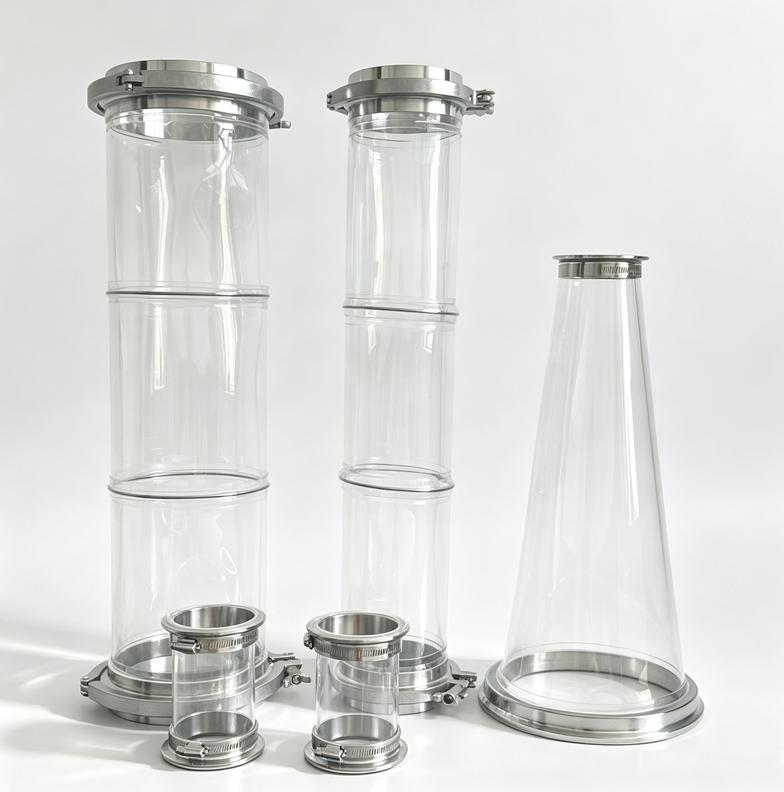
High Transparency Flexible Couplings: Real-Time Material Flow Visualization
1. Why Visual Flow Inspection Matters
In powder processing, the worst failures are the ones you cannot see. A blockage, a bridging buildup, or a color change in the product often signals a problem only after it has contaminated a batch or stalled the line.
- Blind connections cost money: An opaque rubber coupling hides the first signs of product buildup, so operators discover the problem only when flow stops or quality fails.
- Inspection equals prevention: A transparent coupling turns every joint into a real-time inspection window — no camera, no sensor, no downtime.
- Regulatory pressure: GMP and food-safety audits increasingly demand verifiable process control; a visible connection point is the simplest, lowest-cost control you can install.
The takeaway: if you cannot see the flow, you are operating blind.
2. The Transparency Advantage: Polyether TPU vs Rubber
Not all flexible materials are transparent. Traditional rubber couplings are opaque by nature — the same properties that make rubber cheap also make it invisible.
- Polyether TPU clarity: SOSHH standard PU-10 is fully transparent, offering clear sightlines through the sleeve wall even after prolonged service.
- Clarity that lasts: Unlike PVC or inferior blends, polyether TPU resists yellowing and clouding from UV, heat and chemical exposure, keeping visibility intact over the product lifecycle.
- No rubber compromise: Opaque rubber forces a trade-off between flexibility and visibility; polyether TPU delivers both — high elasticity plus full transparency.
Result: you get a flexible joint that is also a monitoring window.
3. Real-Time Monitoring: Detect Problems Before They Escalate
Transparency is not cosmetic — it is an operational control that prevents three failure modes:
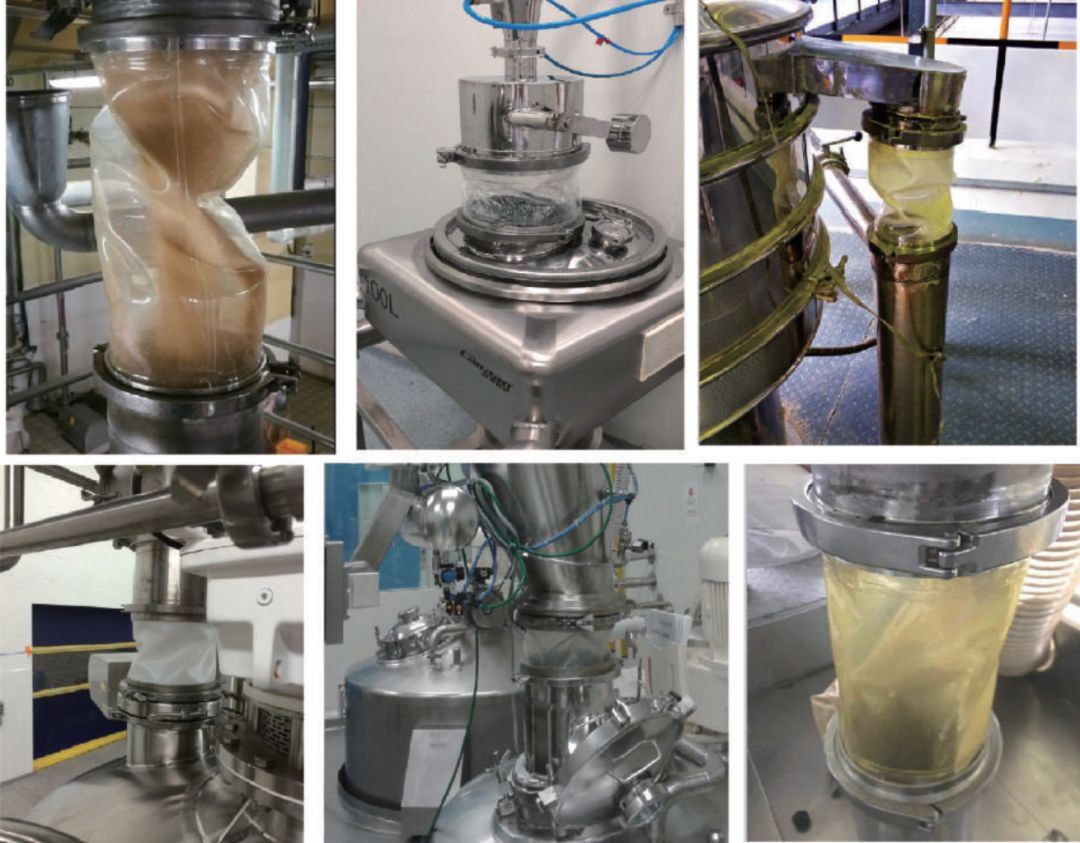
- Early buildup detection: Operators spot powder bridging or residue accumulation on the sleeve wall before it blocks the line or sheds into the product.
- Color and consistency checks: A change in product color, moisture or granule size becomes visible at the connection point, triggering immediate corrective action.
- Contamination interception: Foreign particles, water ingress or cross-batch residue are visible the moment they enter the flow path — before they reach downstream equipment or packaging.
4. Transparent Grade Comparison Table
Select by pressure, temperature and inspection requirement:
PU-10 (Standard Transparent) — 1.0 mm wall, fully transparent polyether TPU, +0.35 bar / −50 mbar, −20 to +110 °C, 40 MPa tensile, ~600% elongation, FDA / EU 10/2011 / EC 1935/2004 / 3-A.
PU-15 (Heavy-Duty Transparent) — 1.5 mm wall, transparent, +0.70 bar / −120 mbar, −20 to +110 °C, for abrasive granular conveying with full visibility.
PU-10-AS (Anti-Static Transparent) — 1.0 mm wall, transparent static-dissipative TPU, +0.35 bar / −50 mbar, −20 to +110 °C, surface resistivity 10⁶–10⁹ Ω, for ATEX Zones 20/21/22 with visual monitoring.
PU-10-VR (Full Vacuum Transparent) — 1.0 mm wall, transparent, +1.0 bar / −1000 mbar, −20 to +110 °C, polymer rings in HF-welded external pockets, metal-detector transparent.
PU-05-WB (Weighing Transparent) — 0.5 mm wall, transparent micro-convolution TPU, +0.10 bar / −20 mbar, for high-precision dosing and load-cell isolation.
5. Transparent Coupling vs. Opaque Rubber(竞品对比表格)
- Flow Visibility — SOSHH Transparent: full sightline through sleeve. Opaque Rubber: no visibility, blind operation.
- Buildup Detection — SOSHH: early visual detection, prevents blockage. Opaque: hidden buildup until failure.
- Color/Consistency Check — SOSHH: visible at the joint. Opaque: requires sampling or line stop.
- Contamination Interception — SOSHH: foreign particles visible instantly. Opaque: undetected until downstream.
- Clarity Retention — SOSHH: polyether TPU resists yellowing/clouding. Opaque: no clarity by design.
- Sanitary Design — SOSHH: crevice-free, HF-welded seam. Opaque: folds and gaps in clamp joints.
6. Technical Specifications
- Material: 100% virgin polyether TPU, latex-free, FDA compliant.
- Certification: FDA 21 CFR 177.2600 (Report Ref: TQT4821B36E), EU 10/2011, EC 1935/2004, 3-A Sanitary Standards.
- Pressure / Vacuum: +0.35 bar / −50 mbar (PU-10); up to +1.0 bar / −1000 mbar (PU-10-VR).
- Tensile Strength: 40.0 MPa. Elongation: ~600% at break.
- Temperature Range: −20 to +110 °C standard; high-temperature grade to +150 °C.
- Sizes: Quick-connect joints Ø152–508 mm (18 standard), lengths 100–1000 mm (19 standard). Non-standard customizable, minimum 100 mm.
7. Applications
Transparent flexible couplings deliver the highest value where visibility prevents loss:
- Pharmaceutical granulation and tablet feed lines — visual verification of API flow and early detection of agglomeration.
- Food and dairy powder transfer — real-time color and consistency checks, faster CIP validation.
- Pneumatic conveying systems — visible powder velocity and density at critical joints.
- Vibrating sifters and sieves — watch material distribution and detect blinding before it stalls throughput.
- Weighing and dosing stations — confirm complete discharge with no residual product.
8. Conclusion: Stop Operating Blind
Visibility is the cheapest sensor you can install on a powder line. A high-transparency polyether TPU coupling turns a passive joint into an active inspection point — detecting buildup, color change and contamination in real time, without tools, sensors or downtime.
Ready to see your process clearly? Contact the SOSHH engineering team for technical drawings and custom sizing (Ø152–508 mm, 100–1000 mm length).
9. Frequently Asked Questions
Is the transparent sleeve food-contact compliant? Yes. The PU-10 is fully transparent and compliant with FDA 21 CFR 177.2600, EU 10/2011, EC 1935/2004 and 3-A Sanitary Standards.
Will the sleeve stay clear over time? Yes. Polyether TPU resists yellowing and clouding from UV, heat and chemical exposure, keeping visibility intact through the product lifecycle.
Can I see powder flowing in real time? Yes — the fully transparent sleeve lets operators visually verify flow, detect buildup, and confirm complete discharge without stopping the line.
Is the transparent version ATEX compliant? Yes. The PU-10-AS combines full transparency with inherently static-dissipative TPU (10⁶–10⁹ Ω) for combustible dust environments.
Does it contain latex? No. It is 100% virgin polyether TPU — latex-free.
What sizes are available? Quick-connect joints Ø152–508 mm (18 standard) and lengths 100–1000 mm (19 standard). Non-standard sizes customizable, minimum 100 mm.
Related Resources
Upgrade to a complete powder-handling connection. Explore our flagship product page — Tri-Clamp Flexible Connectors: The Gold Standard for High-Efficiency Powder Handling — for full material grades, TC size matrix and ordering codes.
Prevent dust leakage at the source. Read Dust Leak Prevention in Factories: Why Snap-fit Systems Outperform Hose Clamps to see how zero-crevice, ATEX-compliant seals eliminate fugitive dust and combustible dust risk.