





OEM Flexible Connector Manufacturing Partner — CAD Support, In-House HF Welding, 316L Special-Process Builds
1. Why OEM Equipment Builders Standardize on SOSHH
Machine builders do not buy a part; they buy a repeatable, documented interface that fits their frame and does not generate field returns. SOSHH delivers that through four controls:
- Draw-to-print geometry — the sleeve is cut and welded to your spigot OD, groove depth and installation gap, not forced from a size chart.
- ±0.5 mm cuff-to-groove fit — the machining tolerance that separates a dust-tight snap-in from a powder bypass at the joint.
- High-frequency welded seams — molecular-level fusion with no stitch holes, no adhesive lines and no delamination under CIP.
- Repeatable documentation — material spec, tolerance, surface resistance and continuity are recorded per order for your incoming QC.
The result is a sleeve your assembly line installs the same way every time, and your end customer can change out in under 30 seconds without tools.
2. CAD & Engineering Support for OEM Integration
SOSHH supports equipment design before the first sample:
- 2D outline PDFs for approval (watermarked until NDA is signed).
- STEP/IGES files for clearance and interference checks in your assembly.
- ISO 2768-m tolerances stated on non-standard geometry.
- Spigot/groove recommendations in 304 (1.4301) or 316L (1.4404) for weld-on or bolted mounting.
Send your envelope, movement and media — we return a dimensioned proposal, not a price-only quote. For robotic pick arms, vacuum grippers and vibratory feeders, the sleeve is engineered around your stroke and frequency.
3. In-House Manufacturing & Quality Control
The difference between a dust-tight sleeve and a leaking one is the process, not the material name. SOSHH controls the build in-house:
- Raw material — polyether-TPU / PTFE / FKM sheet and tube, lot-traceable, selected by media and temperature.
- CNC knife cutting — automated cutting of cuffs and convolutions to millimeter tolerances.
- High-frequency (HF) welding — cuffs and convolutions fused at molecular level, solvent-free.
- Fit inspection — spigot groove-to-cuff seating checked to ±0.5 mm before release.
This is the mechanical reason a SOSHH sleeve stays sealed where glued canvas or stitched rubber sleeves fail. When a competitor sleeve “leaks at the seam,” the first question is whether it was HF-welded or glued — glue delaminates under hot-water CIP.
4. Material & Configuration Options for OEMs
| MATERIAL | TEMPERATURE | SURFACE RESISTANCE | OEM USE |
|---|---|---|---|
| Ether-TPU | −20 to +110 °C | >10¹² Ω | General powder, transparent |
| Antistatic TPU | −20 to +110 °C | 10⁶–10⁹ Ω | LIB, silica, explosive dust |
| Conductive TPU | −20 to +110 °C | 0.5 Ω end-to-end | Static-bonded, grounded |
| PTFE (conductive option) | −40 to +260 °C | 10⁶–10⁹ Ω | Corrosive, hot, sticky |
| FKM | Mid-to-high temp | — | Solvent / oil duty |
| 304-wire reinforced PU | −20 to +110 °C | — | Stroke, vibration, vacuum |
End configurations: inner-spring snap-in, TC clamp, gasket-seal, flange, square-to-round, and mixed ends (e.g. TC top × flange bottom).
Customization: diameter 38–500 mm standard, larger to 800 mm custom; length built to installation gap; eccentric and conical reducers; non-standard ferrule diameters (e.g. 265 mm) reverse-engineered from imported equipment.
5. Special-Process & Defense Capability
For special-industry and defense projects where static hazard, chloride exposure and flange alignment are critical, SOSHH fabricates non-standard antistatic sleeves with:
- 316L (1.4404) flat-face flanges — chloride-resistant, non-magnetic, suitable for aggressive washdown and corrosive powder lines.
- Miniature loose flanges (van stone / companion flange) — the flange ring rotates freely around the sleeve stub, so bolt holes align without twisting or stressing the pipe.
- Antistatic & non-sparking hardware — static-dissipative TPU/PTFE with a dedicated earth lug, bonded at both ends.
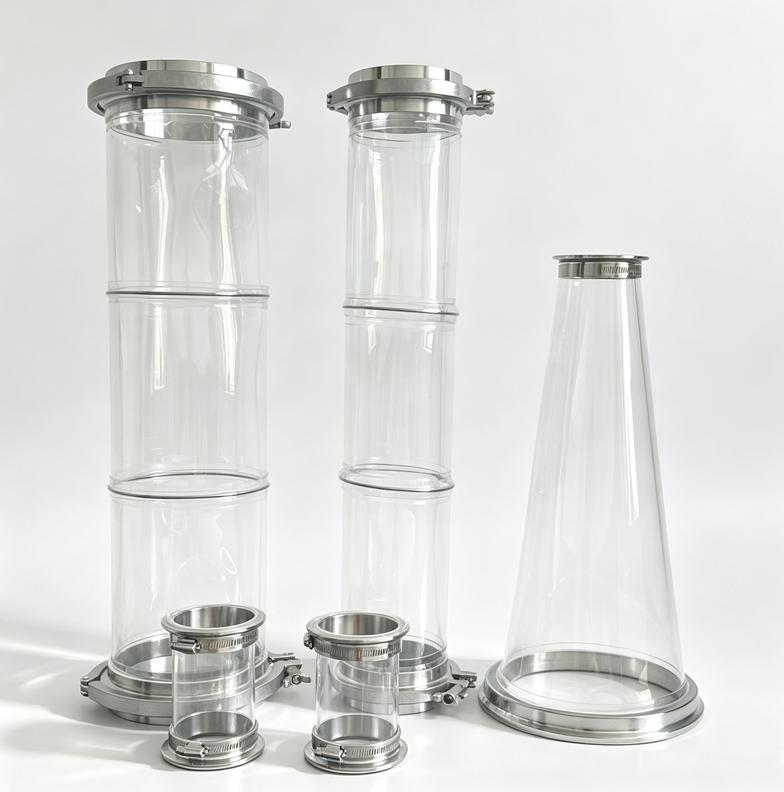
- Tapered transparent body — variable diameter with full flow visibility for critical transfer duties.
Compliance note: project work is performed under a signed mutual NDA/NNN. Electrical continuity and static dissipation are documented per order — not assumed. SOSHH does not publish “military certified” claims; documentation is supplied to the customer under agreement.
6. Industries Served
- Food & dairy (FDA 21 CFR 177.2600, EU 10/2011)
- Pharmaceutical & biopharma (CIP-rated, Ra-controlled spigots)
- Lithium battery & new energy (antistatic, flame-retardant options)
- Fine chemical & fluorochemical (conductive PTFE inner + TPU outer)
- Semiconductor silica (thick-wall dissipative sleeves)
- Ceramic, tungsten & molybdenum (metal-free liners)
- State-owned and intelligent-equipment OEMs (import replacement)
7. OEM Documentation Package
Every OEM order can include:
- Material specification and temperature rating
- Surface resistance / continuity report (antistatic builds)
- Dimensional drawing with tolerance
- Compliance statements (FDA / EU 10/2011 / phthalate-free)
- Lot marking on 304/316L heads for traceability
8. FAQ
Can SOSHH build from my CAD drawing? Yes. Send your envelope, spigot OD, groove depth and movement. We return a 2D outline for approval, then STEP/IGES for your assembly. Custom geometry is engineered to ISO 2768-m.
How does SOSHH keep the cuff dust-tight? The inner-spring cuff seats into a machined groove at ±0.5 mm fit. Too loose and powder bypasses; too tight and it will not seat or release by hand. The tolerance is the seal.
Why does HF welding matter? High-frequency welding fuses the material at molecular level — no stitch holes, no adhesive and no delamination in CIP. Glued or stitched sleeves fail exactly at the seam.
Can SOSHH do import replacement? Yes. Send a photo and dimensions of the existing spigot. We reverse-engineer the groove and cuff to match, including non-standard diameters (e.g. 265 mm) that are neither GB nor ANSI standard.
Is antistatic documentation available? Yes. For antistatic builds we supply surface resistance and continuity documentation, not a claim. Static-dissipative is 10⁶–10⁹ Ω; a separate conductive grade (0.5 Ω end-to-end) is available for grounded, bonded lines.
Does SOSHH work on defense projects? Special-process and defense-related work is accepted under a signed mutual NDA. Documentation is supplied to the customer under agreement; no “military certified” claim is published.
9. RFQ Fields for OEM Projects
- Equipment type and application
- Port OD/ID, top and bottom
- Spigot groove depth and lip thickness
- Installed gap height and stroke (extended/collapsed)
- Powder media and bulk density
- Temperature and CIP temperature (°C)
- Pressure / vacuum (kPa / bar / mbar)
- Vibration amplitude and frequency
- End type (inner-spring / TC / flange / gasket / mixed)
- Antistatic requirement (dissipative 10⁶–10⁹ Ω or conductive earthed)
- Metal detector / X-ray downstream?
- Required documentation (FDA / EU / resistivity / continuity)
10. Get a Working Solution, Not a Catalogue Part
Every SOSHH sleeve is engineered to your spigot groove, stroke, media and pressure — never forced from a size chart.
Three steps:
- Tell us the duty — port OD/ID, groove depth, installed gap, stroke, media, temperature, pressure/vacuum, antistatic requirement.
- Send a photo or drawing — the existing spigot, the groove, or a 2D sketch. For flange ends, add bolt-hole count and PCD.
- Get your proposal — we confirm material, cuff fit, reinforcement and tolerance, then return a quotation, lead time and documentation package.
Email photos or drawings to amin@soshh.com or attach them through the enquiry form below — a SOSHH application engineer replies with a fit-for-purpose solution, not a price-only quote.