





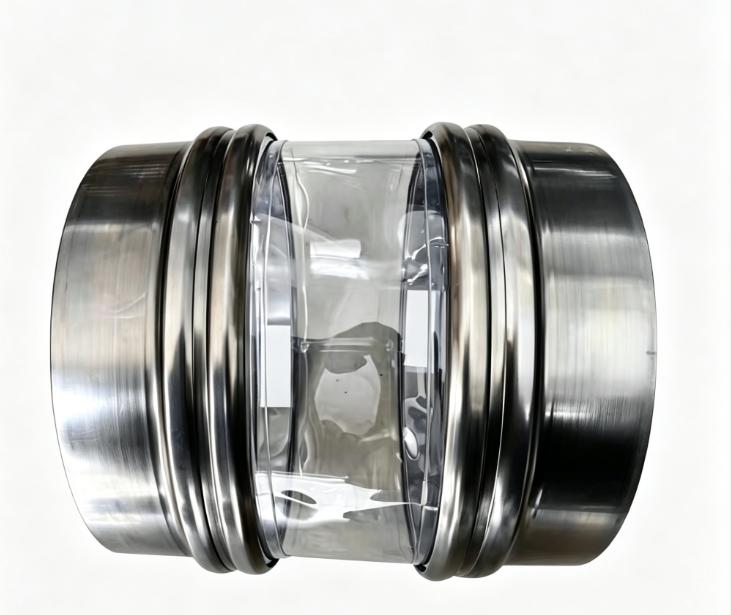
Powder Handling PU Sleeves for Bulk Powder Transfer
1. Why the Connection Point Is the #1 Failure Site in Powder Transfer
In bulk powder handling — silo discharge, hopper-to-conveyor, sifter-to-packer — the flexible connection carries the full duty of the process. It is the cheapest component on the line and the most common source of failure:
- Abrasive wall thinning: high-velocity powder acts as a sandblaster. A 1.0 mm wall thins to failure in weeks on abrasive media like starch, sugar, minerals or battery cathode powder.
- Clamp-edge leakage: a hose clamp crushes the sleeve locally, concentrating stress along one line. Under vibration, the sleeve tears exactly at the clamp edge.
- Trapped product: wire-reinforced or ribbed sleeves create crevices where powder lodges — a cross-batch contamination risk and a bacteria harbour in food lines.
The material and the joining method are therefore not interchangeable. They are the two variables that decide whether the connection leaks in month one or runs a full production season.
2. Material Engineering: Polyether TPU vs. Rubber, Silicone and Ester TPU
Material comparison table:
| Property | Polyether TPU (SOSHH) | Rubber | Silicone | Ester TPU |
|---|---|---|---|---|
| DIN abrasion | 39.0 mg | Poor | Moderate | Good |
| Tensile strength | 40 MPa | Low | Low | Good |
| Elongation at break | ~600% | Moderate | High | Good |
| Hydrolysis resistance (CIP) | Excellent | Good | Excellent | Poor — hydrolyzes |
| Flex-fatigue life | Excellent | Moderate | Good | Good |
| Transparency | Yes | No | Limited | Yes |
| FDA 21 CFR 177.2600 | Yes | Depends | Depends | Depends |
Two distinctions matter in practice:
- Polyether vs. ester TPU: ester TPU is cheaper but hydrolyzes — it breaks down chemically under hot water, steam and caustic CIP, yellowing, stiffening and cracking. SOSHH uses polyether TPU exclusively, the polymer class recognized for hydrolysis resistance through repeated 85 °C CIP cycles.
- Roughly 10× rubber abrasion resistance: polyether TPU outlasts rubber by an order of magnitude in abrasive powder duty, which is why it is the default for powder transfer.
3. The HF-Welded Cuff: Why the Seam Is the Seal
The snap-in cuff is not sewn, glued or heat-sealed — it is HF-welded (high-frequency welded).
How HF welding works: a high-frequency electromagnetic field causes the TPU molecules at the weld zone to polarize and oscillate, generating frictional heat from the inside out. Under pressure, the two surfaces fuse into a single homogeneous mass — no adhesive, no stitch holes, no added material.
What that changes in service:
| Failure mode | Stitched / glued cuff | HF-welded cuff |
|---|---|---|
| Powder trap at seam | Yes — stitch holes and glue lines | No — seamless fusion |
| Leak at join line | Yes, under pressure | No — monolithic wall |
| Delamination | Yes, over time | No — single material |
| Bacterial harbour (food) | Yes — crevices | No — flush bore |
The product-contact bore is therefore 100% metal-free, crevice-free and flush — which keeps it food-safe, CIP-cleanable and invisible to metal detectors.
4. SOSHH PU Sleeve Grades (Match to Your Duty)
| Grade | Wall | Key Properties | Typical Duty |
|---|---|---|---|
| PU-10 | 1.0 mm | 40 MPa, Shore A 90, −20 to +110 °C, +0.35 bar / −50 mbar | Food, dairy, general powder |
| PU-15 | 1.5 mm | +0.70 bar / −120 mbar | Abrasive, higher-pressure |
| PU-10-AS | 1.0 mm | 10⁶–10⁹ Ω surface resistivity, no wires | Combustible dust, ATEX |
| PU-10-VR | 1.0 mm | Polymer rings in HF-welded pockets | Full vacuum, −1000 mbar |
| PU-05-WB | 0.5 mm | Micro-convoluted, near-zero reaction force | Weighing, dosing |
The mating component is the weld-on stainless spigot (SS304/SS316L), available here: https://www.soshh.com/collections/sf-snap-in-flexible-connectors/products/sf-internal-snap-on-steel-spigot-connector-2mm — the cuff snaps over the spigot to form the seal, no clamps, no torque, no tools.
5. Sizing: Getting the Part Number Right
| Measurement | What to record |
|---|---|
| Spigot OD (ØD) | Outer diameter of the spigot the cuff snaps over — Ø102–Ø804 mm standard |
| Length / Installation Gap (CL / IG) | Set with slight slack, never in tension; add 10–15% for vibratory service |
| Custom geometry | Square-to-round, conical, eccentric — fabricated as one-piece sleeves |
Part-number format (example matrix):
| Model | ØD (mm) | CL (mm) |
|---|---|---|
| PU10-102-200 | 102 | 200 |
| PU10-204-300 | 204 | 300 |
| PU10-254-400 | 254 | 400 |
| PU10-304-500 | 304 | 500 |
Custom diameters up to Ø1000 mm are available. Send ØD and CL and we return a confirmed part number within one business day.
6. Case-Proven: Three Application Snapshots
Snapshot 1 — Milk powder sifter (dairy): a milk powder plant was replacing rubber sleeves on its vibratory sifters every 4–6 weeks. The rubber tore at the clamp edge and the ribbed bore trapped lactose dust between CIP cycles, flagging on hygiene audits. Switching to a transparent polyether TPU snap-in sleeve with HF-welded cuffs and stainless spigots gave a flush bore that drains cleanly through hot-caustic CIP, transparent walls for visual flow check, and tool-free changeover under 60 seconds.
Snapshot 2 — Chemical powder hopper (abrasive): a chemical processor handling abrasive additives was thinning 1.0 mm generic sleeves in weeks and fighting clamp leaks at the discharge. Re-specifying to a 1.5 mm heavy-duty sleeve (PU-15) rated +0.70 bar / −120 mbar removed the wall-thinning failure mode.
Snapshot 3 — Lithium battery cathode line (combustible dust): a cathode-materials line required both static control and metal-contamination prevention. The connection was re-specified to the anti-static grade (10⁶–10⁹ Ω) — charge dissipates through the material itself, with a 100% metal-free bore that does not trigger metal detectors. The sleeve is engineered for ATEX Zones 20/21/22.
These snapshots describe typical duty profiles, not specific customer claims. Your exact specification is confirmed by our engineering desk from your measured parameters.
7. Compliance for Regulated Plants
- Food contact: FDA 21 CFR 177.2600 (Report TQT4821B36E), EU 10/2011, EC 1935/2004; latex-free and phthalate-free.
- Anti-static / ATEX: 10⁶–10⁹ Ω surface resistivity; volume resistivity 4.02×10⁷ Ω tested per IEC 62631-3-1:2023 (SGS SHMR240801578301-1); engineered for ATEX Directive 2014/34/EU, Zones 20/21/22 (IEC 60079-32-2).
- Spigots: EN 10204 3.1 material test certificate with every order.
8. Frequently Asked Questions
Q1: How do I know if I need a standard or heavy-duty PU sleeve?
If your powder is food-grade and non-abrasive, PU-10 (1.0 mm) is the default. If the powder is abrasive or the line runs above +0.35 bar, step up to PU-15 (1.5 mm, +0.70 bar / −120 mbar).
Q2: Is the PU sleeve food-contact safe?
Yes — the polyether TPU is compliant with FDA 21 CFR 177.2600 (Report TQT4821B36E), EU 10/2011 and EC 1935/2004, and is latex-free and phthalate-free.
Q3: What is the difference between HF welding and a stitched or glued seam?
HF welding fuses the TPU into a single homogeneous wall — no stitch holes, no glue lines, no delamination. The result is a flush, crevice-free, metal-free bore that drains cleanly through CIP.
Q4: Can the sleeve be used under vacuum?
Standard PU-10 handles to −50 mbar. For full vacuum to −1000 mbar, specify PU-10-VR, with non-metallic polymer rings in HF-welded exterior pockets.
Q5: How long does a PU sleeve last?
Service life depends on powder abrasiveness, temperature, vibration and installation gap. Polyether TPU offers roughly 10× the abrasion resistance of rubber; correct IG and material grade are the two biggest levers on lifespan.
Q6: Do I need a gasket with the snap-in connection?
No. The HF-welded cuff forms a 360° radial compression seal directly against the spigot, eliminating both the gasket and its leak path.
9. Request Engineering Review
Ready to replace a worn sleeve or upgrade a leaking connection? Send us your spigot OD, length, powder type, operating temperature and pressure — we’ll confirm the correct sleeve + spigot configuration and return a watermarked 2D approval drawing within 24 hours.
1-piece prototype testing is available, with 100% of the sample fee credited toward your first bulk order exceeding $3,000.
- TPU flexible connections
- PU Snap-in Connector Manufacturer
- FDA Approved PU Connectors
- Food Grade Polyurethane Sleeves
- best flexible connector for powder transfer
- snap-in powder connectors high hygiene standards
- snap-in powder connectors for machinery manufacturers
- Sanitary CIP Connectors
- FDA Compliant Powder Sleeve
- Bulk Solids Handling Connector