





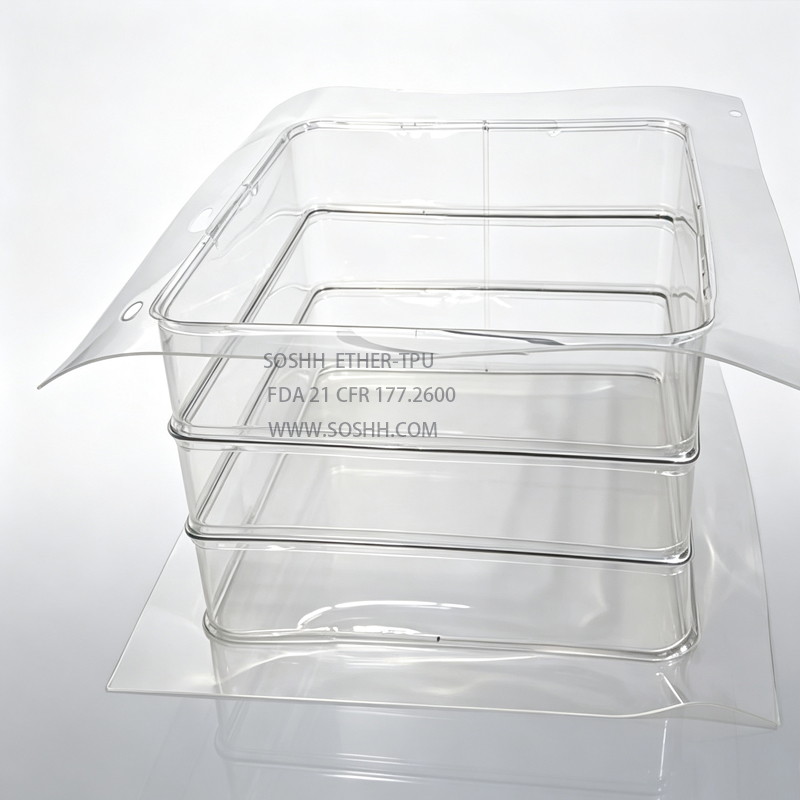
Retractable Flexible Discharge Sleeves for Malt, Barley and Bulk Solids
Retractable Flexible Discharge Sleeves for Malt and Barley
A fixed flexible sleeve is suitable when the discharge connection can remain in one position during both operation and maintenance.
That is not the case for every bulk-solids installation.
In some facilities, a discharge chute must:
extend downward during discharge
and then:
move upward or compress when the process is not operating.
This requirement is common where vehicles, railcars or maintenance equipment pass below the discharge point.
A retractable flexible discharge sleeve provides a way to accommodate that movement without permanently installing a long rigid chute.
What Is a Retractable Discharge Sleeve?
A retractable sleeve is a flexible discharge connection designed to operate between two defined positions.
Extended Position
The sleeve reaches the required receiving point and provides the discharge path.
Retracted Position
The sleeve is raised, compressed or otherwise moved away from the receiving area to create the required clearance.
The connector therefore has two important dimensions:
Maximum extended length
and
Minimum retracted length
Both must be defined during engineering.
Why Malt and Barley Applications Require Careful Selection
Malt and barley are dry bulk materials containing particles of different shapes and sizes.
The connector may be exposed to:
- particle impact
- abrasion
- vibration
- dust generation
- repeated movement
- cleaning
- static accumulation.
The right construction therefore depends on more than the outlet diameter.
A suitable specification should consider:
Material abrasion
Wall thickness
Dynamic flexing
Food-contact requirement
Static dissipation
Installation clearance
Discharge rate
Particle characteristics
A Real Engineering Requirement: Large Gravity Discharge With Limited Clearance
A recent customer inquiry supplied to SOSHH described a demanding gravity-discharge application with:
Outlet diameter: approximately Ø540 mm
Extended sleeve length: 1,200–1,500 mm
Available rigid connection height: approximately 50 mm
Material: malt and barley
Flow requirement: up to 200 metric tons/hour
Area classification: ATEX Zone 22
Application: gravity discharge
Additional requirement: sleeve must retract to clear railcars when not operating.
This should be treated as an engineering sizing problem rather than a simple standard-sleeve quotation.
The 200 t/h value is the customer's process requirement; it should not automatically be interpreted as a universal capacity rating for one flexible sleeve.
Step 1 — Define the Extended Discharge Position
First establish where the sleeve must reach during operation.
The drawing should show:
Outlet centerline
Receiving point
Extended sleeve length
Minimum required clearance from surrounding equipment
Material discharge direction
For a gravity chute, the outlet geometry should avoid creating an unnecessary restriction in the discharge path.
Step 2 — Define the Retracted Position
Next establish the clearance required when the sleeve is not operating.
For example:
Railcar clearance
Truck clearance
Maintenance access
Operator access
The retracting mechanism must be designed so that the flexible sleeve is not forced into an excessive bend or compression.
The minimum retracted dimension should therefore be determined from the actual sleeve construction and movement envelope.
It should not be guessed from the extended length alone.
Step 3 — Do Not Transfer the 700 → 80 mm Compression Figure to Every Application
SOSHH's existing wire-reinforced vacuum sleeve information includes a compression range of approximately 3.5:1 to 4:1 in a specific construction. That does not mean that every diameter, length and material will have the same compression ratio.
For example:
A Ø540 × 1,500 mm retractable discharge sleeve should not automatically be stated as “compresses to 375 mm” without engineering verification.
The actual collapsed height depends on:
Diameter
Wall construction
Reinforcement
Number and geometry of support elements
Required stroke
Material
Installation conditions
Step 4 — The 50 mm Rigid Connection Height Is a Separate Dimension
A common mistake is to confuse:
rigid spigot height
with:
flexible sleeve length
and:
installation gap.
A project may have:
50 mm available rigid connection height
but still require:
1,200–1,500 mm flexible discharge length.
These are different dimensions.
The drawing should show all three where relevant.
Step 5 — Select the Material for the Actual Duty
For dry bulk applications, the starting material can be selected according to the combination of abrasion, hygiene and static requirements.
| Requirement | Starting Configuration |
|---|---|
| Standard food/bulk powder | PU-10 |
| Higher abrasion | PU-15 |
| Static-dissipative application | PU-10-AS |
| Vacuum / collapse resistance | Reinforced configuration |
| High-temperature chemical duty | PTFE / engineered material |
| Complex retractable geometry | Custom engineered construction |
The current SOSHH portfolio includes PU-10, PU-15, anti-static PU and reinforced vacuum constructions. (soshh.com)
Step 6 — Food Contact and Static Control Are Separate Requirements
A material can be selected for food contact, but that does not automatically define its static-dissipation performance.
Similarly, an anti-static flexible material should not be described as an ATEX-certified complete equipment assembly without evaluating the complete installation.
For a malt or barley application, the engineering package should separately identify:
Food-contact requirement
Surface-resistance requirement
Grounding/bonding method
Hazardous-area classification
Complete equipment assessment.
Step 7 — What Does ATEX Zone 22 Change?
Zone 22 describes an area where a combustible dust cloud is not likely to occur in normal operation and, if it does occur, is expected to exist only for a short period.
For such an application, the flexible connector should be considered as part of the complete dust-handling installation.
The design discussion should include:
Static-dissipative material
Electrical resistance
Bonding
Grounding
Dust containment
Equipment classification
SOSHH's existing anti-static PU material documentation provides electrical-property information and should be evaluated together with the final installation. (soshh.com)
Step 8 — Consider the Discharge Geometry
For a high-throughput gravity application, the flexible sleeve geometry is important.
Possible configurations include:
Cylindrical Sleeve
Useful where the receiving connection is also circular.
Round-to-Rectangular Transition
Useful where the upper outlet is circular but the receiving chute requires a rectangular discharge.
Eccentric Transition
Useful where the centerlines do not align.
Custom Discharge Skirt
Useful where the lower end must spread material over a specific receiving opening.
The final geometry should be chosen from the actual equipment drawing.
Step 9 — Abrasion Is Not Only About Wall Thickness
A thicker wall can improve mechanical durability, but abrasion life also depends on:
Particle size
Particle velocity
Impact angle
Bulk density
Movement
Contact frequency
Temperature
For malt and barley, the plant should consider whether the sleeve sees mainly:
gravity contact
or:
repeated high-energy mechanical movement.
This distinction can affect the recommended material and reinforcement.
Step 10 — How to Specify the Sleeve on the Drawing
For a retractable discharge sleeve, the engineering drawing should ideally include:
| Dimension / Parameter | Required |
|---|---|
| Upper outlet diameter | Yes |
| Lower outlet geometry | Yes |
| Extended length | Yes |
| Minimum retracted length | Yes |
| Maximum stroke | Yes |
| Rigid connection height | Yes |
| Lateral offset | If applicable |
| Material | Yes |
| Wall thickness | Yes |
| Reinforcement | If applicable |
| Temperature | Yes |
| Pressure/vacuum | Yes |
| Product | Yes |
| Flow requirement | Yes |
| Food contact | If applicable |
| Static requirement | If applicable |
| Hazardous area | If applicable |
Common Design Mistakes
Mistake 1 — Specifying Only Diameter
Ø540 mm does not define the dynamic requirement.
Mistake 2 — Specifying Only Extended Length
1,500 mm does not define the required retracted clearance.
Mistake 3 — Treating Flow Rate as a Universal Sleeve Rating
200 t/h is a process requirement, not a universal flexible-sleeve capacity.
Mistake 4 — Ignoring Railcar or Vehicle Clearance
The retracted position is part of the equipment function.
Mistake 5 — Selecting Material Before Defining Movement
The material and reinforcement should be selected after the dynamic duty is understood.
Mistake 6 — Confusing Spigot Height With Flexible Length
The rigid connection height and flexible discharge length should be separately dimensioned.
SOSHH Custom Engineering Approach
For non-standard retractable sleeves, SOSHH can review:
Existing equipment drawing
Outlet dimensions
Photographs
Extended position
Retracted position
Available clearance
Product characteristics
Temperature
Pressure/vacuum
Food-contact requirement
Static/ATEX requirement
The resulting specification can then define the sleeve diameter, length, material, reinforcement, attachment system and retraction geometry.
FAQ
Can a flexible discharge sleeve be retractable?
Yes. Retractable or collapsible designs can be engineered for applications requiring movement between operating and clearance positions.
Can SOSHH manufacture a Ø540 mm retractable sleeve?
A Ø540 mm configuration can be evaluated as a custom design. SOSHH's standard diameter system includes nearby Ø504 and Ø554 references, while non-standard diameters are supported through custom engineering. (soshh.com)
Can a retractable sleeve handle malt and barley?
The material and wall construction can be selected for dry bulk handling, but abrasion, movement, temperature, food-contact and cleaning conditions should be reviewed together.
Can it be used in ATEX Zone 22?
A static-dissipative configuration can be considered where required. Final suitability depends on the complete assembly and site hazardous-area assessment.
Can it handle 200 t/h?
The sleeve should not be assigned a universal flow rating solely from the diameter. Flow capacity must be evaluated from the material bulk properties, outlet geometry, discharge mode and process conditions.
How do I specify the minimum collapsed length?
Provide the maximum available clearance when the equipment is idle. SOSHH can then evaluate the flexible construction and required compression from the extended length and movement requirements.
Engineering Rule
A retractable discharge sleeve should be designed from two positions: the operating position and the clearance position. Diameter, extended length, retracted length, movement, product and process conditions must be specified together.