





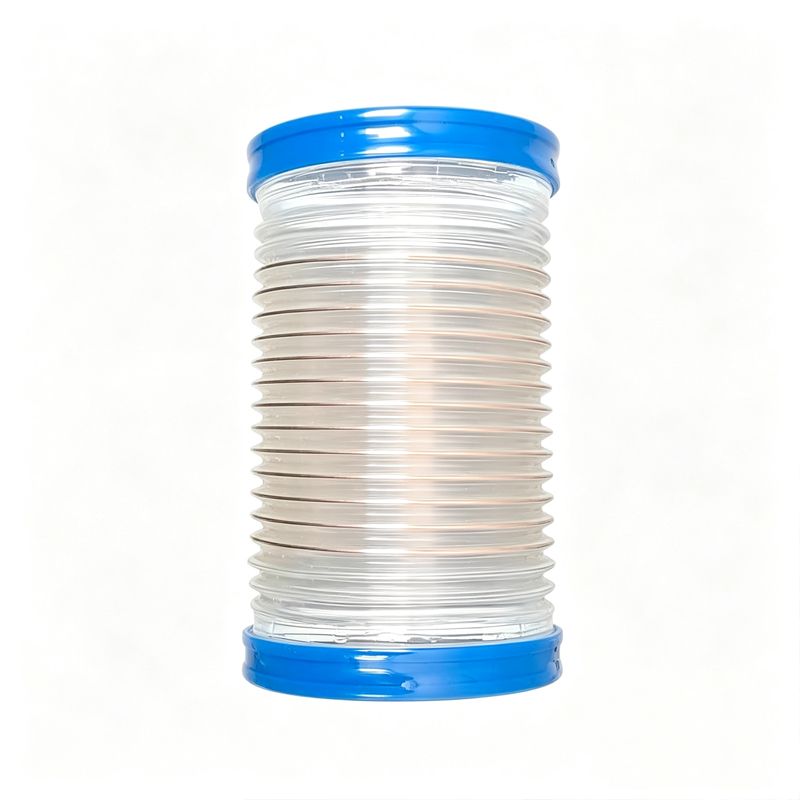
When a Technical Specialist Says “Corrugated”: How to Specify the Right Flexible Connector
When a Technical Specialist Says “Corrugated”
One of the questions SOSHH sometimes receives during a flexible-connector quotation is very simple:
“Our technical specialist specifically requires a corrugated connector. Do you manufacture those?”
This is a useful question, but it is not yet a complete connector specification.
“Corrugated,” “convoluted,” and “bellows” describe a family of flexible constructions. The reason for requiring that geometry matters more than the word itself.
Before selecting the connector, determine what the equipment needs the flexible element to do.
Does it need to:
- compress into a short space?
- absorb axial movement?
- accommodate lateral movement?
- accommodate angular movement?
- isolate vibration?
- operate under vacuum?
- withstand higher temperatures?
- maintain a smooth product-contact surface?
Smooth-Wall and Corrugated Connectors Solve Different Problems
A smooth-wall flexible sleeve has a continuous internal surface.
A corrugated or convoluted bellows has repeated folds or convolutions.
The basic difference is mechanical:
Corrugation can provide greater flexibility and compression within a given overall length, but the internal geometry must also be considered when the connector is part of the product-contact path.
There is no universal rule that one construction is always better.
The correct choice depends on the equipment and process.
| Engineering Requirement | Smooth-Wall Sleeve | Corrugated / Convoluted Bellows |
|---|---|---|
| Smooth internal product-contact surface | Strong starting option | Requires internal-profile review |
| Small movement | Often suitable | May be unnecessary |
| Large axial compression | Application-dependent | Often advantageous |
| Large axial stroke | Application-dependent | Often advantageous |
| Significant lateral movement | Custom design may be required | Often advantageous |
| Very limited installation envelope | Application-dependent | Can be advantageous |
| High-temperature service | Material dependent | PTFE bellows may be advantageous |
| Vacuum service | Reinforcement may be required | Geometry/reinforcement dependent |
| Food-contact service | Material and documentation dependent | Material and geometry must both be evaluated |
Why “Corrugated” Should Be Defined on the Drawing
A customer may use the word corrugated to describe several different structures.
Before production, clarify whether the requirement means:
External corrugation only
Internal corrugation
Full convoluted bellows
Single-convolution flexible joint
Multi-convolution bellows
Wire-reinforced collapsible sleeve
These are not interchangeable constructions.
For a powder-processing line, it is particularly important to state whether the corrugation is exposed to the product-contact path.
A drawing should ideally identify:
Number of convolutions
Convolution depth
Pitch
Root radius
Extended length
Compressed length
Maximum stroke
Internal diameter
External diameter
Connection geometry
Why Internal Geometry Matters for Powder Handling
A powder-processing engineer is usually concerned with more than flexibility.
The internal surface affects:
Product retention
Cleaning
Cross-contamination
Flow restriction
Inspection
Potential powder accumulation
A smooth-wall TPU sleeve provides a continuous product-contact surface.
A corrugated construction introduces internal geometry that must be evaluated for the specific powder, particle size and cleaning procedure.
Therefore, the statement:
“Corrugated is required because the machine vibrates”
is not enough information to select the connector.
A better engineering question is:
How much movement occurs, and what compressed length is required?
When a Smooth Connector May Be the Better Starting Point
A smooth-wall connector can be considered when the application mainly requires:
- powder containment
- a smooth internal surface
- visual inspection
- straightforward cleaning
- limited movement
- simple cylindrical geometry
- food-contact construction
- transparent material.
SOSHH's PU-10 family uses clear polyether TPU for smooth flexible-connector applications.
Where a more abrasive process requires additional wall thickness, PU-15 is available.
Where static dissipation is required, an anti-static TPU configuration can be specified.
Where significant negative pressure creates a collapse risk, reinforced constructions are available.
When Corrugated or Convoluted Construction Becomes More Relevant
Corrugated or convoluted construction becomes more relevant when the connector must repeatedly change its length or shape.
Typical examples include:
Large Axial Compression
The connector must become substantially shorter when the equipment moves.
Long Axial Stroke
Two pieces of equipment repeatedly move apart and together.
Limited Rigid Headroom
The available space does not permit a conventional fixed-length sleeve.
Angular Movement
The equipment changes angle relative to the fixed pipe.
Complex Dynamic Movement
The movement cannot be accommodated efficiently by a straight thin-wall sleeve.
In these applications, the connector should be specified around the complete movement envelope rather than by diameter and length alone.
Corrugated Does Not Automatically Mean “More Flexible”
Flexibility depends on more than the presence of folds.
Important variables include:
Material modulus
Wall thickness
Convolution geometry
Number of convolutions
Diameter
Free length
Reinforcement
Temperature
Movement frequency
A thin smooth TPU sleeve can be extremely flexible.
A thick corrugated construction can still generate considerable restoring force.
This is why flexible-connector selection should be based on the actual equipment movement.
Example: A Technical Specialist Requires a Corrugated Connector
Suppose an equipment engineer tells the supplier:
“Corrugated is specifically required.”
The supplier should obtain at least:
| Requirement | Information Required |
|---|---|
| Diameter | ___ mm |
| Extended length | ___ mm |
| Minimum compressed length | ___ mm |
| Axial stroke | ___ mm |
| Lateral movement | ___ mm |
| Angular movement | ___° |
| Temperature | ___ °C |
| Pressure / vacuum | ___ |
| Product handled | ___ |
| Particle size | ___ |
| Food contact | Yes / No |
| Static requirement | Yes / No |
| Cleaning method | ___ |
| Internal profile | Smooth / Corrugated |
| Connection | Snap-In / Clamp / Flange / Custom |
Smooth TPU vs Corrugated PTFE
SOSHH currently supplies different flexible constructions for different engineering duties.
For example:
Smooth PU-10 / PU-15
Used for flexible powder-processing connections where a smooth TPU wall and the required mechanical properties are appropriate.
Anti-Static PU
Used where static dissipation is part of the process specification.
Vacuum-Reinforced Flexible Sleeves
Used where negative pressure creates a collapse risk.
Corrugated PTFE Bellows
Used for applications requiring the chemical and temperature characteristics of PTFE together with convoluted flexibility.
The material and geometry therefore need to be selected together.
A Practical Selection Sequence
SOSHH recommends evaluating a corrugated requirement in the following order:
1. Identify the Movement
What does the machine actually move?
2. Measure the Available Space
What are the extended and minimum available lengths?
3. Define the Product-Contact Requirement
Does the inside surface contact food, powder, chemical or pharmaceutical material?
4. Define Temperature and Pressure
Include both process temperature and cleaning temperature where relevant.
5. Define Static Requirements
For combustible or static-sensitive powders, identify whether a dissipative material and grounding arrangement are required.
6. Select the Material
Choose TPU, anti-static TPU, reinforced TPU, PTFE or another material according to the duty.
7. Select the End Connection
Confirm Snap-In, hose clamp, Tri-Clamp, flange or custom interface.
8. Confirm the Complete Movement Envelope
Check the connector in both operating and idle positions.
What SOSHH Needs for a Corrugated Connector RFQ
For an existing machine, a photograph plus a drawing is often the fastest way to begin.
Please provide:
Current connector photograph
Upper connection dimensions
Lower connection dimensions
Extended length
Compressed length
Movement
Pressure/vacuum
Temperature
Product
Required material
The engineering team can then determine whether the required construction should be smooth-wall, reinforced, corrugated or a custom configuration.
FAQ
Are SOSHH flexible connectors smooth or corrugated?
SOSHH supplies different constructions. Standard PU flexible connectors use smooth-wall TPU, while dedicated corrugated PTFE bellows are available for applications where convoluted flexibility is required.
Does a powder-handling connector always need to be smooth?
No. The correct construction depends on the movement and product-contact requirements. A smooth internal profile is often advantageous for powder handling, but a corrugated construction may be appropriate when the mechanical movement requirement cannot be met efficiently by a smooth sleeve.
Is corrugated the same as convoluted?
The terms are commonly used for bellows-type constructions, but the actual geometry should be confirmed from the engineering drawing.
Can SOSHH manufacture a custom corrugated connector?
Corrugated/bellows availability depends on the material and construction required. SOSHH can review the drawing and application before confirming the manufacturable configuration.
What is more important than diameter when specifying a corrugated connector?
For dynamic applications, the required movement and minimum/maximum operating length are often as important as the diameter.
Engineering Rule
Do not specify a flexible connector as “corrugated” without defining why corrugation is required. Specify the movement, compressed length, extended length, internal profile and process conditions first.
That gives the manufacturer enough information to design the flexible element around the equipment rather than simply matching a nominal diameter.