1. Why Standard TC Sleeves Don’t Fit Small-Bore Lines
Most sanitary flexible connectors are catalogued for DN76–508. On small-bore lines (DN15–40, 1.5" ≈ DN40), three problems appear:
- Standard ferrules (114/119/133 mm) are too large for miniature spigots.
- Clamp access is cramped, so a wrench-driven hose clamp or bolted flange is impractical.
- Wall thickness and reinforcement space shrink to almost nothing, so a sleeve that works at DN150 leaks or tears at DN25.
SOSHH builds small-bore sleeves from your spigot drawing — not from a standard size chart.
A Note on “1.5 Inch” Small-Bore Sizing
“1.5 inch” means different things on different equipment, and mixing them causes a leak:
- 1.5" NPS / DN40 = nominal bore ≈ Ø38–50 mm.
- 1.5" sanitary tri-clamp = Ø50.5 mm ferrule outside diameter.
Always send the spigot OD, groove depth and lip thickness — do not write only “1.5 inch”. SOSHH machines the cuff to your actual spigot, so a 33.4 mm non-standard ferrule is built exactly, not forced into a 50.5 mm standard.
2. What We Build
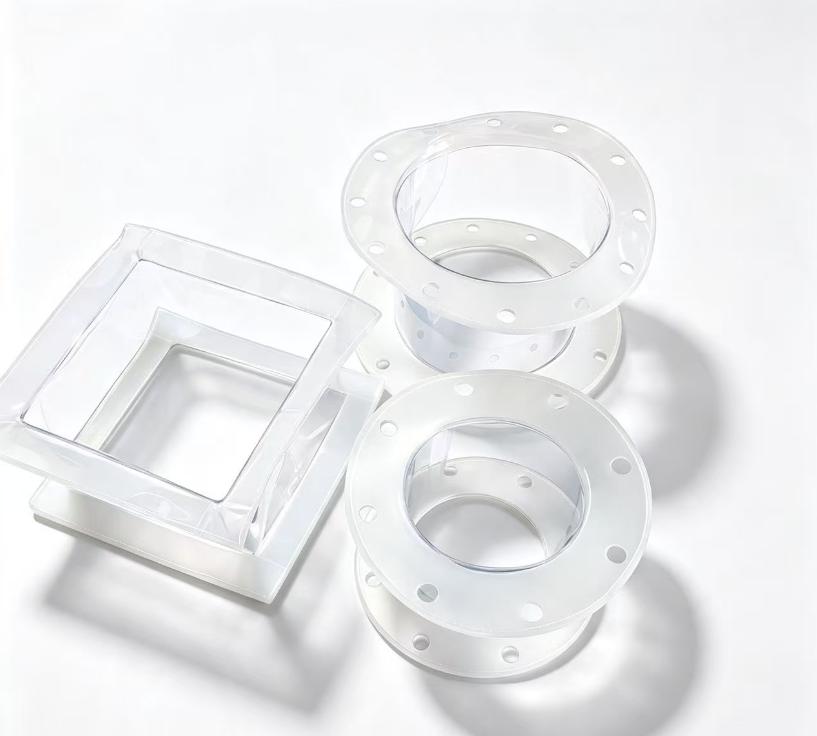
- Non-standard TC ferrules — clamp OD machined to your spigot, not forced into 114/119/133 mm.
- Mixed ends — flange top / TC bottom, cam-lock, or inner-spring combinations for retrofit.
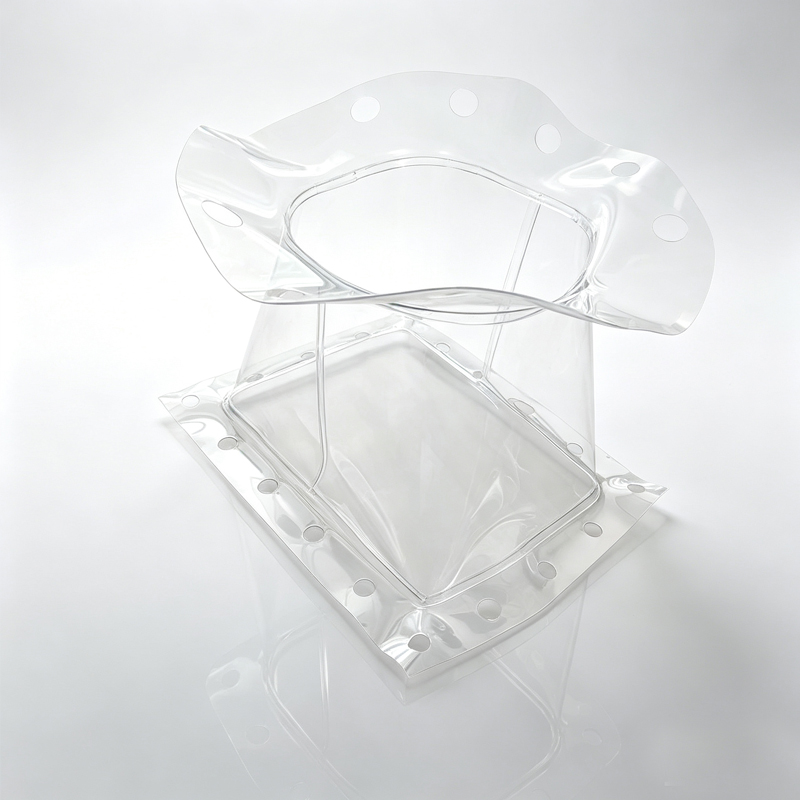
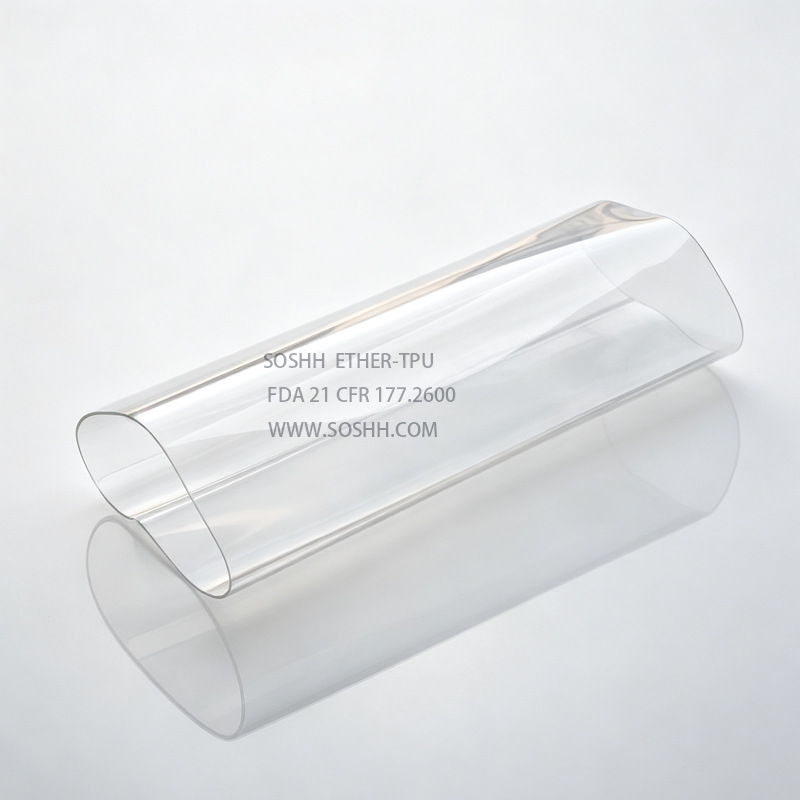
- Thin-wall ether-TPU (0.8–1.0 mm) — low reaction force, smooth flow in micro-dosing.
- Conductive helix + ground tab — for static-safe micro-powder lines (LIB cathode, silica).
- ±0.5 mm cuff-to-spigot fit — the difference between a leak-free snap-in and powder bypass.
- Proprietary quick-lock cuff with captive blue gasket — seats in seconds with no PTFE tape, no wrench marathon, up to ~80% faster changeover than a threaded union.
- Flange-ring adapters and mixed ends — black bolted flange collar on one side, TC / cam-lock / inner-spring on the other, for retrofit where top and bottom are different.
Why ±0.5 mm Is the Difference Between Sealing and Leaking
Small-bore leaks are almost never about the material — they are about the fit between the steel groove and the spring-expansion cuff:
- Too loose → powder bypasses at the joint.
- Too tight → the cuff cannot seat or release by hand.
SOSHH holds the cuff-to-spigot match to ±0.5 mm, so the inner-spring ring locks dust-tight under its own tension and still releases tool-free in under 30 seconds. If your current sleeve leaks at the groove, check the groove depth and cuff OD first — this is the failure, not the TPU.
3. Material Options
| MATERIAL | TEMP RANGE | SURFACE RESISTANCE | USE |
|---|
| Ether-TPU | −20 to +110 °C | >10¹² Ω | General micro-powder |
| Antistatic TPU | −20 to +110 °C | <10⁹ Ω | LIB, silica, explosive dust |
| PTFE | −40 to +260 °C (special high-temp grade to +300 °C on request) | >10¹² Ω / <10⁶ Ω (AS) | Corrosive, hot micro-powder |
| FKM | Mid-high temp | — | Solvent/oil duty |
Temperature Ratings, Clarified
Small-bore lines are often hot and cramped, so the material ceiling matters:
- Standard ether-TPU: −20 to +110 °C continuous, short-term +120 °C.
- High-temperature PU: to +150 °C (specify when powder exceeds 110 °C).
- PTFE: −40 to +260 °C continuous; a special grade to +300 °C is available on request.
- FKM: for solvent/oil duty at mid-to-high temperature.
Never select a small-bore sleeve on diameter alone — wall thickness, ferrule clearance and temperature rating all shrink together below DN40.
4. Specification
- Bore range: DN15–40 (1.5" ≈ DN40 / Ø38–50)
- Wall thickness: 0.8–1.0 mm ether-TPU (thinner on request)
- Connection: non-standard TC / flange / cam-lock / mixed-end
- Grounding: conductive helix + ground tab option
- Tolerance: ±0.5 mm cuff-to-spigot fit
- Changeover: under 30 seconds, tool-free
- Compliance: FDA 21 CFR 177.2600, EU 10/2011, phthalate-free
5. 4-Step Selection Checklist
- Send spigot OD, groove depth and lip thickness — non-standard small-bore is built from the drawing, not a catalogue diameter.
- State both ends — top and bottom may differ; send both, plus bolt-hole count and PCD if flanged.
- Confirm static requirement — LIB / silica micro-powder → conductive helix + ground tab.
- Check access space — small-bore lines have awkward clamp access; specify a quick-lock cuff if wrench space is tight.
6. FAQ
Q: My ferrule is a non-standard 33.4 mm — can you match it? Yes. We build the cuff to your spigot OD and groove depth with ±0.5 mm fit. Do not force a 114/119/133 mm standard onto a non-standard spigot.
Q: Can the small-bore sleeve be antistatic? Yes. A conductive helix with ground tab is available for LIB and silica micro-powders. Reports provided on request.
Q: What if my top is a flange and bottom is TC? Mixed-end miniature sleeves are standard SOSHH work. Send both end details.
Q: Can you do 1.5" (DN40) with a quick-lock cuff? Yes. A proprietary quick-lock cuff with captive blue gasket seats the sleeve in seconds — no PTFE tape, no wrench marathon.
Q: My small-bore line is hot AND antistatic — can one sleeve do both? Yes. For LIB / silica micro-powder above 110 °C, specify the conductive PTFE grade (10⁶–10⁹ Ω/sq, to +260 °C) instead of antistatic TPU. TPU antistatic stops at +110 °C; PTFE carries the static-dissipative property through higher temperatures.
Q: The groove on my spigot is shallow — will the cuff still lock? It depends on groove depth and lip thickness. Send both measurements and we machine the spring-expansion cuff to match. A shallow groove needs a different cuff profile, not a thicker wall.
Q: Can I cut a small-bore sleeve to length myself? Only on plain straight-bore ends. Inner-spring cuffs, TC ferrules and flange collars are factory-machined — do not field-cut them. Send the installed gap height and we build the length to spec.
Q: What material for ceramic / tungsten-molybdenum micro-powder? These are abrasive and metal-sensitive. Use PTFE or UHMW-PE bore with zero copper/zinc hardware. Specify “zero metal contamination” so we exclude brass and use 304/316L or non-metallic parts.
7. RFQ Fields — What to Send
- Bore (DN15–40 / 1.5")
- Spigot OD, groove depth, lip thickness (top & bottom)
- Installed gap height
- Powder media and bulk density
- Temperature and CIP temperature (°C)
- Static requirement (dissipative <10⁹ Ω or conductive earthed)
- End type (non-standard TC / flange / cam-lock / mixed)
- Access space / wrench clearance
8. Get a Working Solution, Not a Catalogue Part
Every SOSHH small-bore sleeve is engineered to your spigot, not forced from a size chart.
Three steps:
- Tell us the duty — bore, spigot OD/groove depth, installed gap, powder media, temperature, static requirement.
- Send a photo or drawing — the existing spigot, the groove, or a 2D sketch. For flange ends, add bolt-hole count and PCD.
- Get your proposal — we confirm material, cuff fit and tolerance, then return a quotation, lead time and compliance documents.
Email photos or drawings to amin@soshh.com or attach them through the enquiry form below — a SOSHH application engineer replies with a fit-for-purpose solution, not a price-only quote.