1. What This Connector Solves
Three failures keep coming up on vibrating screens, feeders and vacuum lines — and they are the exact questions buyers send us.
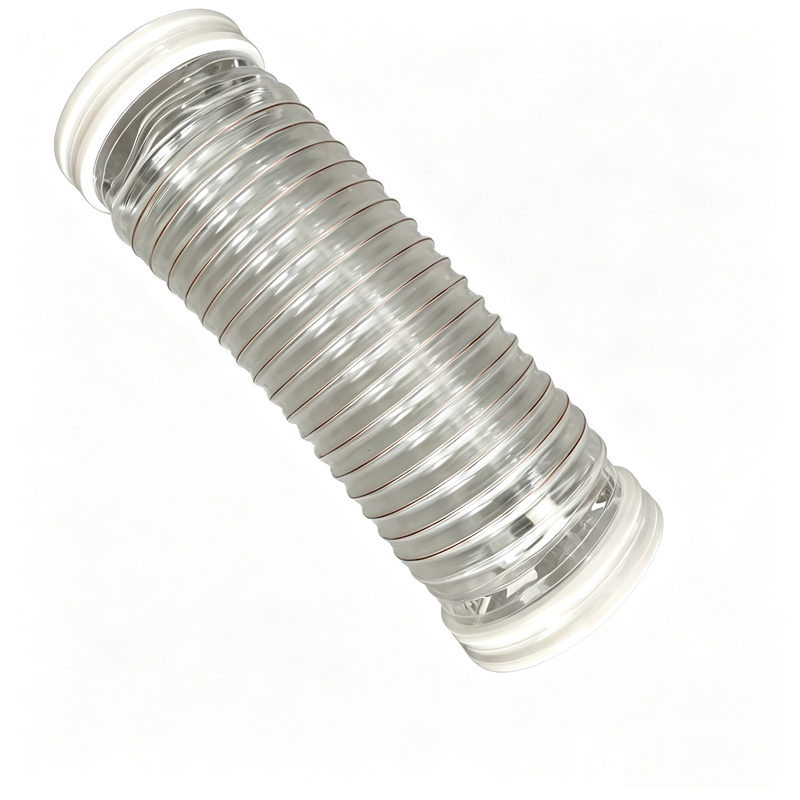
First — vacuum collapse. “How much vacuum can it take? Will it flatten?” A plain thin-wall TPU sleeve sucks inward at roughly −20 to −30 kPa, chokes the bore and stops powder flow. The fix is reinforcement, not a thicker wall.
Second — stroke tearing. “Will it break in the middle under up-down vibration?” When a screen lifts or strokes, a fixed sleeve rips at the seam or pulls off the spigot. The wire skeleton turns that movement into axial compression and extension.
Third — clamp loosening. “The clamp is too long — I have to shorten it 0.5–1 cm, otherwise the screw bottoms out but it’s still loose.” A hose clamp vibrates loose and leaks powder. The inner-spring cuff locks into a machined groove and does not depend on clamp tension.
The common thread: on moving, vibrating, vacuum-loaded equipment, the joint and the wall fail separately. SOSHH engineers both at once.
2. How the Inner-Spring Seal Works (No Clamp, No Gasket)
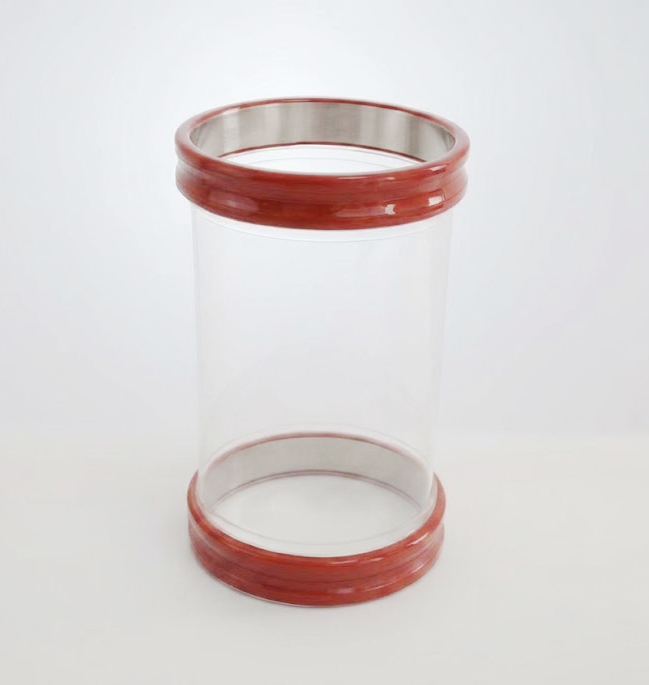
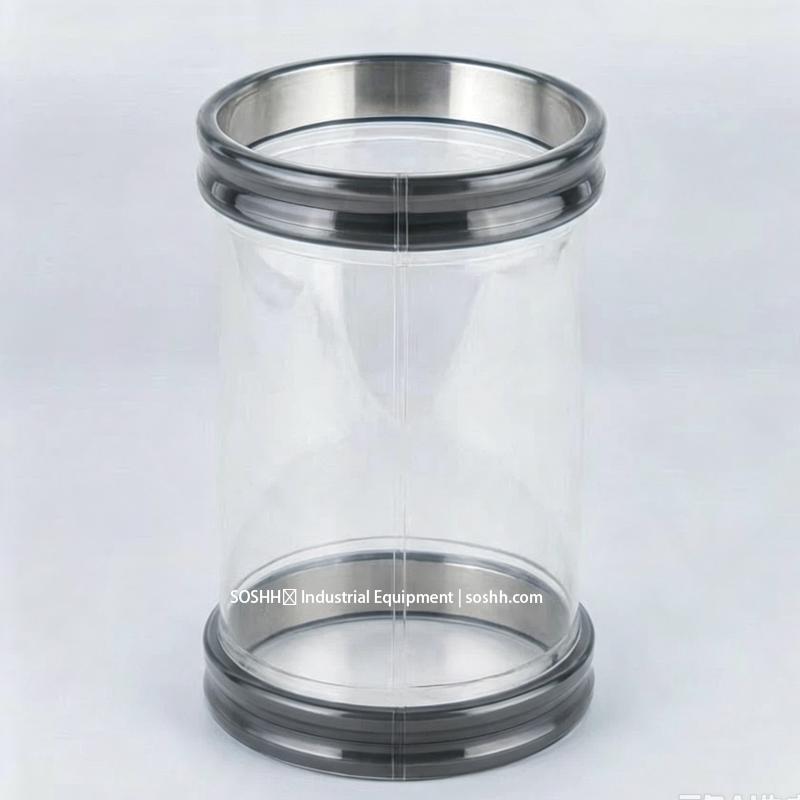
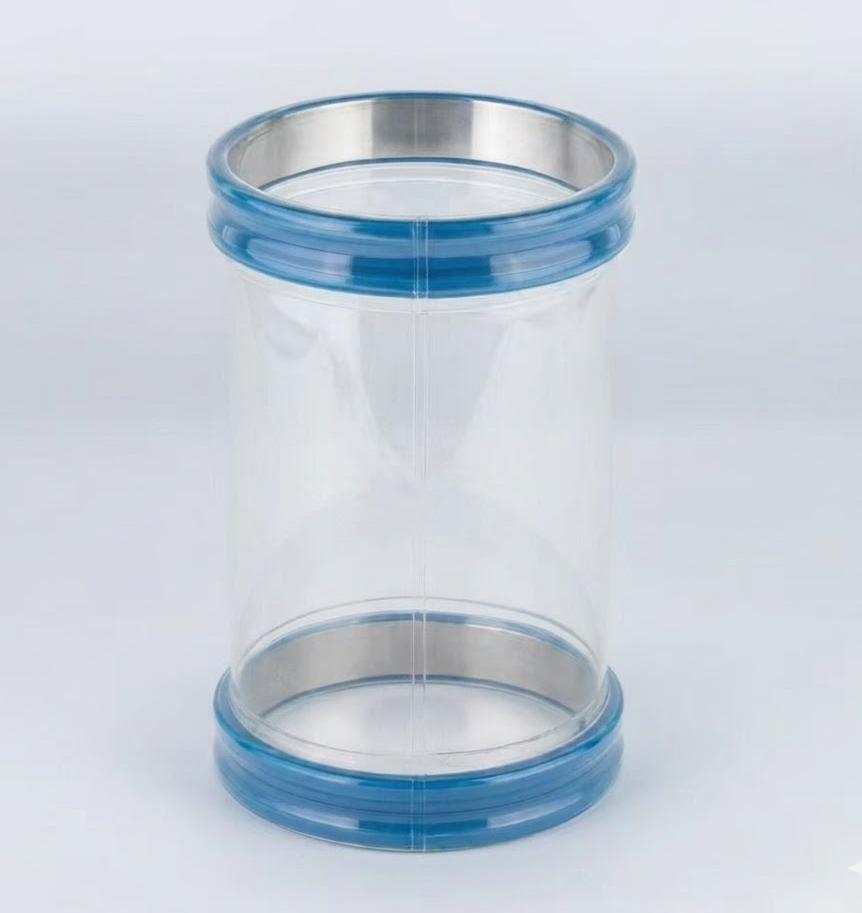
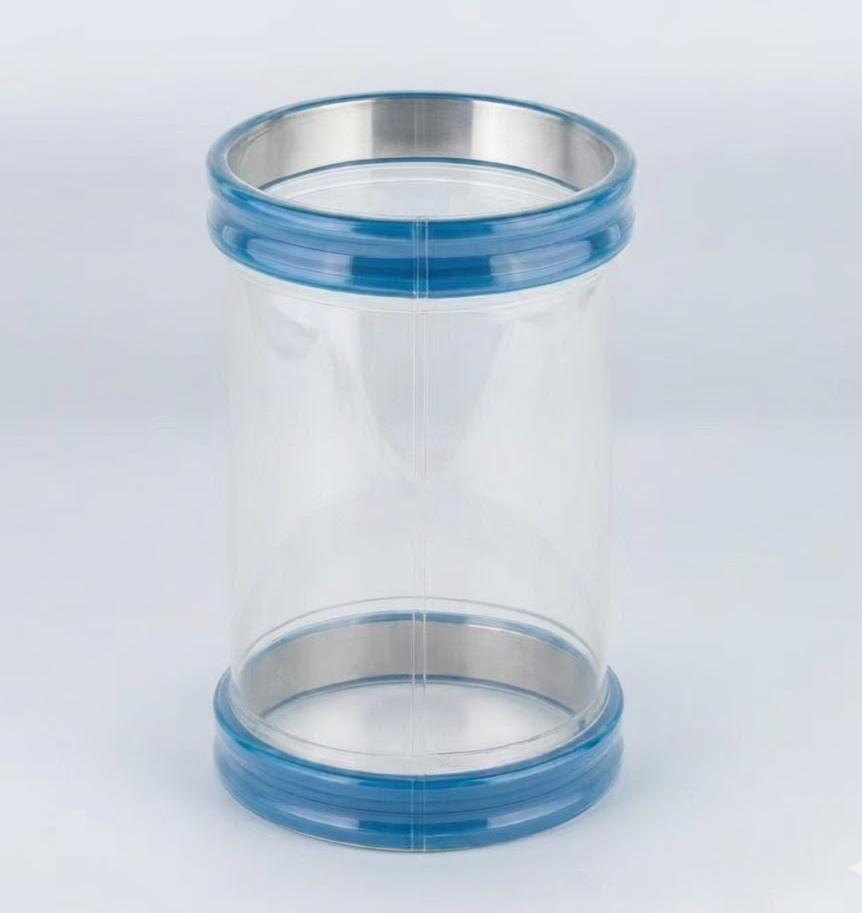
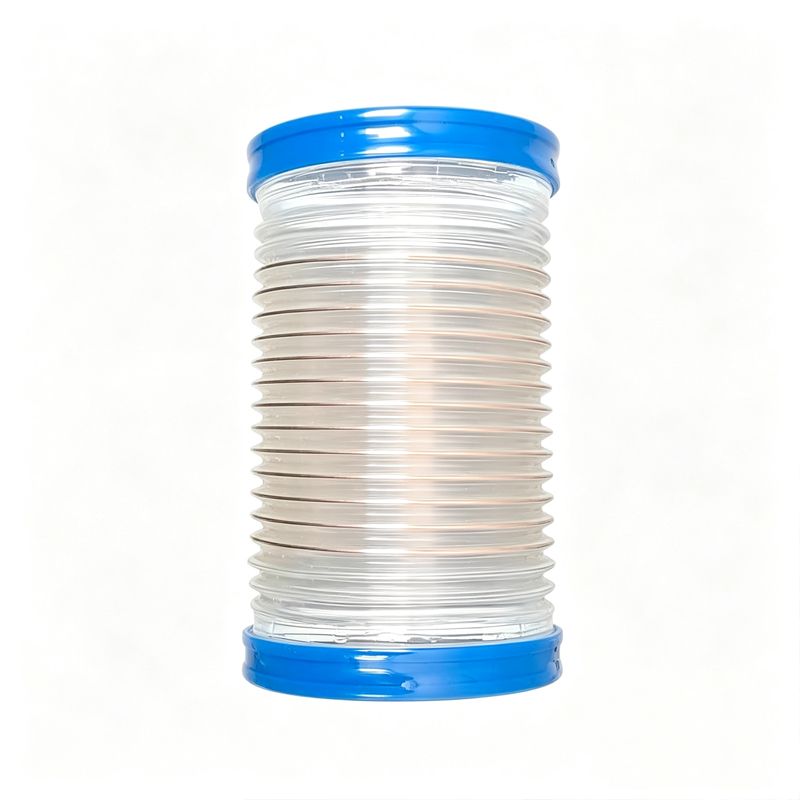
Each end carries an inner-spring expansion cuff that seats into a machined groove on the stainless steel spigot.
- The cuff is machined to a ±0.5 mm fit with your groove depth and spigot OD.
- It locks under its own spring tension and releases by hand.
- No wrench, no hose clamp, no PTFE tape, no separate gasket.
The seal is the cuff-to-groove fit itself. Buyers ask: “Does it need a gasket? How is the static bond fixed?” No separate gasket is required for the seal; on antistatic builds, the static path is made through a dedicated ground tab at each end.
Changeover takes under 30 seconds per end — push to seat, pull to remove.
3. Vacuum Anti-Collapse: Wire vs Ring
There are two separate problems, answered separately.
The 304 coiled-wire skeleton (in the wall):
- Keeps the bore round under moderate vacuum.
- Absorbs axial stroke and vibration.
- Rated for positive pressure around +30 kPa (0.3 bar) in standard build.
The support ring (for deeper vacuum):
- Buyers ask: “Can it take −1000 mbar?” Full vacuum (−0.1 MPa) requires ring reinforcement, not wire alone.
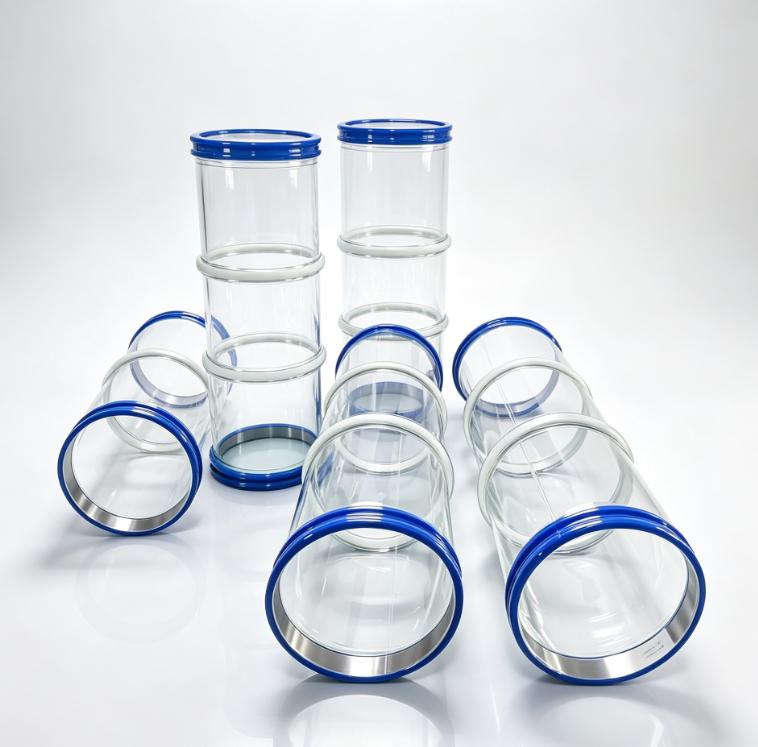
- Standard vacuum conveying → 304/316L support ring or helical coil.
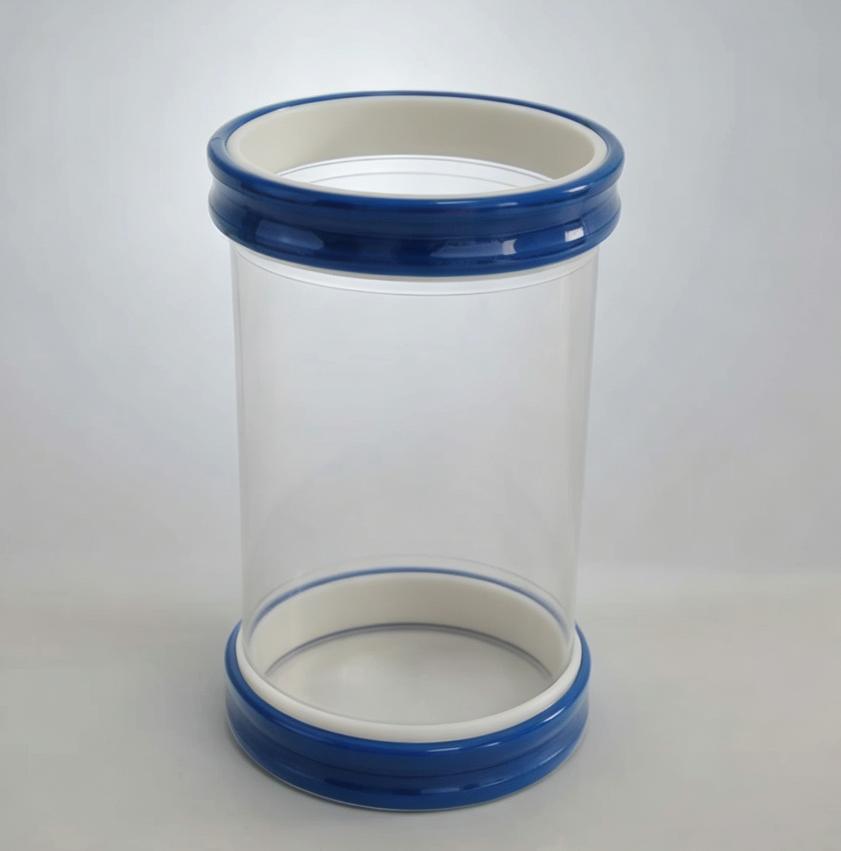
- Metal-detector / X-ray lines → non-metallic POM ring in an HF-welded external pocket, so no steel sits in the product path and the detector does not false-reject.
Buyers also ask: “Can it handle −0.1 to +0.1 MPa?” That range is beyond a single wire skeleton and needs ring or composite reinforcement. We select the structure from the worst-case differential — never “any pressure.”
4. Compression & Stroke
- Standard compression ratio: 3.5:1–4:1 — a 700 mm extended sleeve collapses to roughly 80 mm.
- Axial stroke built to your movement, typically 20–100 mm.
- The sleeve telescopes with the screen; the wire absorbs the stroke instead of tearing the material at the weld line.
Buyers ask: “What is the compression ratio? 700 mm extended, what is the collapsed height?” Standard answer: 700 mm extended compresses to about 80 mm.
5. Material & Specification
| PARAMETER | SOSHH STANDARD |
|---|
| Material | Transparent ether-TPU, food-contact grade available |
| Reinforcement | 304 stainless coiled wire in the wall; 304/316L or non-metallic POM ring for deeper vacuum |
| Connection | Inner-spring snap-in, both ends (TC clamp / flange / mixed options) |
| Working pressure | +30 kPa (0.3 bar) standard; higher with ring/composite design |
| Working vacuum | Moderate with coiled wire; to −0.1 MPa (−1000 mbar) with ring reinforcement |
| Compression ratio | 3.5:1–4:1 (700 mm → ~80 mm) |
| Continuous temperature | −20 to +110 °C (short-term +120 °C); high-temp PU to +150 °C; PTFE to +260 °C |
| Surface resistance | 10⁶–10⁹ Ω static-dissipative option (permanent, not a spray); conductive grade available, bonded at both ends |
| Hardness | Shore A 85–90 (structural under suction) |
| Cuff tolerance | ±0.5 mm cuff-to-spigot fit |
| Size range | Quick-install to DN500; non-standard custom 200–800 mm |
| Length | Custom, built to installation gap |
| Changeover | Under 30 seconds, tool-free |
| Welding | High-frequency (HF) welded — no stitch holes, no adhesive, no delamination in CIP |
| Metal control | Copper-free / zinc-free option for metal-sensitive lines |
6. Antistatic & Earthed Grade
Buyers ask: “Is it antistatic? Conductive? I need below 10⁸ ohms.” and “Does the antistatic property wash off?”
- Static-dissipative grade: surface resistance 10⁶–10⁹ Ω — permanent molecular-grade property, not a topical spray that washes off in CIP.
- Conductive grade: low end-to-end resistance (0.5 Ω measured on request), must be bonded to equipment ground at both ends.
- Transparent dissipative option available; a fully conductive carbon-filled version is dark.
The standard grade is insulating and does not dissipate charge. Specify antistatic explicitly when the powder is combustible — do not assume “food-grade” means “antistatic.”
7. Selection & Installation Checklist
- State both pressure values — vacuum and positive. Wall thickness and reinforcement are selected for the worst-case differential.
- Send extended and collapsed heights — compression ratio is built to your stroke (e.g. 700 mm → 80 mm). We confirm feasibility before fabrication.
- Confirm metal-detector or X-ray position — detector downstream → non-metallic POM ring, never steel wire in the product path.
- Measure the spigot groove — the cuff is machined to your groove depth and spigot OD at ±0.5 mm. Send groove dimensions, not just the pipe diameter.
- Specify antistatic if the powder is combustible — state “dissipative 10⁶–10⁹ Ω” or “conductive earthed,” not just “antistatic.”
8. FAQ
How much vacuum can it take before collapsing? A plain thin-wall TPU sleeve collapses around −20 to −30 kPa. The coiled-wire version holds the bore open under moderate vacuum. For −1000 mbar (full vacuum), specify ring reinforcement. On metal-detector lines, use the non-metallic POM ring.
Will it break in the middle under up-down vibration? No. The 304 wire skeleton converts screen stroke into axial compression and extension, so the material does not tear at the weld line. Ring pitch and wall thickness are engineered from your amplitude and frequency.
Can both ends be inner-spring (snap-in)? Yes. Both ends use inner-spring expansion cuffs with a ±0.5 mm fit; changeover is tool-free and under 30 seconds per end.
What is the compression ratio? 700 mm extended, what is the collapsed height? Standard ratio is 3.5:1–4:1, so 700 mm extended compresses to roughly 80 mm. Send your required stroke and we confirm the exact ratio before fabrication.
Does it need a separate gasket? No. The cuff-to-groove fit is the seal. For antistatic builds, the static path is made through a dedicated ground tab, not through the seal.
Can it handle −0.1 to +0.1 MPa? That range is beyond a single wire skeleton and needs ring or composite reinforcement. Send positive pressure, vacuum, diameter and height — we select the structure for the worst-case differential.
Will the wire trip a metal detector? Potentially yes — any steel near the product path can cause false rejects. For metal-detector or X-ray lines, specify the non-metallic POM ring grade instead of the 304 wire.
Is it suitable for feed-mill vibrating screens? Yes. Ether-TPU is abrasion- and tear-resistant, and the wire skeleton absorbs screen vibration. Service life depends on amplitude, frequency, media and temperature — send these and we confirm the right wall and ring pitch.
Is the inner wall smooth? Can you make 114 mm diameter? Yes, the bore is smooth and non-sticking. 114 mm and non-standard diameters are built to your spigot size, up to DN500 standard and 800 mm custom.
Is it copper-free / zinc-free? Yes, a copper-free and zinc-free build is available for metal-sensitive powder lines. Specify this explicitly when the product must avoid metal contamination.
Can it be used for lithium-battery (LFP) negative-pressure transfer? Yes. For LiFePO4 under vacuum, the inner-spring sleeve keeps the bore open; the antistatic dissipative grade (10⁶–10⁹ Ω) with grounding tab is required for combustible battery dust.
9. RFQ Fields — What to Send
- Port OD/ID, top and bottom (they may differ)
- Spigot groove depth
- Installed gap height and stroke (extended / collapsed)
- Powder media and bulk density
- Temperature and CIP temperature (°C)
- Positive pressure and vacuum (kPa / bar / mbar)
- Vibration amplitude and frequency (if on a screen)
- Connection type (inner-spring / TC clamp / flange / mixed)
- Antistatic requirement (dissipative 10⁶–10⁹ Ω or conductive earthed)
- Metal detector or X-ray downstream?
- Copper/zinc-free requirement
10. Get a Working Solution, Not a Catalogue Part
Every SOSHH wire-reinforced connector is engineered to your spigot groove, stroke, media and pressure — never forced from a size chart.
Three steps:
- Tell us the duty — port OD/ID, groove depth, installed gap, stroke, powder media, temperature, vacuum/pressure, antistatic requirement.
- Send a photo or drawing — the existing sleeve, the spigot groove, or a 2D sketch. For flange ends, add bolt-hole count and PCD.
- Get your proposal — we confirm material, wire pitch, ring reinforcement, compression ratio and cuff tolerance, then return a quotation, lead time and compliance documents.
Email photos or drawings to [AMIN@SOSHH.COM] or attach them through the enquiry form below — a SOSHH application engineer replies with a fit-for-purpose solution, not a price-only quote.