





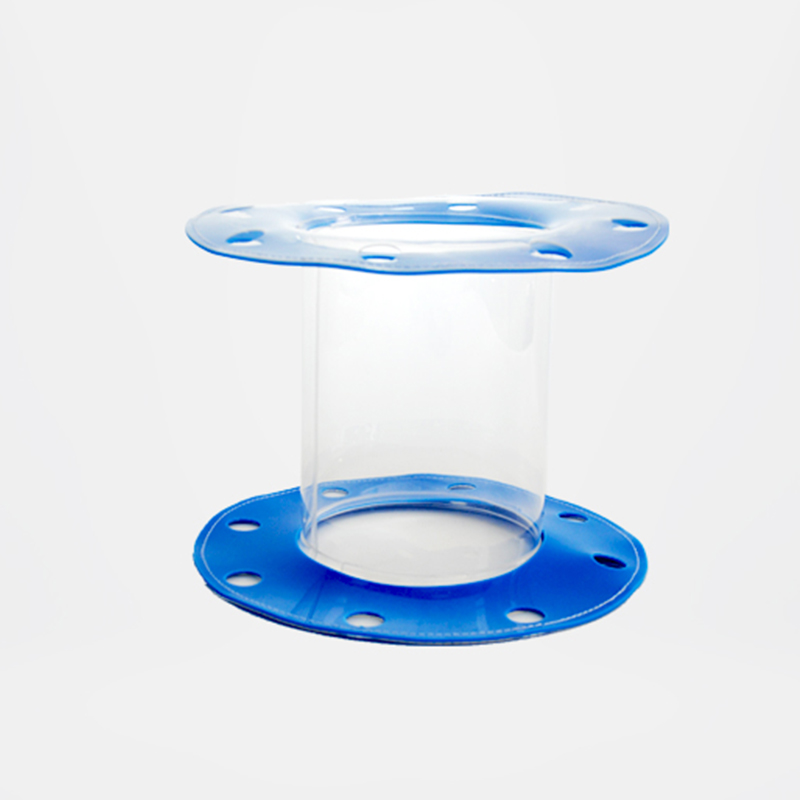
Hose-Clamp / Gasket-Seal Flexible Connector — Static-Seal Sleeve for Fixed Flange & Spigot Lines
1. What This Connector Is
The hose-clamp (HC) sleeve is the entry-level, field-retrofittable solution in the SOSHH range. It seals by clamping a flexible wall over a smooth pipe or spigot — no welding, no special groove required. It is the direct replacement for:
- Worn fabric/bag sleeves that leak and shed fiber.
- Silicone sleeves that hide blockages and tear at the clamp.
- Bolted rubber sleeves that crack under CIP and powder exposure.
The HC sleeve is transparent, so operators see bridging, rat-holing and wall wear before the sleeve fails — the same visibility that lets you shift from breakdown repair to planned changeover.
2. How the Hose-Clamp / Gasket Seal Works
The sealing principle is external compression: a worm-drive clamp or bolted gasket collar squeezes the sleeve wall onto the pipe OD.
This is correct for static duty. Where flanges and spigots are fixed and movement is under 3–5 mm, external clamp pressure is stable and dust-tight.
This is wrong for dynamic duty. On a vibrating screen, feeder or stroking discharger, clamp tension loosens under vibration, powder bypasses and the clamp bottoms out. For those lines, move to the wire-reinforced compressible sleeve — do not over-tighten an HC sleeve to compensate for movement it was never designed to absorb.
3. Installation Steps (Hose-Clamp / Gasket Type)
- Confirm the pipe or spigot is smooth and burr-free. Beaded, ribbed or rolled ends need a profiled gasket — send the cross-section before ordering.
- Slide the sleeve over the pipe end to the correct overlap length.
- Place the gasket (where specified) evenly around the pipe mouth.
- Fit the worm-drive clamp or gasket collar and tighten evenly by hand, then snug with a screwdriver.
- Repeat the opposite end, then re-check both clamps after the first hour of vibration — a static seal should not need constant re-tightening; if it does, the duty is dynamic and the sleeve type is wrong.
For beaded or ribbed pipes where a plain gasket cannot seat, SOSHH machines a profiled gasket profile to the pipe cross-section, and a 3M-backed PTFE sealing tape can fill the bead root for a bubble-tight low-pressure seal.
4. Gasket-Seal vs Expandable Sleeve — The Selection Rule
Choosing the wrong type causes both failures at once: a static sleeve tears on a moving discharger, and a heavy wire sleeve corrupts a scale reading. Match the sleeve to the movement, not the pipe diameter.
| DUTY | CORRECT SLEEVE | WRONG SLEEVE — AND WHY |
|---|---|---|
| Fixed flange / spigot, movement under 3–5 mm | Gasket-seal / hose-clamp sleeve (this HC series) | Wire sleeve — adds spring force, no benefit |
| Stroke 20–100 mm, vibration, screen motion | Wire-reinforced compressible sleeve | Static sleeve — tears at the weld line |
| Loss-in-weight feeder, load cell | 0.5 mm weighing bellows | 1.5 mm stiff sleeve — drifts the scale |
| High vacuum, metal detector downstream | Non-metallic POM ring sleeve | Steel wire — trips the detector |
| High vacuum, no detector | 304/316L ring or coiled wire | Plain TPU — collapses and chokes |
| Combustible dust (LIB, flour, silica) | Antistatic dissipative 10⁶–10⁹ Ω, grounded | Insulating sleeve — static builds, fire/explosion risk |
5. Material Specification
| MATERIAL | TEMPERATURE | SURFACE RESISTANCE | USE |
|---|---|---|---|
| Ether-TPU (transparent) | −20 to +110 °C | >10¹² Ω | General powder, food |
| Antistatic TPU | −20 to +110 °C | 10⁶–10⁹ Ω | Explosive dust, LIB |
| Conductive TPU | −20 to +110 °C | 0.5 Ω end-to-end | Grounded, bonded lines |
| PTFE | −40 to +260 °C | >10¹² Ω / 10⁶–10⁹ Ω (conductive) | Corrosive, hot |
| FKM | Mid-to-high temp | — | Solvent / oil duty |
End options: plain slip-on, gasket collar, hose clamp, TC clamp, flange, and mixed ends.
Size range: 38–500 mm bore standard, larger custom; length built to installation gap.
Welding: high-frequency (HF) welded seams — no stitch holes, no adhesive, no delamination in CIP.
6. FAQ
Does the HC sleeve need a separate gasket? For slip-on ends, the clamp pressure against the pipe forms the seal; where a gasket is specified, it sits between the sleeve and the pipe mouth. For beaded or ribbed pipes, a profiled gasket is required — a plain gasket will not seat.
My clamp is fully tight but the sleeve still leaks. Why? The seal is depending on clamp tension, which vibration destroys. If the equipment strokes or vibrates, the duty is dynamic — move to the wire-reinforced compressible sleeve, not a tighter clamp.
Can I cut the HC sleeve to length myself? Only on plain slip-on ends. Ends with gasket collars, flanges or cuffs are factory-formed — do not field-cut them. Send the installed gap height and we build the length to spec.
Will the HC sleeve collapse under vacuum? A plain TPU sleeve collapses around −20 to −30 kPa. For vacuum duty, specify a ring or wire-reinforced sleeve. The HC static seal is not a vacuum-rated structure.
Is it food-grade? Ether-TPU is available in FDA 21 CFR 177.2600 / EU 10/2011 compliant, phthalate-free grade. Antistatic and PTFE options are available for combustible or corrosive powders.
7. RFQ Fields — What to Send
- Pipe OD, top and bottom
- Pipe end type (smooth / beaded / ribbed / rolled)
- Installed gap height
- Powder media and bulk density
- Temperature and CIP temperature (°C)
- Pressure / vacuum (kPa / bar / mbar)
- Movement (axial / lateral mm)
- End type (slip-on / gasket collar / TC / flange / mixed)
- Antistatic requirement (dissipative 10⁶–10⁹ Ω or conductive earthed)
8. Get a Working Solution, Not a Catalogue Part
Every SOSHH sleeve is engineered to your pipe, movement, media and pressure — never forced from a size chart.
Three steps:
- Tell us the duty — pipe OD, end type, installed gap, media, temperature, pressure/vacuum, movement.
- Send a photo or drawing — the existing pipe end, the clamp, or a 2D sketch.
- Get your proposal — we confirm material, gasket profile and tolerance, then return a quotation, lead time and compliance documents.
Email photos or drawings to amin@soshh.com or attach them through the enquiry form below — a SOSHH application engineer replies with a fit-for-purpose solution, not a price-only quote.