


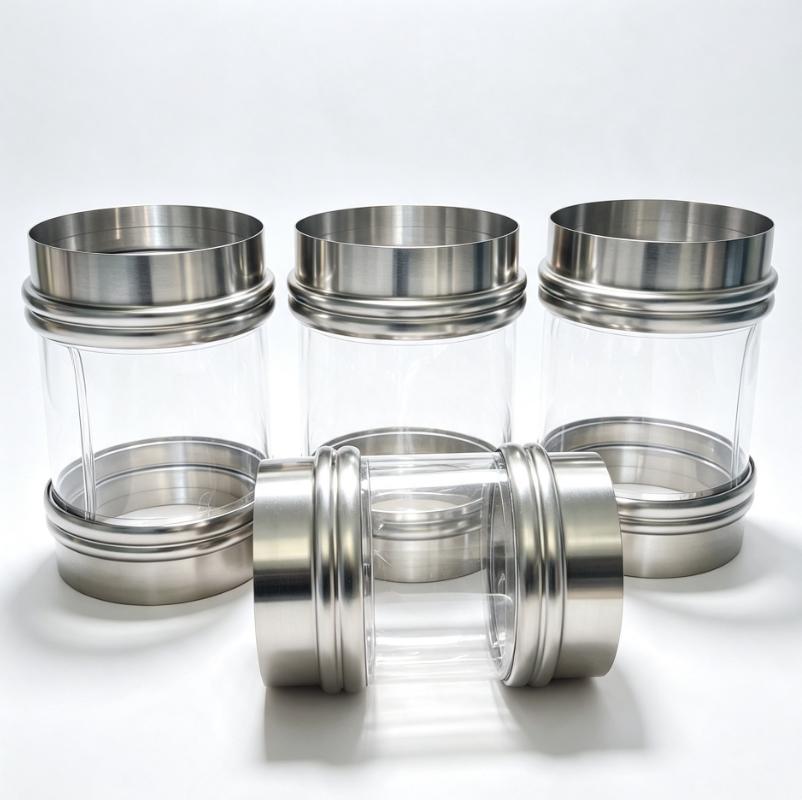
Improving Pipeline System Performance: 6 Benefits of Polyurethane Flexible Joints
1. What a Polyurethane Flexible Joint Is — and What It Is Not
A polyurethane (PU) flexible joint is the connector that bridges two fixed points in a powder-handling line — silo to hopper, sifter to packer, conveyor to chute. It absorbs vibration, tolerates misalignment and holds a dust-tight seal. It is not a generic rubber boot.
The difference is in the material decision. SOSHH joints are built exclusively from polyether TPU, the polymer class selected for hydrolysis resistance under hot water and caustic CIP — the failure mode that destroys cheaper ester TPU in humid plants.
| PARAMETER | VALUE |
|---|---|
| Tensile strength | 40 MPa |
| Elongation at break | ~600% |
| Shore hardness | Shore A 90 |
| DIN abrasion | 39.0 mg |
| Standard temperature | −20 to +110 °C |
| High-temp grade (PUHT) | −20 to +150 °C |
| Chemical / >150 °C | Pure PTFE, −40 to +300 °C, pH 0–14 |
2. The Six Benefits, Quantified
Benefit 1 — Abrasion Resistance: 39.0 mg DIN, ~10× Rubber
High-velocity powder acts as a sandblaster, thinning the wall of a standard sleeve within weeks. Polyether TPU carries a 39.0 mg DIN abrasion rating — roughly 10× the abrasion resistance of rubber — which is why it is the default for starch, sugar, minerals and battery cathode powder.
Benefit 2 — Vibration Dampening and Flex-Fatigue Life
Machinery vibration and fluid-flow pulsation fatigue the connector on every cycle. A hose clamp concentrates that stress on a single line and tears there first. Polyether TPU delivers ~600% elongation at break, absorbing high-frequency flex without micro-cracking — and the snap-in design removes the clamp-edge stress concentration entirely.
Benefit 3 — Temperature and Chemical Resistance, Correctly Specified
Here the specification must be precise, not vague. Polyurethane is not a universal high-temperature or strong-chemical material. The correct grade depends on the duty:
| EXPOSURE | CORRECT GRADE | CONTINUOUS RANGE |
|---|---|---|
| Ambient powder, washdown | Polyether TPU (PU-10 / PU-15) | −20 to +110 °C |
| Sustained heat / flash drying | PUHT | −20 to +150 °C |
| Strong acids, alkalis, solvents, >150 °C | Pure PTFE | −40 to +300 °C, pH 0–14 |
Specification warning: standard polyether TPU degrades above ~110 °C and is only moderately chemical-resistant. Pushing TPU into acid or solvent duty is the most common mis-specification we correct. For those lines, specify pure PTFE: https://www.soshh.com/collections/ptfe-corrugated-bellows
Benefit 4 — Reduced Maintenance and Downtime: Tool-Free <60 s Swap
Durability is only half the equation; changeover speed is the other. A snap-in joint is replaced tool-free in under 60 seconds — no wrench, no clamp, no torque setting. The cuff is HF-welded slightly undersized and snaps over the stainless spigot to reseal instantly.
Benefit 5 — Adaptability to Different Pipeline Systems
Standard diameters run Ø102–Ø804 mm, lengths 100–1000 mm, with custom to Ø1000 mm. Non-standard geometry — square-to-round, conical, eccentric — is fabricated as one-piece seamless sleeves with no tooling fee: https://www.soshh.com/collections/custom-non-standard-flexible-connectors
Benefit 6 — Seal Integrity and ATEX Safety
The HF-welded cuff fuses the TPU into a single homogeneous wall — no stitch holes, no glue lines, no delamination. The product-contact bore is 100% metal-free, crevice-free and flush, holding a 360° radial compression seal against the spigot. For combustible dust, the anti-static grade PU-10-AS (10⁶–10⁹ Ω, ATEX Zones 20/21/22) dissipates charge through the material body — no internal wires, no grounding strap.
3. Grade Matrix: Match the Part Number to the Duty
| GRADE | WALL | KEY PROPERTIES | TYPICAL DUTY |
|---|---|---|---|
| PU-10 | 1.0 mm | 40 MPa, −20 to +110 °C, +0.35 bar / −50 mbar | Food, dairy, general powder |
| PU-15 | 1.5 mm | +0.70 bar / −120 mbar | Abrasive, higher-pressure |
| PU-10-AS | 1.0 mm | 10⁶–10⁹ Ω, no wires | Combustible dust, ATEX |
| PU-10-VR | — | Polymer rings, −1000 mbar | Full vacuum |
| PU-05-WB | 0.5 mm | Near-zero reaction force | Weighing, dosing |
Mating weld-on stainless spigot (SS304/SS316L): https://www.soshh.com/collections/sf-snap-in-flexible-connectors/products/sf-internal-snap-on-steel-spigot-connector-2mm
4. Operations: Troubleshooting the Common Failures
| # | SYMPTOM | ROOT CAUSE | CORRECTIVE ACTION |
|---|---|---|---|
| 1 | Cuff-edge tearing | Clamp stress concentration + flex | Switch to snap-in 360° compression seal |
| 2 | Wall thinning / weeping | Abrasive powder + thin wall | Upgrade to PU-15 (1.5 mm) |
| 3 | Yellowing / cracking after CIP | Ester TPU hydrolysis | Switch to polyether TPU |
| 4 | Suction collapse | Vacuum beyond grade rating | Switch to PU-10-VR (−1000 mbar) |
| 5 | Static spark risk | Non-dissipative material | Switch to PU-10-AS (10⁶–10⁹ Ω) |
If a joint fails repeatedly, it is rarely “worn out” — it is mis-specified. SOSHH engineers provide a free duty audit and a corrected grade.
5. Procurement: TCO Over Unit Price
| COST ELEMENT | LOW-COST SUPPLIER | SOSHH.COM |
|---|---|---|
| Replacement frequency | High — repeated downtime | Low — 10× rubber abrasion |
| Changeover | Tool-heavy, minutes | Tool-free, <60 s |
| Compliance risk | Missing reports | FDA/ATEX/EN 10204 3.1 shipped |
| Inventory burden | Multiple grades | Engineer locks one correct grade |
MOQ and lead time: standard Ø102–Ø804 mm and lengths 100–1000 mm in stock; custom sizes carry no tooling fee, flexible MOQ and tiered volume pricing.
6. Frequently Asked Questions
Q1: How do I choose between PU-10 and PU-15? Food-grade, non-abrasive powder: PU-10 (1.0 mm). Abrasive powder or pressure above +0.35 bar: PU-15 (1.5 mm, +0.70 bar / −120 mbar).
Q2: Is polyurethane food-contact safe? SOSHH polyether TPU is compliant with FDA 21 CFR 177.2600 (Report TQT4821B36E), EU 10/2011 and EC 1935/2004, and is latex-free and phthalate-free.
Q3: Can polyurethane handle high temperature or strong chemicals? Standard polyether TPU runs −20 to +110 °C. For sustained heat, specify PUHT (−20 to +150 °C). For strong acids, solvents or >150 °C, specify pure PTFE (−40 to +300 °C, pH 0–14).
Q4: What is the difference between HF welding and a glued seam? HF welding fuses the TPU into a single homogeneous wall — no stitch holes, no glue lines, no delamination — leaving a flush, crevice-free, metal-free bore.
Q5: Do I need a gasket with the snap-in joint? No. The HF-welded cuff forms a 360° radial compression seal directly against the spigot, eliminating the gasket and its leak path.
7. Request Engineering Review
Replacing a worn joint or upgrading a leaking pipeline? Send us your spigot OD, length, powder type, operating temperature and pressure — we’ll confirm the correct sleeve + spigot configuration and return a watermarked 2D approval drawing within 24 hours.
1-piece prototype testing is available, with 100% of the sample fee credited toward your first bulk order exceeding $3,000.
- TPU flexible connections
- PU Snap-in Flexible Connectors
- TPU Flexible Connectors
- PU Snap-in Connector Manufacturer
- Wholesale Polyurethane Connectors
- Food grade PU snap-in sleeve
- best flexible connector for powder transfer
- Vibrating Screen Flexible Joint
- Engineering Guides
- Polyether TPU
- Food Grade TPU Sleeve
- FDA 21 CFR 177.2600