





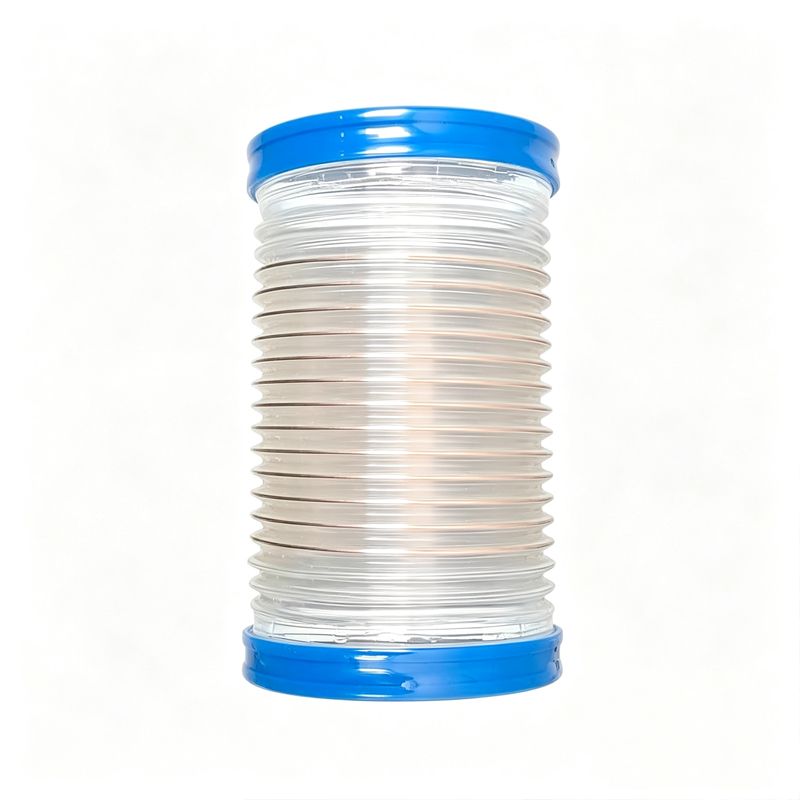
Zero Reaction Force: Ultra-Flexible Bellows for Loss-in-Weight Feeders & Hoppers
Zero Reaction Force: Ultra-Flexible Bellows for Loss-in-Weight Feeders & Hoppers
⚡ Executive Summary for Process & Instrumentation Engineers
- Eliminates Load Cell Signal Drift: Isolates weighing hoppers and loss-in-weight feeders from rigid plant piping, removing mechanical tare resistance and restoring gravimetric dosing precision to within ±0.1%.
- Zero Reaction Force Design (< 0.05 N): Diaphragm-style multi-convolutions absorb vertical stroke, lateral offset, and angular misalignments without exerting opposing mechanical resistance onto load cells.
- Ultra-Soft 70 Shore A Polyether-TPU: Custom-compounded soft ether-grade elastomer delivers maximum flexural compliance while maintaining > 110 N/mm tear strength.
- 100% Sanitary & Food-Grade: Fully compliant with FDA 21 CFR 177.2600 and EU 10/2011 regulations; sweeping internal radii prevent powder bridging and deadload buildup.
- Fig 1. SOSHH zero-reaction-force TPU weighing bellows installed on a precision gravimetric feeder.
In automated batching, continuous extrusion compounding, pharmaceutical blending, and infant nutrition packaging, precision weighing is critical. Modern loss-in-weight (LIW) feeders, micro-dosing systems, and gravimetric batching hoppers depend on ultra-sensitive load cells to control material feed rates with target accuracies as tight as ±0.1% to ±0.5%.
However, process engineers frequently encounter calibration errors, zero-point baseline drift, and erratic weight fluctuations. In over 80% of gravimetric dosing troubleshooting cases, the root cause is not electrical noise or a faulty load cell—it is mechanical force transmission from a standard flexible sleeve.
When standard thick-walled sleeves or rigid silicone connectors bridge the gap between a vibrating feed hopper and fixed upstream ducting, they act as stiff mechanical springs. This technical guide explains how sleeve stiffness distorts gravimetric dosing and how SOSHH® SF-WeighFlex™ Ultra-Flexible Weighing Bellows deliver true zero reaction force to safeguard load cell accuracy.
1. The Mechanical Interference: How Standard Sleeves Distort Weighing Accuracy
Standard straight flexible sleeves manufactured from 85 to 90 Shore A polyurethane, heavy silicone, or reinforced canvas exert measurable mechanical interference on weighing systems through three primary mechanisms:
The Spring Effect (Axial & Radial Stiffness)
Standard cylindrical sleeves possess natural elastic memory. As the weighing hopper fills or empties, minor vertical travel compresses or tensions the sleeve. This creates an opposing spring force that transfers directly onto the load cells, causing the control system to register false weight values.
Lateral Misalignment and Side-Loading
Thermal expansion and structural tolerances frequently cause slight lateral offsets between the hopper and the feeding chute. A stiff sleeve resists this offset, imposing a horizontal shear force (side-load) on load cell sensors, which are designed exclusively to measure pure vertical gravitational loads.
Powder Accumulation and Weight Deadload
Inferior corrugated sleeves with deep, sharp internal crevices allow fine powder to settle inside the folds. Over continuous production runs, kilograms of trapped material create an unmeasured, fluctuating deadload that throws off automatic tare calibrations.
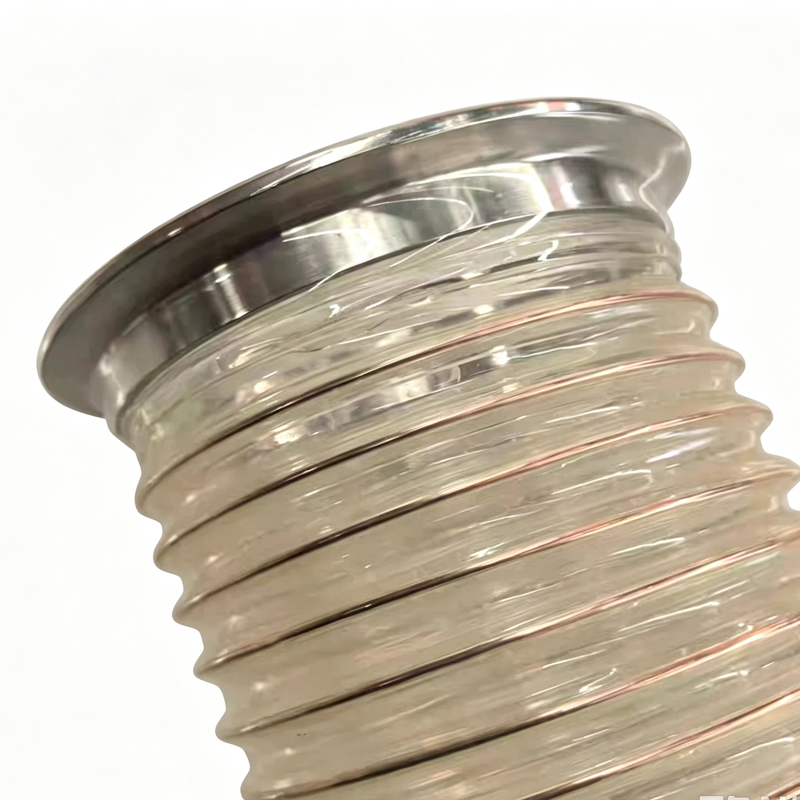
- Fig 2. Multi-convolution profile engineered to absorb 3D displacements with near-zero reaction force.
2. Engineering Zero Reaction Force: Multi-Convolution Geometry & 70 Shore A TPU
To achieve complete mechanical isolation without compromising dust containment, SOSHH Weighing Bellows combine advanced polymer chemistry with precision geometric engineering:
Custom 70 to 75 Shore A Polyether-TPU Formulation
While standard industrial sleeves use rigid 85A to 90A polymers, SOSHH utilizes a custom ultra-soft 70 Shore A polyether-based TPU. This elastomer provides exceptional flexural compliance, requiring minimal mechanical force to bend or compress.
Calibrated Multi-Convolution Bellows Geometry
Rather than a straight cylinder, the connector features precision-formed convolutions. When axial or lateral movement occurs, the convolutions flex like a diaphragm. The reaction force exerted on the load cell is virtually zero (less than 0.05 N), keeping load cell readings entirely unaffected by movement.
Swept-Root Internal Contour (Anti-Bridging)
The internal roots of the convolutions are engineered with smooth, sweeping radii rather than sharp V-grooves. When paired with high-clarity transparent walls, powder slides through without stagnating, ensuring clean product changeovers and zero deadload buildup.
3. Engineering Comparison: Standard Sleeves vs. SOSHH Weighing Bellows
| Performance Metric | Standard Cylindrical Sleeves | SOSHH® SF-WeighFlex™ Bellows | Engineering Impact on Dosing |
|---|---|---|---|
| Material Hardness | 85 to 90 Shore A (Stiff polymer) | 70 to 75 Shore A (Ultra-soft) | Reduces initial bending resistance by > 80% |
| Reaction Force on Load Cell | High (5.0 N to 50.0 N) | < 0.05 N (Virtually Zero) | Eliminates load cell tare signal distortion |
| Zero-Point Baseline Stability | Frequent baseline drift | Completely Stable | Reduces manual zero recalibration frequency |
| 3D Offset Absorption | Poor (Causes horizontal side-load) | Axial ±30 mm / Lateral ±20 mm | Protects single-point shear beam load cells |
| Gravimetric Dosing Precision | ±1.0% to ±3.0% (Sub-optimal) | ±0.1% to ±0.2% (High Precision) | Ensures batch consistency in micro-dosing |
| Dust Tightness | Prone to clamp leaks under vibration | 100% Hermetic Dust-Tight | Prevents powder dusting in cleanroom suites |
4. Performance Benchmark: Drop-In Replacement for Industry Standard Flexible Sleeves
SOSHH® SF-WeighFlex™ Ultra-Flexible TPU Weighing Bellows is engineered as a Form-Fit-Function drop-in replacement for standard industry precision weighing sleeves:
| Engineering Parameter | Standard Market Flexible Sleeve | SOSHH® SF-WeighFlex™ TPU Bellows |
|---|---|---|
| Tear Strength (Die C) | 67 N/mm | 110+ N/mm (Enhanced Tear & Wear Resistance) |
| Elongation at Break | 593% | 700%+ (Extended Cyclic Flex Fatigue Life) |
| Material Hardness | 90 Shore A (Stiffer elastomer) | 70 to 75 Shore A (Ultra-Soft Custom Formulation) |
| Mechanical Reaction Force | Noticeable spring resistance | < 0.05 N (True Zero-Force Mechanical Isolation) |
| Optical Clarity | Translucent | High-Clarity Transparent (100% Visual Flow Monitoring) |
| Sanitary Compliance | FDA 21 CFR 177.1680 / 177.2600 | FDA 21 CFR 177.2600 + EU Regulation 10/2011 |
| Tooling & Custom Lead Time | Standard sizes only; 4–8 weeks | Zero Tooling Fee on Custom Geometries; 7-Day Dispatch |
5. Sanitary Compliance & Quality Documentation
To satisfy strict quality assurance and regulatory audits in food and pharmaceutical manufacturing, every SOSHH weighing connector is supported by complete documentation:
- Declaration of Compliance (DoC): Certified compliant with US FDA 21 CFR 177.2600.
- EU Migration Reports: Full compliance testing per EU Regulation 10/2011 & EC 1935/2004 (SGS / TÜV tested).
- High-Purity Formulation: 100% virgin polyether-TPU (Free of phthalate plasticizers, BPA, and heavy metals).
- Batch Traceability: Laser-etched batch traceability codes for hygienic plant maintenance records.
- Material Certification: EN 10204 3.1 Inspection Certificates available upon request.
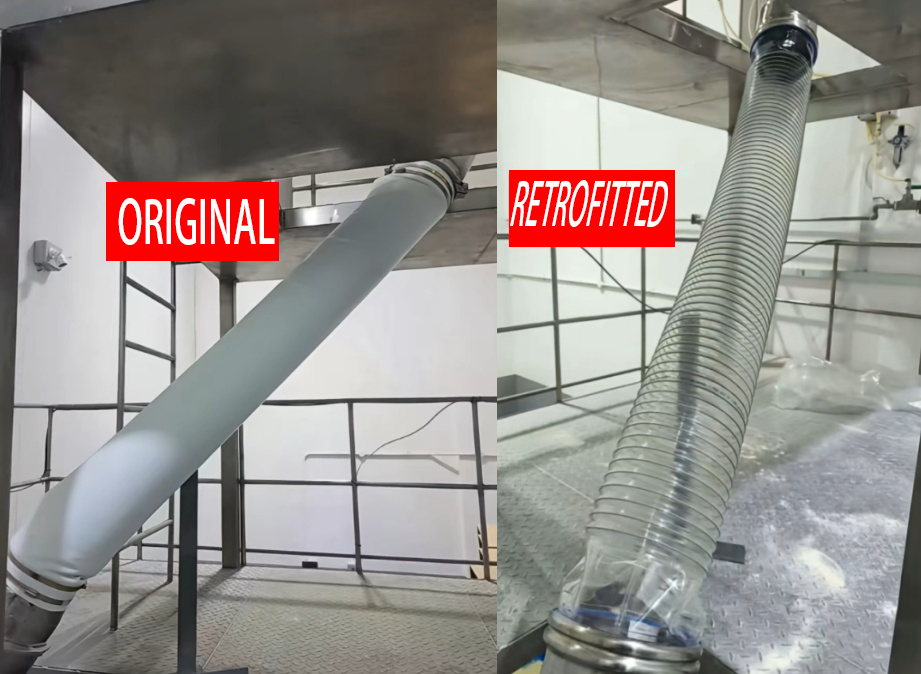
- Fig 3. Real-world case study: Replacing stiff legacy canvas sleeves with SOSHH® zero-reaction-force TPU weighing bellows on a dosing hopper.
6. Key Application Scenarios in High-Precision Powder Processing
Loss-in-Weight (LIW) Continuous Screw Feeders
Installed between the refill hopper and the weighing feeder (e.g., Brabender, Coperion K-Tron style systems), ensuring refill pulses do not disrupt gravimetric feeding control.
Batch Weighing Tanks & Gain-in-Weight Hoppers
Connecting recipe dosing hoppers above ribbon blenders or mixing vessels, isolating the vessel from plant structural vibrations.
Micro-Dosing Ingredient Feeders
Used in pharmaceutical API dispensing and infant formula premix stations where additions of 50 to 500 grams require absolute load cell sensitivity.
7. Technical Specifications: SOSHH SF-WeighFlex™ Bellows
| Specification Category | Engineering Parameter & Standard |
|---|---|
| Base Polymer | 100% Virgin Ether-Grade TPU (Plasticizer-free, hydrolysis-resistant) |
| Durometer Hardness | 70 to 75 Shore A (Custom ultra-soft grade) |
| Convolution Profiles | Multi-convolution continuous flex geometry with smooth swept roots |
| Standard Diameters | DN50 (2"), DN100 (4"), DN150 (6"), DN200 (8"), DN250 (10"), DN300 (12") up to DN600 |
| Deflection Capacity | Axial compression/extension: ±30 mm | Lateral offset: ±20 mm |
| Operating Temperature | -25°C to +85°C (Intermittent steam/CIP peaks up to +100°C) |
| Regulatory Approvals | FDA 21 CFR 177.2600, EU 10/2011, EC 1935/2004, 3-A Sanitary |
| Available End Interfaces | Snap-in SF Rings (Blue/White), Sanitary Tri-Clamp Ferrules, Plain Clamp-on |
8. Frequently Asked Questions (FAQ)
Q1: Why do precision loss-in-weight feeders require zero reaction force?
A1: Loss-in-weight feeders calculate feed rates by monitoring milligram-level weight loss over milliseconds. Stiff conventional sleeves exert opposing mechanical spring forces as the hopper shifts, leading to tare baseline drift, calibration errors, and costly batch rejections.
Q2: Will fine powder accumulate inside the convolutions and affect the tare weight?
A2: No. SOSHH weighing bellows are designed with wide, sweeping internal convolution radii rather than tight V-notches. When material flows downwards, fine particles slide freely past the crests. The transparent wall allows operators to visually confirm that no powder bridging or stagnation occurs.
Q3: Can these bellows be installed as a direct retrofit on existing machinery?
A3: Yes. SOSHH supplies standard diameters from DN50 to DN300 and custom lengths with zero tooling fees. They fit directly onto standard industry spigots with 100% dimensional compatibility.
Q4: What is the difference between Blue and White Snap-In rings?
A4: Blue rings are the standard industrial Snap-in configuration, while White rings are certified for strict food and dairy contact under FDA and EU 10/2011 standards. Both offer the same 30-second tool-free installation and hermetic sealing mechanism.
9. Related Powder Handling Solutions
- SOSHH® SF-WeighFlex™ Ultra-Flexible TPU Weighing Bellows – Direct product page for load cell isolation sleeves.
- SOSHH® SF-StatFlex™ Permanent Anti-Static TPU Connectors – ATEX Zone 20/21 static-dissipative sleeves (10⁶ to 10⁹ Ω).
- SOSHH® SF-ClearFlex™ Standard Transparent Food-Grade TPU Sleeves – Transparent straight sleeves for sifters and chutes.
- SOSHH® SF-VacuScale™ PTFE Bellows – Chemical- and high-temperature-resistant weighing bellows up to +260°C.
- Stainless Steel Grooved Spigots (304 / 316L) – Precision-machined weld-in adapters for snap-in sleeves.
10. Request Your Engineering Consultation & Free Sample Kit
Not sure which convolution count, durometer, or end connection style fits your gravimetric feeder? Share your equipment model, hopper dimensions, and material characteristics—our engineers will respond with a custom 3D model and quotation within 24 hours.
- Free Sample Kits available for verified OEM & EPC engineering projects
- Custom Diameters, Lengths & Conical Transitions (Zero Tooling Fee)
- Direct Factory Supply with reliable DDP international shipping to your plant site
- 📧 Technical RFQ & CAD Review: amin@soshh.com
- 🌐 Official Website: www.soshh.com
- 📱 WhatsApp / Direct Engineering Support: +86 13567045023