


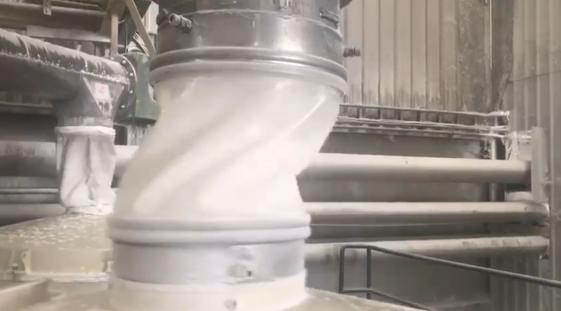
How to Measure & Size a Snap-In Flexible Connector: Dynamic Movement and Installation Guide
Learn how to measure and size snap-in flexible connectors for vibrating powder equipment. Verify metal spigot dimensions, installation gap, movement envelope, and dynamic length requirements to avoid sizing errors and premature failure.
READ MORE...
Why Vibrating Sifter Flexible Connectors Fail: TPU Material Selection, Fatigue Analysis, and Engineering Solutions
A vibrating sifter flexible connector is a dynamic fatigue component, not a static joint. It must absorb repeated bending, tension-compression, and vacuum pulsing while holding a seal. Premature failure is usually caused by wrong TPU grade, excessive vibration, poor geometry, or improper installation — not diameter alone. Correct sizing requires measuring the full movement envelope and matching a polyether TPU grade rated −30 to +110 °C continuous, +120 °C short-term peak, 85 °C CIP.
READ MORE...
Static Control in Powder Flexible Connectors: A Four-Level Engineering Framework for Combustible Dust Applications
Static control in powder handling systems requires more than an antistatic material specification. This engineering guide explains the four-level electrostatic control framework covering static dissipative TPU material, finished connector continuity, equipment bonding, and plant grounding for safe combustible dust processing.
READ MORE...
Polyether vs. Polyester TPU: Which TPU Material Is Better for Food, Pharma, and Powder Handling Applications?
Polyether TPU and polyester TPU are both used in industrial flexible connectors, but they perform differently in moisture, temperature, abrasion, and cleaning environments. Learn why polyether TPU is the preferred choice for food processing, pharmaceutical powder handling, fermentation, and CIP cleaning applications, while polyester TPU is mainly suitable for dry abrasive service.
READ MORE...
Flexible Connector TCO Calculator: Replacement, Labor & Downtime Cost
Flexible connector cost is not limited to the connector purchase price. A useful TCO calculation includes replacement frequency, maintenance labor, planned downtime, interface conversion cost, cleaning, inspection, failure response and, where applicable, weighing-system troubleshooting. This guide provides the formulas and a worksheet to calculate the true annual cost of a powder-handling connector installation, and to determine when changing the connection architecture pays back.
READ MORE...
How a Flexible Connector Affects Loss-in-Weight Feeder Accuracy
A loss-in-weight (LIW) feeder measures changes in the weight of its weighing assembly over time. That makes the mechanical connections around the weighing assembly part of the measurement system, not just part of the powder-containment system. A connector that is too stiff, incorrectly sized, installed under tension, exposed to excessive lateral movement, or coupled to a pressurized process can transmit forces back into the weighing structure. This guide explains how to select an ultra-flexible, low-reaction-force connector for loss-in-weight feeders, load-cell hoppers, batching systems and multi-head weighers.
READ MORE...
How to Choose an Abrasion-Resistant Flexible Connector
Choosing an abrasion-resistant flexible connector requires more than selecting a thicker wall. Engineers should consider the conveyed material, abrasion level, equipment movement, installation gap, temperature, pressure or vacuum, and connection geometry. This guide explains how to select TPU flexible connectors for abrasive powder handling and when a heavier-duty construction such as SOSHH PU-15 may be appropriate.
READ MORE...
Food-Grade Flexible Connectors: FDA 21 CFR 177.2600 Compliance, Explained
Why flexible connectors are compliant, not certified, under FDA 21 CFR 177.2600. Engineering guide to extractives migration testing and audit-proof documentation.
READ MORE...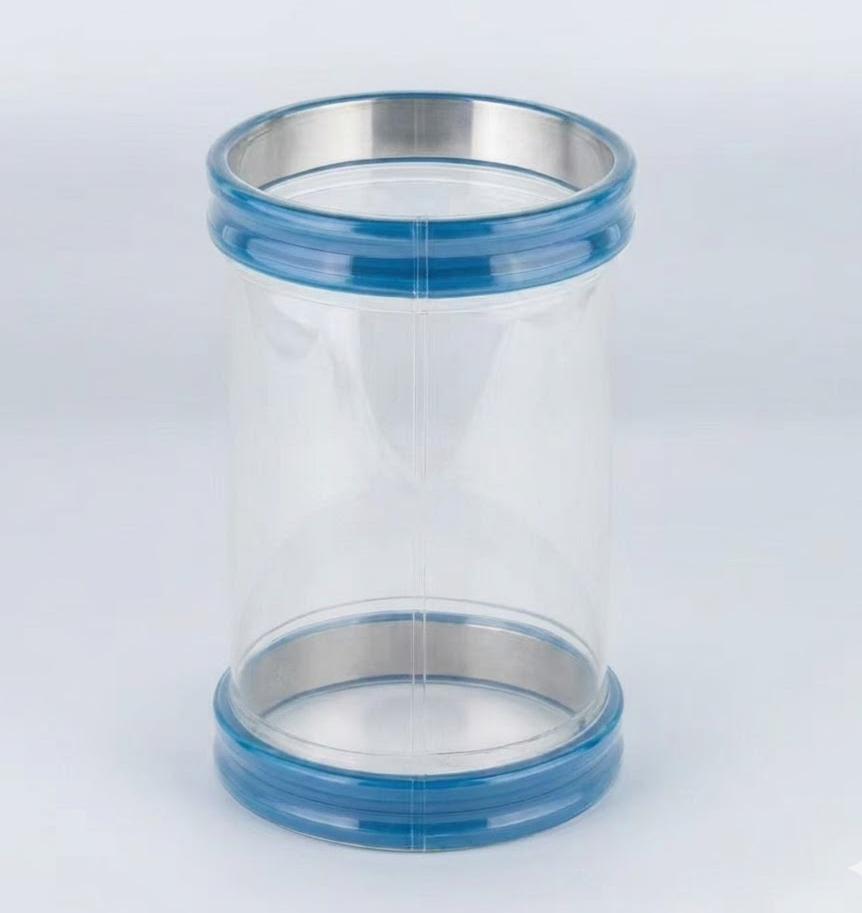
Snap-In Flexible Connector Sizing Guide: Diameter, Installation Gap & Duty Matrix
Engineering guide to sizing snap-in flexible connectors for powder handling. Features the 4-variable duty matrix, Installation Gap (IG) failure physics, and pressure specs.
READ MORE...
Flexible Connector FAQ: Sizing, Materials, Installation & Troubleshooting
Answers to the most common flexible connector questions on sizing, material selection, CIP washdown, ATEX static control, vacuum collapse and tool-free installation.
READ MORE...
Flexible Connectors for Powder Packaging & Filling Machines: Eliminating Parasitic Force and Line Downtime
Technical guide on flexible connectors for powder packaging, auger fillers, and weigh hoppers. Discover how LightTC sleeves eliminate parasitic tare force on load cells, ensure dust-tight snap-in sealing, and cut batch changeover downtime.
READ MORE...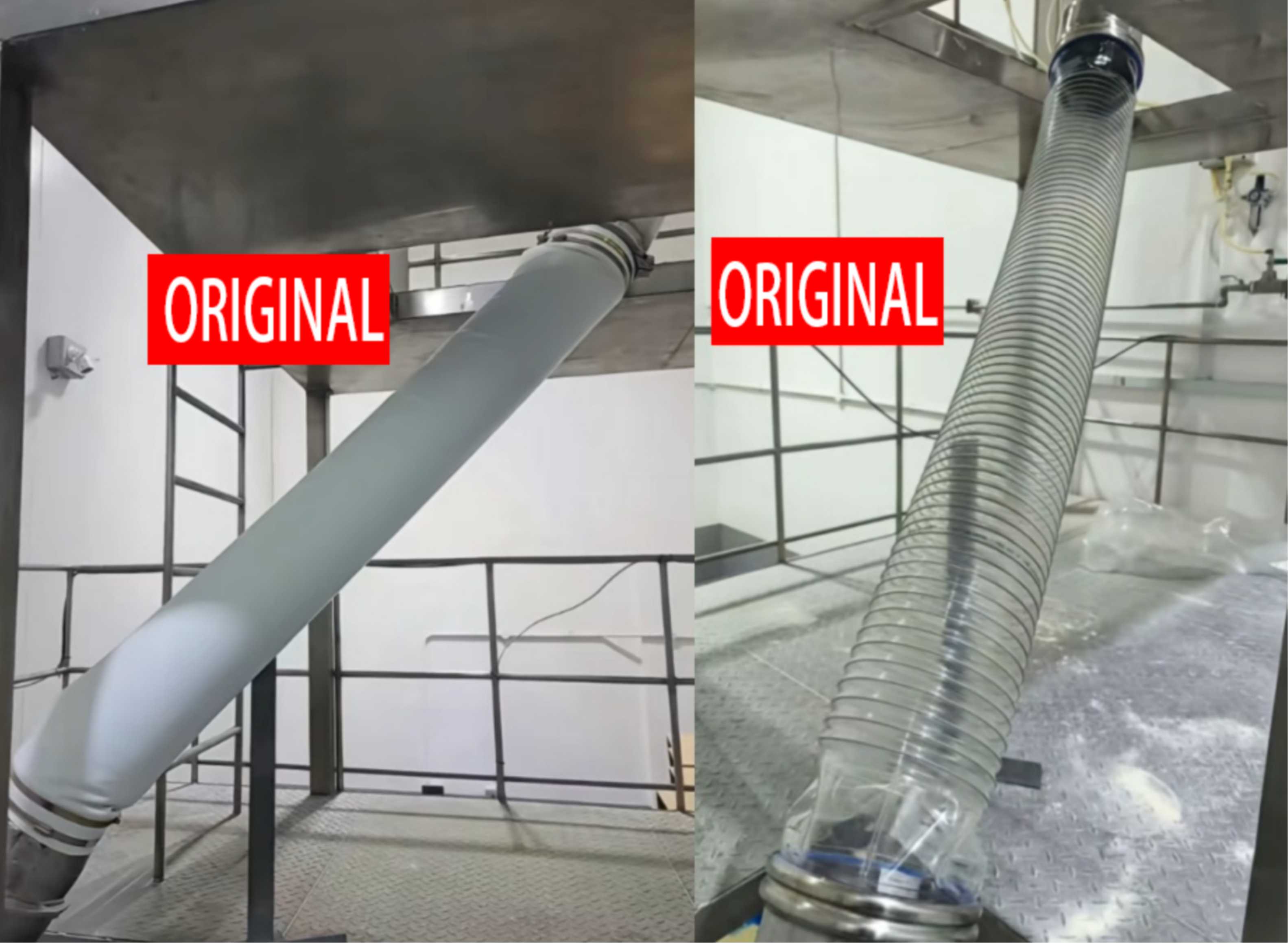
Flexible Connectors for Lithium Battery Powder & New Energy Material Conveying
Engineering guide on selecting flexible connectors for lithium battery cathode (NMC/LFP) and anode powder handling. Explore ATEX-compliant anti-static PUAS sleeves, 100% metal-free designs, and vacuum collapse resistance.
READ MORE...
SOSHH PU-15 & PU-20 Heavy-Duty Flexible Connectors: Monolithic Extruded TPU for High-Abrasion Processing
Upgrade your powder handling system with SOSHH PU-15 heavy-duty flexible connectors. Engineered with 1.5mm monolithic extruded polyether TPU for extreme abrasion resistance, zero delamination, and 100% metal-detector safe compliance.
READ MORE...
SOSHH Zero-Reaction-Force Weighing Bellows for Loss-in-Weight Feeders
Eliminate load cell tare drift on gravimetric feeders with SOSHH PU-05-WB ultra-soft polyether TPU weighing bellows. Zero reaction force, tool-free snap-in installation.
READ MORE...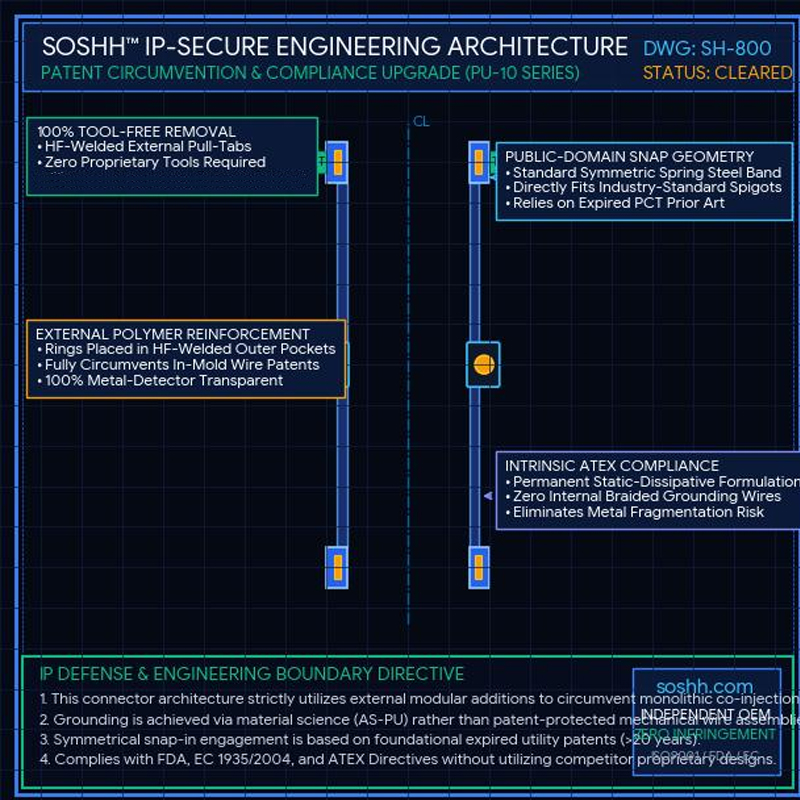
SOSHH Tool-Free Snap-In Flexible Connector (ATEX & Metal Detector Safe)
Upgrade your powder processing with SOSHH's snap-in flexible connectors. Featuring tool-free pull-tabs, metal-detector safe polymer rings, and intrinsic ATEX compliance. Cross-brand compatible with standard spigots.
READ MORE...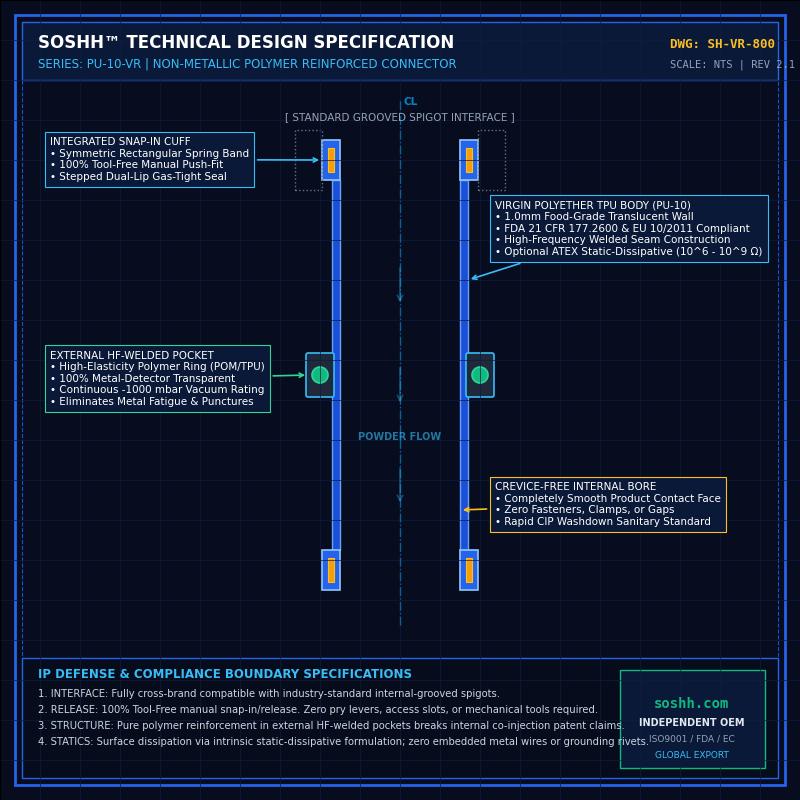
SOSHH Technical Bulletin: Polymer-Reinforced Flexible Connectors (100% Tool-Free & Metal Detector Safe)
Overcome metal fatigue and false metal detector alarms with SOSHH's polymer-reinforced flexible sleeves. Engineered with HF-welded external pockets and a 100% tool-free snap-in design for hygienic bulk powder processing.
READ MORE...
Drop-In Alternative Guide for Snap-In Flexible Sleeves: Solving Custom Lengths, Vacuum Collapse & Extreme Temperature Gaps
100% drop-in snap-in flexible sleeves for standard spigots. Discover zero-tooling custom lengths, -1000 mbar anti-collapse rings, and +260°C CNC PTFE bellows.
READ MORE...
FDA Polyurethane Compliance | Food-Contact TPU Sleeves (21 CFR 177.2600, EU 10/2011) | SOSHH
Is polyurethane food-contact safe? Yes — polyether TPU meets FDA 21 CFR 177.2600 extractives limits and EU 10/2011. Operating range -30°C to +85°C, CIP to +85°C. Compliance guide for powder-handling sleeves.
READ MORE...
FDA Polyurethane Compliance | Food-Contact TPU Sleeves (21 CFR 177.2600, EU 10/2011) | SOSHH
Is polyurethane food-contact safe? Yes — polyether TPU meets FDA 21 CFR 177.2600 extractives limits and EU 10/2011. Operating range -30°C to +85°C, CIP to +85°C. Compliance guide for powder-handling sleeves.
READ MORE...
How to Specify a Vacuum-Rated Flexible Connector: Collapse Pressure, Reinforcement & Validation
A flexible connector operating under negative pressure is a structural stability problem before it is a material-selection problem. Atmospheric pressure pushes inward on the sleeve, and an unsupported wall can buckle long before the conveying system reaches full vacuum. This guide quantifies the diameter-dependent collapse threshold, compares four anti-collapse reinforcement architectures, and provides the engineering rules for vacuum specification, metal-detector constraints, static control, temperature derating, ISO 7233 qualification, and total cost of a collapse incident. Specify vacuum as a differential-pressure requirement and qualify the complete connector at the actual diameter, temperature, movement and reinforcement configuration. Do not infer vacuum capability from TPU tensile strength, wall thickness, or nominal pipe size alone.
READ MORE...